

















@2026 – All Right Reserved. TheDefenseWatch.com
- Home
- Catalog
- Bombs & Aerial Munitions
- GBU-28 Bunker Buster Bomb
GBU-28 Bunker Buster Bomb


Full Specifications
1. General Information
| Name / Designation | GBU-28 |
| Type | Precision-Guided Penetrator Bomb |
| Manufacturer | Raytheon |
| Country of Origin | United States |
| Year Introduced | 1991 |
| Operational Status | Active |
2. Physical Characteristics
| Weight | Approx. 4,700 lb (2,130 kg) |
| Length | Approx. 19 ft (5.8 m) |
| Diameter | Approx. 14.5 in |
| Casing Type | Hardened Steel Penetrator |
3. Performance
| Yield | Conventional High Explosive |
| Guidance | Laser Guidance |
| Accuracy (CEP) | High precision, estimated within a few meters |
| Delivery Platforms | F-15E, B-2 Spirit |
| Penetration Capability | Deep reinforced concrete penetration |
4. Warhead / Explosive Details
| Warhead Type | High-Explosive Penetrator |
| Fuzing Options | Delayed impact fuze |
| Explosive Composition | Tritonal or equivalent explosive fill |
5. Operational Use
| Primary Mission | Destroy hardened underground targets |
| Operators | United States and allied operators |
| Notable Deployments / History | Gulf War, Middle East strike operations |
6. Variants
| Variants | GBU-28A/B and upgraded guidance variants |
PROS
- Highly effective against underground bunkers
- Precision laser guidance improves strike accuracy
- Compatible with multiple U.S. combat aircraft
- Proven combat history in real operations
- Capable of penetrating reinforced concrete targets
CONS
- Requires laser target designation
- Limited effectiveness against moving targets
- Heavy weight restricts aircraft payload flexibility
- Non-powered weapon with limited standoff range
- High operational and integration costs
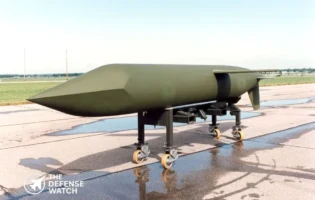
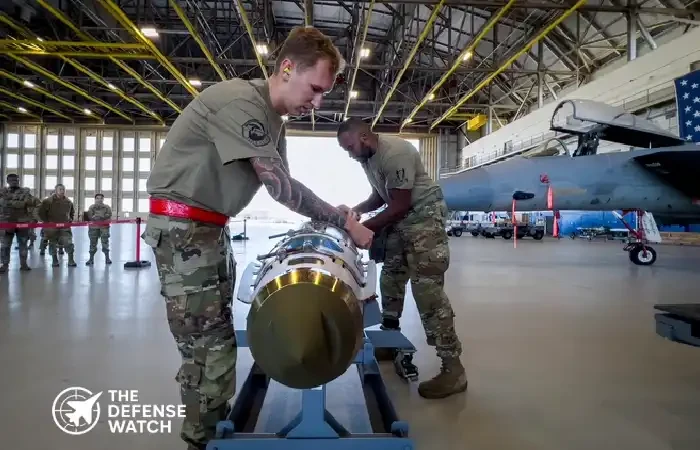
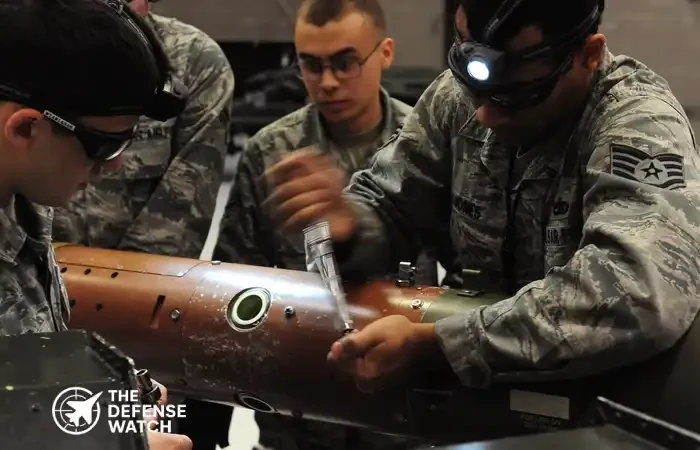
The GBU-28 Bomb is a U.S.-developed precision-guided bunker buster designed to destroy deeply buried and hardened military targets. Developed during the Gulf War in the early 1990s, the bomb was created to penetrate reinforced underground bunkers, command centers, and fortified facilities that standard munitions could not effectively destroy.
The weapon combines a heavy penetrating warhead with laser guidance technology, allowing it to strike targets with high accuracy. The GBU-28 became one of the most recognized bunker-penetrating weapons used by the U.S. Air Force and allied forces in modern combat operations. Its operational role focuses on strategic deep-strike missions against heavily protected infrastructure.
Manufacturer
The GBU-28 was primarily developed by Raytheon in cooperation with the United States Air Force. Early versions used modified artillery barrel casings to accelerate wartime production during Operation Desert Storm.
The bomb integrates the Paveway laser-guidance kit, enabling precision targeting from aircraft such as the F-15E Strike Eagle, B-2 Spirit, and other compatible combat aircraft.
Speed and Range
The GBU-28 itself is an air-dropped gravity bomb and does not possess an onboard propulsion system. Its operational range depends on the launch altitude and speed of the delivery aircraft. When released from high altitude, the bomb gains significant kinetic energy, allowing it to penetrate multiple meters of reinforced concrete and underground structures before detonation.
The laser-guided navigation system provides high accuracy with a low Circular Error Probable (CEP), making it effective against hardened strategic targets. The bomb is optimized for high-speed strike aircraft operating in contested environments.
Cost/Price
Estimated unit costs for the GBU-28 vary depending on guidance packages and modernization upgrades. Public estimates generally place the cost between $200,000 and $300,000 per unit. Exact pricing remains dependent on production contracts, integration requirements, and export configurations.
FAQs
What is the primary role of the GBU-28 bomb?
The GBU-28 is designed to destroy hardened underground bunkers, command centers, and fortified military structures.
Is the GBU-28 a nuclear weapon?
No. The GBU-28 is a conventional precision-guided penetrator bomb.
Which aircraft can carry the GBU-28?
Aircraft such as the F-15E Strike Eagle and B-2 Spirit are capable of deploying the weapon.
How does the GBU-28 guidance system work?
The bomb uses laser guidance technology to accurately strike designated targets.
When was the GBU-28 first used in combat?
The weapon was first introduced and used during the 1991 Gulf War.
Reviews
Disclaimer Note
The information provided on TheDefenseWatch.com is for general informational purposes only. While we strive to ensure the accuracy, completeness, and timeliness of our content regarding defense and aerospace products, technologies, and specifications, we cannot guarantee that all information is 100% accurate or up-to-date due to the evolving nature of military technology and classified data.TheDefenseWatch.com does not warrant the reliability, suitability, or availability of the information for any specific purpose. Users are advised to consult official sources, such as manufacturers, government publications, or defense agencies, for precise and verified data before making decisions based on our content.We are not affiliated with any defense manufacturers, governments, or military organizations mentioned. Opinions, reviews, and ratings reflect expert analysis but are subjective and should not be considered endorsements. TheDefenseWatch.com is not responsible for any errors, omissions, or consequences arising from the use of this website’s content.External links are provided for convenience and do not imply endorsement. TheDefenseWatch.com reserves the right to update or modify content without prior notice. By using this website, you agree to our Privacy & Cookies Policy.

New Arrivals
-
 GÖKHAN ER Missile
-
Boeing JDAM LR Precision Strike Weapon
-
China JL-1 Air-Launched Ballistic Missile
-
H-6N Bomber
-
INS Drakon Submarine
-
MiG-31BM Fighter Jet
-
Gripen E Fighter Jet
-
De Havilland Mosquito Aircraft
-
Altay (Turkey) Tank
-
VT-4 Main Battle Tank
-
T-90M Proryv Main Battle Tank
-
Leclerc XLR Main Battle Tank
Popular Comparisons
-
 Rafale Fighter Jet vs F-22 Raptor: Which Air Dominance Fighter Has the Edge?
View Comparison →
Rafale Fighter Jet vs F-22 Raptor: Which Air Dominance Fighter Has the Edge?
View Comparison → -
Tejas Fighter Jet vs. Rafale Fighter Jet: India’s Indigenous Fighter Meets France’s Proven Multirole Combat Aircraft
View Comparison →
-
F-22 Raptor vs. F-35 Joint Strike Fighter: Which Fifth Generation Fighter Has the Edge?
View Comparison →
-
F-35A vs. F-22 Raptor: Which U.S. Stealth Fighter Dominates Modern Air Combat?
View Comparison →
-
AGM-114 Hellfire vs. AGM-179 JAGM: Which U.S. Precision Missile Is Better?
View Comparison →
-
Patriot (PAC-3) vs. THAAD: Complete Missile Defense System Comparison, Capabilities, Range, and Strategic Roles
View Comparison →
-
AIM-120 AMRAAM vs. AIM-9X Sidewinder: Complete Air-to-Air Missile Comparison, Range, Speed, and Combat Roles
View Comparison →
-
BGM-109 Tomahawk vs. AGM-158 JASSM: Which Long Range Precision Strike Missile Offers Greater Strategic Advantage?
View Comparison →
-
Patriot PAC-3 vs. Russian S-400 Triumf: Which Air Defense System Is More Capable?
View Comparison →
-
Su-30MKI Fighter Jet vs JF-17 Thunder: Complete Comparison of Capabilities, Radar, Weapons & Performance
View Comparison →
- Boeing Wins $109M F/A-18 Outer Wing Panel Contract

- DOGE Claim Of $1.76 Billion Military Health IT Savings Challenged By GAO
- Hanwha Moves To Buy Austal’s U.S. Operations As Shipbuilding Capacity Becomes Strategic Priority
- Pakistan Moves To Turn Makkah Defense Pact Into Broader Economic Partnership
- Rheinmetall And Boeing Pitch MQ-28 Ghost Bat To Accelerate Germany’s CCA Capability By 2029
- Türkiye’s GÖKHAN Missile Could Expand Pakistan’s Long-Range Air Combat Options
- Türkiye Launches Malaysia’s Final LMS Batch 2 Corvette, Completing Three-Ship Build Program
- Ottawa Moves To Transfer 10 C-130H Hercules Aircraft To Coulson Aviation For Firefighting
- Rolls-Royce Secures Propulsion Support Deal For French-German C-130J Fleet
- UK Moves To Replace RAF Hawk Trainers As T-7A Red Hawk Enters Competition