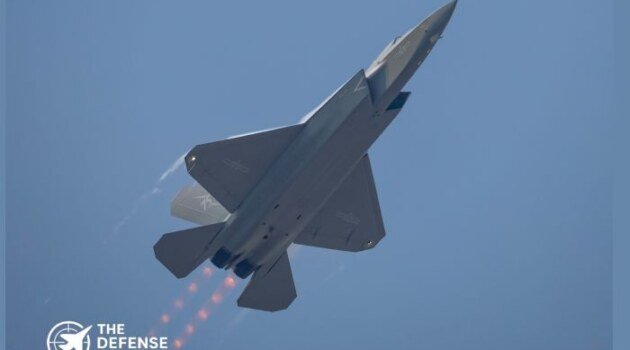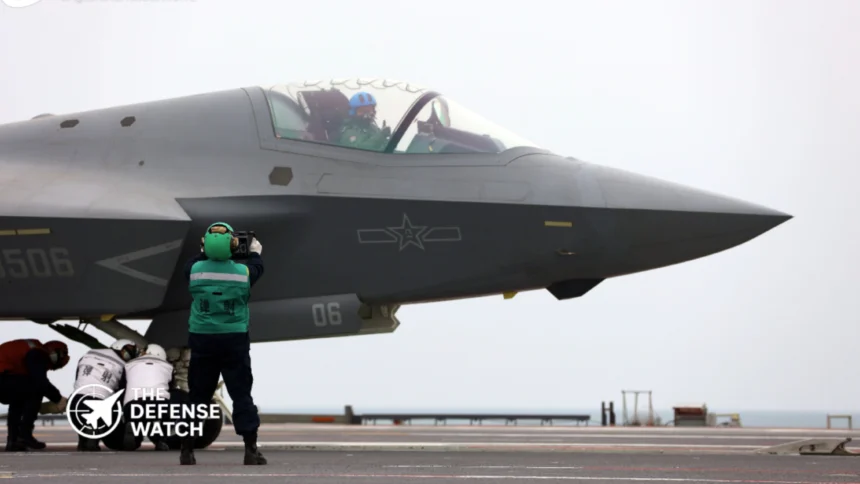
China is expanding the use of metal 3D printing in military aircraft development, with the institute responsible for the J-35 stealth fighter series reporting progress in manufacturing large, integrated airframe structures.
The work is being conducted at the Key Laboratory of Aviation Science and Technology for Novel Aircraft Structures, part of the Aviation Industry Corporation of China’s (AVIC) Shenyang Aircraft Design and Research Institute.
According to an AVIC announcement reported by Global Times on November 16, the laboratory has developed a 3D-printed structural component measuring more than five meters in length. The component is designed for an aircraft’s central fuselage, where it performs primary load-bearing and structural load-transfer functions.
The announcement also describes a multifunctional annular heat exchanger manufactured through additive manufacturing, demonstrating how the technology could combine several aircraft functions within a single component.
A five-meter structure demonstrates progress beyond conventional manufacturing
One of the most notable aspects of the announcement is the reported size and structural purpose of the printed component.
Aircraft manufacturers traditionally produce major structural assemblies through combinations of machining, forming, tooling and mechanical joining. These methods remain essential to aircraft production but can introduce additional parts, manufacturing stages and assembly requirements.
AVIC says its laboratory has used additive manufacturing to produce an integrated structure exceeding five meters in length.
The component is located in the central fuselage and is intended to carry and transfer structural loads. This makes the reported achievement more relevant to airframe engineering than the production of smaller, non-structural printed components.
However, AVIC has not publicly disclosed the component’s precise dimensions, material composition, weight reduction, mechanical test results or the aircraft program in which it will be used.
The announcement therefore establishes progress in manufacturing technology, not confirmation that the component has entered serial production or been installed on an operational J-35 fighter.
Multifunctional heat exchanger targets aircraft weight and space requirements
The second development involves a 3D-printed annular heat exchanger designed for installation inside an aircraft air intake.
According to AVIC, the component combines four functions:
- Heat transfer.
- Air extraction.
- Structural load-bearing.
- Maintenance-related functions.
Conventional manufacturing can make it difficult to produce intricate internal channels within compact aerospace components. Additive manufacturing allows engineers to incorporate more complicated internal geometries directly into the component design.
AVIC says its engineers developed internal flow channels that increase the available heat-transfer surface area while reducing component weight.
The team also developed a specialized magnetic grinding device to finish the internal channels. Fine steel needles are placed inside the passages and moved using an external magnetic field, allowing the surfaces to be polished without damaging the surrounding structure.
This is an important manufacturing consideration. Producing a complicated internal geometry is only one part of the process. Engineers must also ensure that internal surfaces meet the requirements for airflow, heat transfer and long-term reliability.
The announcement does not provide comparative thermal performance figures, weight savings or service-life data for the heat exchanger.
Why additive manufacturing matters for modern fighter development
Metal additive manufacturing, commonly called metal 3D printing, builds components layer by layer from digital engineering designs.
Unlike conventional manufacturing, which often removes material from a larger workpiece or requires separate parts to be assembled, additive manufacturing can produce complex structures with integrated features.
For military aircraft developers, this offers several potential advantages.
Reduced structural complexity: Integrating multiple components can reduce the number of individual parts, connectors and assembly operations.
Greater design flexibility: Engineers can develop complex geometries and internal passages that are difficult to manufacture using conventional techniques.
Faster prototyping: Digital designs can be converted into physical test components without necessarily requiring dedicated molds or extensive tooling.
Potential weight savings: Designers can optimize material distribution and combine functions within individual structures.
Weight reduction is particularly relevant to fighter aircraft, where structural mass affects the aircraft’s overall design requirements, including fuel capacity, payload and performance.
However, these benefits depend on the material, manufacturing process and intended application. A printed component is not automatically lighter, stronger or cheaper than a conventionally manufactured equivalent.
The engineering team must demonstrate that the resulting structure meets its required mechanical and environmental performance standards.
J-35 developer builds on two decades of manufacturing research
The Shenyang Aircraft Design and Research Institute has a substantial role in China’s military aviation industry.
According to the Global Times report, citing People’s Daily, the institute has participated in the development of more than 40 major aviation equipment models across five aircraft series.
These include the J-8, J-11, J-15 and J-35, as well as unmanned aircraft.
Its additive manufacturing laboratory has reportedly worked on the technology for more than two decades.
AVIC says the laboratory has developed and applied:
Manufacturing capability Reported progress Additive manufacturing processes 6 Metal material types 13 Categories of 3D-printed structural components 19 These figures describe the laboratory’s reported technological experience. They should not be interpreted as the number of aircraft components currently in serial production.
The laboratory’s work has progressed from initial technology research toward engineering applications, with an emphasis on integrating structural design, material selection and manufacturing processes
Manufacturing challenges remain before wider aircraft adoption
Despite its potential advantages, metal 3D printing introduces technical challenges that become increasingly important when components perform critical structural functions.
One issue identified by AVIC involves thermal stress, deformation and cracking during the production of large components.
The laboratory says it addressed these problems through a manufacturing process combining segmented printing with additive fusion joining.
This approach is intended to make the production of larger structures more manageable.
Another challenge involves finishing complex internal passages. The development of the magnetic grinding device addresses one part of that problem, but it does not independently establish the overall reliability of the finished component.
Aircraft structures must withstand repeated mechanical loads, vibration, temperature changes and other operational stresses.
The U.S. National Institute of Standards and Technology (NIST) identifies process qualification, material consistency and repeatability as important requirements for additive manufacturing in aerospace and defense applications. NASA’s technical guidance also identifies manufacturing defects, material variability and fatigue performance as issues requiring careful assessment.
For primary load-bearing structures, engineers must establish that printed materials maintain predictable mechanical properties and that the manufacturing process can consistently produce components meeting design requirements.
AVIC has not published detailed qualification results for the five-meter component. Its announcement also does not establish whether the reported structures have completed full-scale fatigue testing, flight testing or production qualification.
What the development means for China’s military aviation industry
The reported work is relevant to China’s broader effort to improve domestic aircraft manufacturing capabilities.
The J-35 program is associated with China’s development of carrier-capable stealth aviation, while the Shenyang institute also supports other military aircraft programs.
Improved manufacturing methods could eventually benefit several aircraft development efforts, particularly where complex structural geometries, thermal management and weight control are important.
There is also a potential industrial advantage.
Reducing reliance on specialized tooling and simplifying the production of complex components could help aircraft developers shorten certain manufacturing and prototyping stages. The extent of these benefits, however, will depend on production scale, material availability, quality control and the cost of maintaining additive manufacturing equipment.
It would be premature to conclude that the reported technology will significantly increase J-35 production rates or directly improve the fighter’s combat performance.
The announcement does not identify the specific aircraft receiving the five-meter structure, disclose a production schedule or confirm its operational integration into the J-35.
For now, the clearest significance lies in the manufacturing technology itself. AVIC is reporting progress in applying metal additive manufacturing to increasingly large and functionally complex aircraft structures, moving beyond the smaller components commonly associated with early aerospace 3D-printing applications.
Whether these developments translate into operational aircraft improvements will depend on the next stage: engineering validation, production qualification and demonstrated performance under aircraft operating conditions.