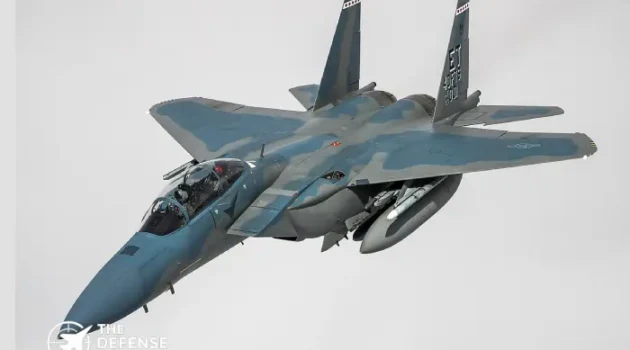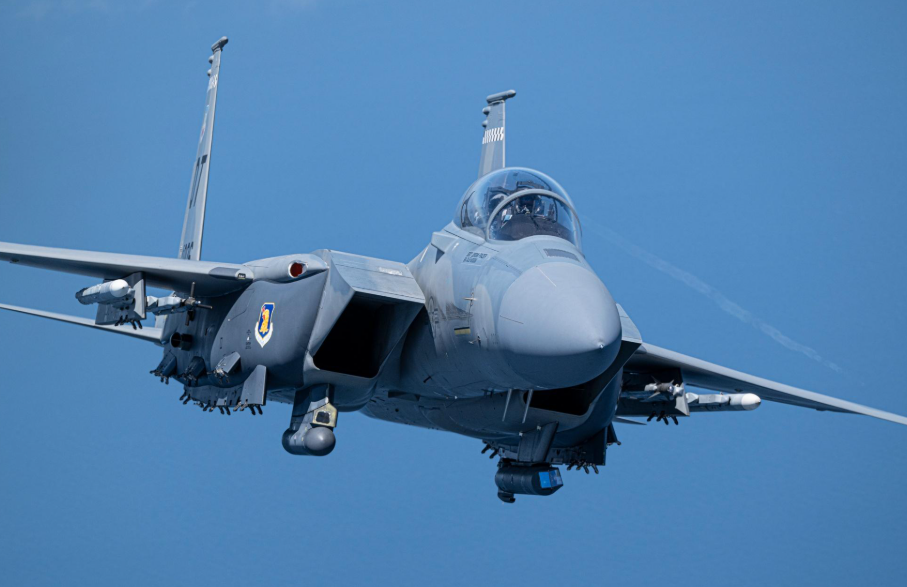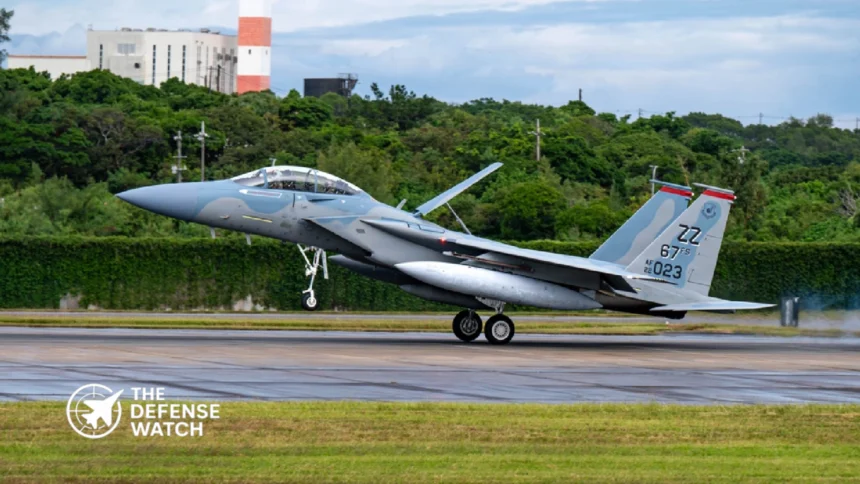
The U.S. Air Force has begun permanently stationing its F-15EX Eagle II fighter aircraft in Japan, with the first two aircraft arriving at Kadena Air Base in Okinawa on November 15, 2026.
Assigned to the 67th Fighter Squadron under the 18th Wing, the aircraft represent the first permanently based F-15EX fighters at an overseas U.S. Air Force installation. Their arrival starts a planned deployment of 36 Eagle II aircraft intended to rebuild and modernize Kadena’s permanent fighter force.
The deployment is particularly important because Kadena previously operated a large fleet of F-15C/D Eagle fighters, which began withdrawing in November 2022 after more than four decades of service.
According to the U.S. Air Force’s 18th Wing, the new aircraft will support counterair operations, strengthen forward-deployed combat capabilities and operate alongside fifth-generation fighters and regional partners.
The arrival was documented by the U.S. military’s Defense Visual Information Distribution Service (DVIDS), which published photographs of the first two permanently assigned aircraft at Kadena.
From F-15C/D Withdrawal to F-15EX Replacement
Kadena Air Base is one of the most important U.S. military aviation installations in the western Pacific. Located on Okinawa, it provides a forward operating location for American airpower near Japan’s southwestern island chain and the wider Indo-Pacific region.
The Air Force’s decision to replace its aging F-15C/D fleet with the F-15EX was announced in July 2024, as part of a broader modernization plan for U.S. forces stationed in Japan.
The original plan called for 36 F-15EX aircraft to replace the 48 older F-15C/D fighters previously assigned to Kadena. The withdrawal of the legacy aircraft began in November 2022, leaving the installation dependent on rotational fighter deployments while the permanent replacement force was prepared.
These temporary deployments have included F-22 Raptors, F-35A Lightning IIs, F-15E Strike Eagles and F-16 Fighting Falcons, alongside other fighter aircraft.
The rotational approach allowed the Air Force to maintain a fighter presence while preparing personnel, maintenance infrastructure and operational procedures for the new aircraft.
The transition, however, took longer than initially expected. In September 2026, the 18th Wing confirmed that the first Kadena-designated F-15EX had departed Boeing’s St. Louis facility on August 28 and moved to Portland Air National Guard Base for additional preparations.
The aircraft was subsequently transferred to Japan, with the first two permanently assigned fighters arriving on November 15.
Why the F-15EX Matters to U.S. Airpower in the Pacific

F-15EX The F-15EX Eagle II is the latest major development of the F-15 Eagle family. Manufactured by Boeing, it combines the established airframe design with modern flight controls, upgraded avionics, advanced electronic warfare equipment and improved weapons integration.
Unlike the F-22 and F-35, the F-15EX is not a stealth fighter. Its operational value comes from a different combination of capabilities, particularly its weapons-carrying capacity, speed, range and modern mission systems.
This distinction matters in the Indo-Pacific, where U.S. forces must operate across large distances while maintaining the ability to conduct air defense, counterair missions and other combat operations.
The F-15EX can complement stealth aircraft rather than replace their role. Fifth-generation fighters can contribute low-observable penetration and advanced sensor capabilities, while the Eagle II provides a different set of weapons and mission options.
For Kadena, this combination could support a more flexible fighter force, particularly during operations involving U.S. and Japanese aircraft.
However, the presence of advanced avionics and electronic warfare systems does not make the F-15EX equivalent to a low-observable fighter. Its survivability in heavily defended airspace will depend on mission planning, supporting aircraft, electronic warfare, intelligence and the wider force package.
Two Squadrons Will Operate the New Fighters
The 18th Wing plans to operate the F-15EX through its 44th and 67th Fighter Squadrons.
The first two aircraft are assigned to the 67th Fighter Squadron. Its pilots completed qualification training at Eglin Air Force Base in Florida and Portland Air National Guard Base in Oregon before the permanent aircraft arrived in Japan.
The transition also required extensive preparation from maintenance personnel.
According to the 18th Wing, members of the 18th Aircraft Maintenance Squadron worked with Air Force and Boeing teams at Eglin and Portland to develop the technical knowledge and maintenance experience required to support the aircraft.
This preparation is important because introducing a new fighter type involves more than delivering aircraft to a runway. Units must establish maintenance procedures, spare-parts support, weapons integration, pilot proficiency and the ability to sustain flying operations.
Lt. Col. Ajay Dua, commander of the 67th Fighter Squadron, described the arrival as the beginning of the squadron’s work to integrate the aircraft into its flying operations and build operational experience.
The 44th and 67th squadrons will eventually form the core of Kadena’s F-15EX fighter force.
Boeing Production Delays Affected the Deployment Schedule
The F-15EX transition also illustrates the challenges involved in delivering new combat aircraft on schedule.
The original timeline anticipated the permanent arrival of the Eagle II at Kadena earlier in 2026. However, production delays affected the deployment schedule.
One contributing factor was a labor strike at Boeing’s St. Louis facility, which lasted from August 4 to November 17, 2025.
In September 2026, the 18th Wing announced that the first Kadena-designated F-15EX had left Boeing’s production facility and moved to Portland for further preparations before its transfer to Japan.
The aircraft’s eventual arrival in November brings the permanent overseas deployment program into its operational integration phase.
The Air Force has not publicly provided a detailed delivery schedule for the remaining aircraft. Additional arrivals will depend on production progress and operational requirements.
How the Deployment Changes the Regional Fighter Picture
The F-15EX deployment gives the United States another modern fighter capability at a strategically important location near the first island chain.
Kadena’s location makes it relevant to potential contingencies involving the East China Sea, Taiwan Strait and wider western Pacific. Its proximity to regional maritime and air routes also supports U.S. operations alongside Japanese forces.
The deployment should be understood as part of a broader U.S. effort to maintain forward-based airpower while modernizing aircraft that have reached the limits of their service lives.
There are three important operational considerations.
First, maintaining a permanent fighter presence. Replacing the withdrawn F-15C/D aircraft with a modern fleet gives Kadena a more stable long-term fighter structure rather than relying entirely on rotating aircraft from the United States.
Second, combining different fighter capabilities. The F-15EX can complement F-22 and F-35 aircraft, providing additional weapons capacity and mission flexibility. This approach allows the Air Force to employ different aircraft according to operational requirements.
Third, strengthening interoperability with Japan. The 18th Wing already conducts training with Japan Air Self-Defense Force F-15 aircraft based at Naha Air Base. The introduction of the F-15EX provides additional opportunities for bilateral training and coordination.
Nevertheless, the deployment of two aircraft does not mean the planned 36-fighter force is already operational. Pilot qualification, maintenance capacity, weapons integration and the arrival of additional aircraft will determine how quickly the new fleet reaches its intended capability.
What Remains Unclear
Several details surrounding the transition remain undisclosed.
The Air Force has not published a complete schedule for the remaining 34 aircraft, nor has it provided a precise date for the full operational establishment of the planned Kadena fleet.
The November 15 arrival is a confirmed permanent stationing milestone, but it should not be confused with a declaration that all planned F-15EX capabilities are already available at the base.
For now, the two aircraft mark the beginning of a longer transition. The effectiveness of the modernization effort will ultimately depend on how successfully the 18th Wing converts the initial deliveries into a sustainable, fully integrated fighter force.