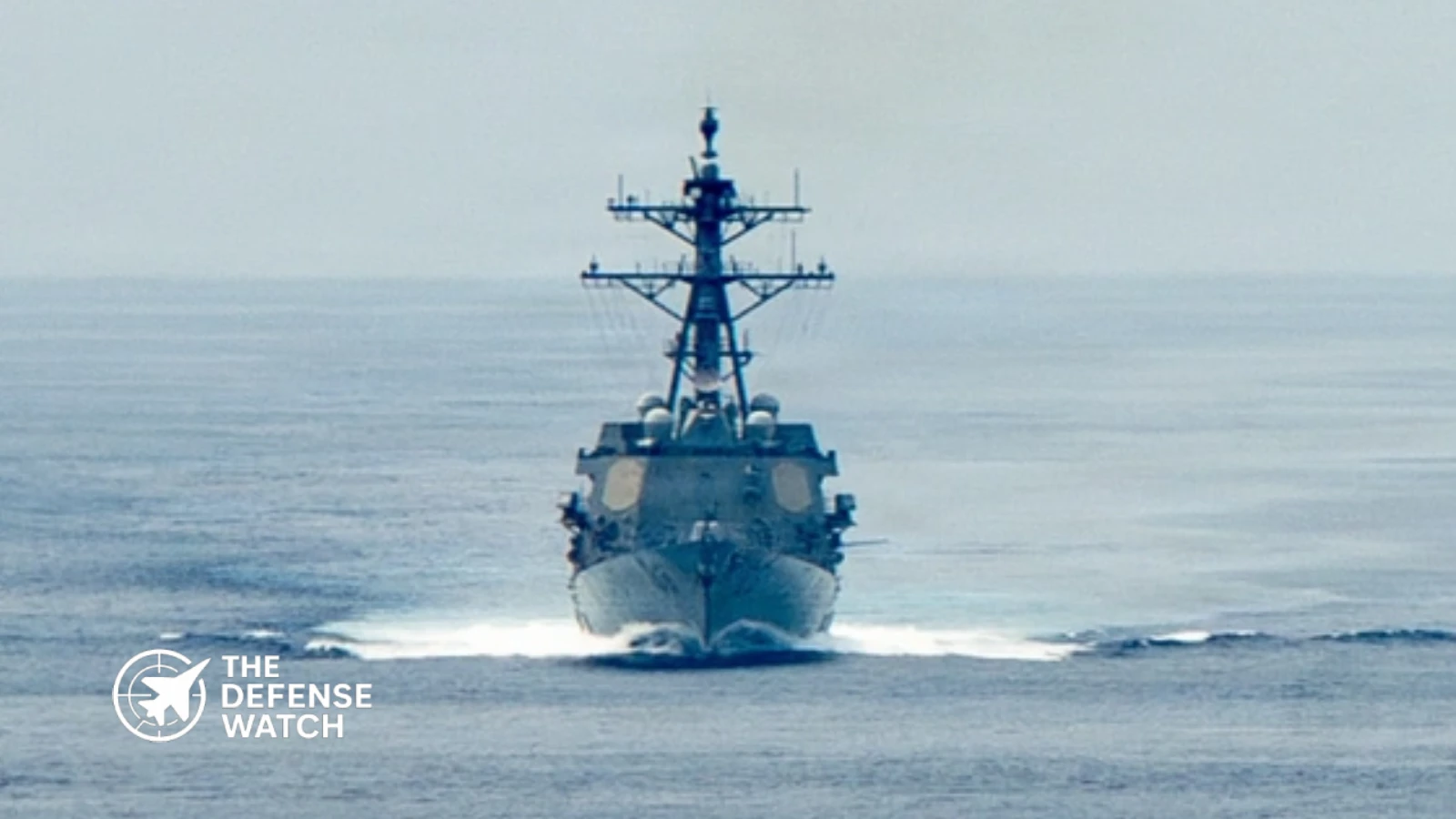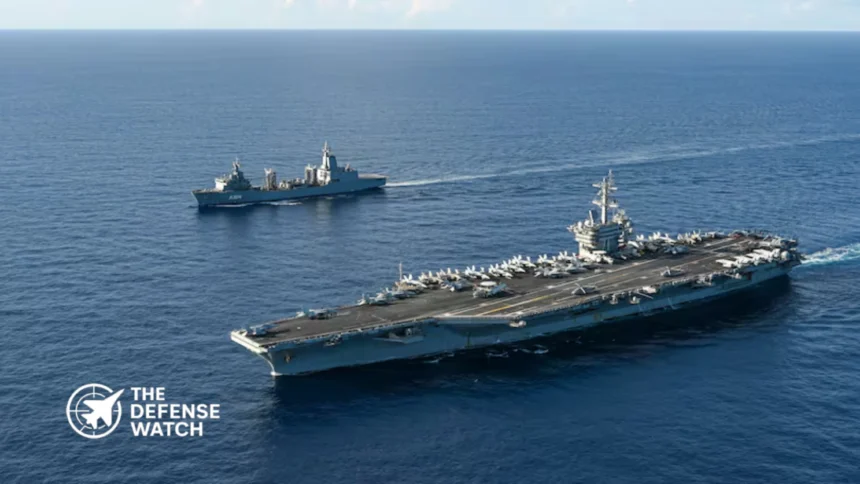
The United States has brought a third aircraft carrier strike group into the Middle East after the USS Theodore Roosevelt (CVN-71) entered the U.S. Central Command (CENTCOM) area of responsibility on Sunday, November 15, according to a U.S. official cited by The National.
The arrival brings three American aircraft carrier strike groups into the region as Washington faces renewed military tensions with Iran, including reported Iranian drone activity targeting facilities in Bahrain.
The deployment places the Roosevelt alongside the USS George H.W. Bush (CVN-77) and USS George Washington (CVN-73), which were already operating in the region. The expanded naval presence gives U.S. commanders additional carrier-based aviation, maritime security and force-protection capabilities.
The National reported the Roosevelt’s arrival on November 16, citing a U.S. official. Earlier reporting by The New York Times, cited by Anadolu Agency, had indicated that the carrier was expected to enter the region within 24 hours.
Three Carrier Strike Groups Expand US Naval Presence
The arrival of the Theodore Roosevelt increases the concentration of U.S. carrier forces in the CENTCOM theater.
The three carriers now reported in the area are:
- USS Theodore Roosevelt (CVN-71): Nimitz-class nuclear-powered aircraft carrier and flagship of Carrier Strike Group 9.
- USS George H.W. Bush (CVN-77): Nimitz-class nuclear-powered aircraft carrier.
- USS George Washington (CVN-73): Nimitz-class nuclear-powered aircraft carrier, normally forward-deployed to Japan.
According to Stars and Stripes, the George H.W. Bush and George Washington had been operating in the region since April and August, respectively. The Roosevelt departed Singapore on November 8 and transited the Strait of Malacca before continuing toward the Middle East.
The distinction between an aircraft carrier and a carrier strike group is important. A strike group is an integrated naval formation rather than an individual ship.
It normally combines an aircraft carrier, an embarked carrier air wing, guided-missile escorts and command elements. These components provide air operations, maritime surveillance, air defense and additional strike capabilities.
The U.S. Navy describes carrier strike groups as flexible formations designed to respond to regional crises, protect American interests and support military operations.
Roosevelt Brings Carrier Air Wing 11 and Escort Ships
The Theodore Roosevelt is a Nimitz-class nuclear-powered aircraft carrier assigned to Carrier Strike Group 9 (CSG-9).
Its embarked Carrier Air Wing 11 provides the strike group’s principal aviation capability. The air wing supports carrier-based combat aviation, airborne early warning, electronic warfare, helicopter operations and logistical support.
Stars and Stripes reported that the Roosevelt strike group includes:
- USS Theodore Roosevelt (CVN-71)
- Carrier Air Wing 11
- USS Chosin, guided-missile cruiser
- USS Paul Hamilton, guided-missile destroyer
- USS Decatur, guided-missile destroyer
The publication reported that the formation included more than 5,000 service members during its deployment toward the Middle East. Its composition provides the carrier with supporting surface combatants and an embarked aviation force.
The presence of multiple escorts is particularly relevant in a region where U.S. naval forces face potential threats from anti-ship missiles, unmanned aerial systems, mines and other maritime threats.
However, the arrival of another carrier does not establish that Washington intends to launch additional strikes. Carrier deployments can support deterrence, maritime security, force protection and contingency planning without necessarily leading to offensive operations.
Iran Tensions Add to the Significance of the Deployment
The Roosevelt’s arrival comes amid renewed friction between Washington and Tehran.
According to The National, Iran targeted a U.S. helicopter base in Bahrain on Sunday, November 15. The Islamic Revolutionary Guard Corps said it launched drones toward the facility.
The same report said the IRGC had previously claimed to have destroyed a U.S. early-warning radar in Bahrain. CENTCOM, however, said it intercepted the two drones launched by Iran. The Iranian claim regarding the radar was therefore not independently established by the available reporting.
The developments add pressure to an already complicated regional security environment, where U.S. naval forces must protect military installations, commercial shipping and maritime routes.
The Arabian Sea, Gulf of Oman, Persian Gulf and Red Sea are important operating areas for American naval forces. The Strait of Hormuz is particularly significant because of its role in international energy transportation.
An expanded carrier presence provides U.S. commanders with additional options for operating in these waters and responding to potential regional contingencies.
Reinforcement or Replacement Remains an Important Question
The number of American aircraft carriers in the region may not remain at three.
The National reported that the Theodore Roosevelt was initially expected to relieve the USS George Washington. However, the George Washington remained in the CENTCOM area when the Roosevelt arrived.
Stars and Stripes also reported on November 9 that it was uncertain whether Washington would maintain three carriers in the region or use the Roosevelt to replace one of the existing deployments.
This distinction matters when assessing the scale of the deployment.
If all three carrier strike groups remain in the theater, the United States will maintain a larger concentration of mobile naval aviation and supporting surface combatants. If one carrier departs as part of a scheduled rotation, the increase will be temporary rather than a sustained expansion of naval strength.
The available reporting does not establish how long all three carrier strike groups will remain in the CENTCOM area.
For now, the Roosevelt’s arrival provides Washington with an additional carrier-based force at a time when diplomatic efforts with Tehran remain uncertain and regional military tensions continue.