• Home
  • About
  • Defense Systems
  • Manufacturer
  • Comparisons
  • Compare 
  • Tools
TheDefenseWatch.com
  • Aerospace & Aviation
  • Military & Ordnance
  • Naval & Maritime
  • Cyber & Space Defense
  • Policy & Strategy
  • Global News
  • Tools Library
    • Smart Calculator
    • Drone Flight Time Calculator
    • Drone Range Calculator
    • Counter-Drone Jammer Effective Range Calculator
    • Counter-Battery Radar Detection Calculator
    • Artillery Fire Correction Calculator
    • Thermal Camera Detection Range Calculator
    • Missile Range & Time-of-Flight Calculator
    • Radar Detection Range Calculator
    • FPV Strike Drone Payload vs Range Calculator
    • Loitering Munition Endurance Calculator
    • Sniper Ballistic Drop & Windage Calculator
    • Bullet Drop Calculator
    • U.S. Army Combat Fitness Test (ACFT) Calculator
    • Military Pension Calculator
    • Military Retirement Calculator
    • Military Pension Calculator
    • Large Number Calculator
Font ResizerAa

TheDefenseWatch.com

The Defense Watch | U.S. & Global Defense News, Analysis & Military Updates

Search
  • Home
  • About
  • Defense Systems
  • Manufacturer
  • Comparisons
  • Compare 
  • Tools

Stay Updated

Get the latest update

Subscribe

Explore

  • Drone
  • Fighter Jets & Military Aircraft
  • Hypersonic Weapons
  • Aircraft Carriers
  • Strategic History & Missions
  • Tools Library
Home » NSA Warns Malware Could Hijack Computers With Common Access Cards
Cyber & Space DefenseCyber Warfare

NSA Warns Malware Could Hijack Computers With Common Access Cards

Daniel Mercer / Defense & Aerospace Analyst
Last updated: November 16, 2026 10:17 pm
Daniel Mercer / Defense & Aerospace Analyst
Share
2 Min Read
NSA malware warning 2026
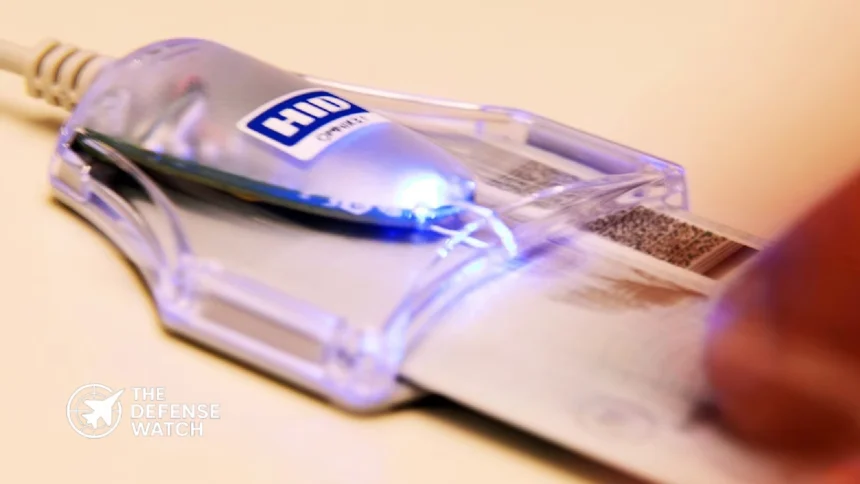
A common access card, or CAC, is commonly used by security-cleared personnel to access classified systems.
SHARE

The National Security Agency (NSA) has warned of a malware threat involving computers connected to Common Access Card (CAC) readers, raising concerns about the security of authentication devices used across the U.S. Department of Defense.

Contents
Why the CAC connection mattersMalware threat raises questions about endpoint securityWhy this matters to U.S. military networksPractical implications for CAC holdersWhat remains unknown

The warning, published through the Department of War on November 16, 2026, concerns malicious software that could target personal computers when users leave their Common Access Cards inserted in connected card readers.

The advisory highlights a security risk for personnel who rely on CAC authentication to access government systems and other protected digital services. It also reinforces the importance of protecting the computer environment in which military and government credentials are used.

Why the CAC connection matters

The Common Access Card is a smart identification credential used by U.S. military personnel, Department of Defense civilian employees, selected reservists and eligible contractors.

- Advertisement -

According to the Department of Defense’s official CAC information portal, the card serves as a primary means of identification and provides access to DoD computer networks and systems.

It also supports several security functions through embedded digital certificates, including authentication, digital signatures and email encryption.

This makes the CAC an important component of the Pentagon’s identity and access management infrastructure.

However, protecting the physical card alone is not sufficient. The computer, card reader, associated software and authentication process must also remain secure.

A compromised endpoint could create opportunities for malicious software to interfere with activities performed through connected authentication hardware.

Malware threat raises questions about endpoint security

The NSA’s warning focuses on the potential exposure created when a CAC remains connected to a computer through a card reader.

Removing the card when authentication is no longer required reduces the period during which the credential remains connected to the potentially compromised endpoint.

The public information available about the warning does not identify a specific malware family, software vulnerability, affected manufacturer or CVE identifier.

- Advertisement -

It also does not establish how many computers may be affected or whether a confirmed intrusion has occurred.

Consequently, the advisory should not be interpreted as confirmation that a particular military network has been breached or that CAC technology itself has been compromised.

The distinction is important. The potential weakness concerns the interaction between malware and a computer operating with an authentication credential connected, rather than evidence that the underlying DoD identity system has been defeated.

Why this matters to U.S. military networks

CAC authentication supports access to a wide range of Department of Defense digital services.

Military personnel and government employees use these credentials for network logins, secure communications, administrative systems and other authorized activities.

A compromised workstation could therefore create risks beyond the individual computer, depending on the user’s access privileges and the systems available through that endpoint.

For military organizations, this makes endpoint security an important part of identity protection.

Even strong authentication mechanisms cannot independently protect an organization if the computer handling the authentication process is already compromised.

The issue also illustrates why cybersecurity measures must address multiple layers, including:

  • Endpoint protection and malware detection.
  • Secure configuration of smart card readers and associated software.
  • Protection of authentication certificates and private keys.
  • Appropriate access controls for privileged accounts.
  • Monitoring for suspicious activity on government-connected computers.
  • User awareness of credential handling procedures.

These measures are particularly relevant in environments where personnel regularly move between workstations, networks and remote access systems.

Practical implications for CAC holders

The NSA warning reinforces a straightforward security precaution: users should avoid leaving their Common Access Cards inserted in readers when they are not actively required.

CAC holders should also follow their organization’s cybersecurity instructions, keep authorized endpoint security software updated and report suspicious computer behavior to their information technology or security personnel.

Users should never share their CAC PIN or attempt to bypass security controls to restore access to a compromised or malfunctioning workstation.

Organizations should assess whether their existing endpoint monitoring and authentication policies adequately address computers used with smart card credentials.

The advisory also raises a broader operational consideration for the Pentagon. As military organizations increasingly depend on connected digital systems, protecting authentication hardware must remain part of a wider approach to securing endpoints and network access.

What remains unknown

The publicly available warning provides limited technical information about the potential malware activity.

Several important questions remain unanswered:

  • Which malware family or threat actor is involved?
  • What specific mechanism allows malware to interact with CAC-enabled computers?
  • Has the NSA identified confirmed cases of exploitation?
  • Are particular operating systems, smart card readers or software configurations affected?
  • Does the threat involve credential theft, unauthorized authentication or another form of malicious activity?

Without these details, it is not possible to assess the precise technical severity or operational scope of the warning.

Further technical guidance from the NSA or Department of War would help clarify the threat and identify whether additional security measures are required.

For now, the warning serves as a reminder that the security of military authentication systems depends not only on the credentials themselves, but also on the computers and software used to access protected networks.

TAGGED:Common Access CardCybersecurityNSAU.S. military
Share This Article
Facebook Copy Link Print
ByDaniel Mercer / Defense & Aerospace Analyst
Follow:
Daniel Mercer is a defense and aerospace analyst at TheDefenseWatch.com covering military aviation, aerospace technology, unmanned systems, air warfare, and defense procurement. His reporting uses official documents, government and military statements, company announcements, and other public sources.

Search Defense Systems

Latest Defense Systems

  • F-15EX Eagle Fighter Jet F-15EX Eagle Fighter Jet
  • TRML-4D Radar TRML-4D Radar
  • F-47A Fighter Jet F-47A Fighter Jet
  • China DF-61 Missile China DF-61 Missile
  • B61 Nuclear Bomb B61 Nuclear Bomb
  • Japan E-767 Airborne Japan E-767 Airborne
  • Remington 870 Shotgun Remington 870 Shotgun
  • RUTA B1 Cruise Missile RUTA B1 Cruise Missile
  • XQ-67A Drone XQ-67A Drone

Recent Compares

  • J-10C vs JF-17 Thunder: Which Fighter Is More Capable? J-10C vs JF-17 Thunder: Which Fighter Is More Capable? View Comparison →
  • Tejas vs Gripen: Key Differences and Capabilities Tejas vs Gripen: Key Differences and Capabilities View Comparison →
  • Tejas vs MiG-21 Bison: How India Replaced Its Iconic Supersonic Fighter Tejas vs MiG-21 Bison: How India Replaced Its Iconic Supersonic Fighter View Comparison →
  • F-35 vs F-16: Stealth, Sensors and Combat Roles F-35 vs F-16: Stealth, Sensors and Combat Roles View Comparison →
  • Tejas Fighter Jet vs F-16 Fighting Falcon: Capability Compared Tejas Fighter Jet vs F-16 Fighting Falcon: Capability Compared View Comparison →
  • Rafale Fighter Jet vs F-16 Fighting Falcon : Which Fighter Has the Edge? Rafale Fighter Jet vs F-16 Fighting Falcon : Which Fighter Has the Edge? View Comparison →
  • Su-57 Fighter Jet vs J-20 Fighter Jet: Stealth and Air Combat Compared Su-57 Fighter Jet vs J-20 Fighter Jet: Stealth and Air Combat Compared View Comparison →
  • Mirage 2000 vs Tejas Mk1A: Legacy Combat Power vs Indigenous Modernization Mirage 2000 vs Tejas Mk1A: Legacy Combat Power vs Indigenous Modernization View Comparison →
  • Rafale Fighter Jet vs F-22 Raptor: Which Air Dominance Fighter Has the Edge? Rafale Fighter Jet vs F-22 Raptor: Which Air Dominance Fighter Has the Edge? View Comparison →
  • Tejas Fighter Jet vs. Rafale Fighter Jet: India’s Indigenous Fighter Meets France’s Proven Multirole Combat Aircraft Tejas Fighter Jet vs. Rafale Fighter Jet: India’s Indigenous Fighter Meets France’s Proven Multirole Combat Aircraft View Comparison →

Recent Posts

  • SpaceX, ULA and Blue Origin Receive $985 Million in National Security Launch Contract Modifications
  • NSA Warns Malware Could Hijack Computers With Common Access Cards
  • Pentagon Fails Ninth Audit as 14 Defense Entities Pass in FY2026
  • Trump’s Asia Visit Faces China Spy Scandal, Midterm Setback and Taiwan Arms Dispute
  • China Advances 3D-Printed Aircraft Structures at J-35 Fighter Developer

You Might Also Like

International Space Station solar array upgrade
Cyber & Space DefenseSpace Assets & Satellites

NASA Completes Final ISS Solar Array Installation, Raising Station Power Capacity by 30%

November 8, 2026
L3Harris EVEREST Pacific Vigilance
AI & Electronic WarfareCyber & Space Defense

L3Harris Demonstrates Multi-Domain Defense Network for Pacific Security

November 11, 2026
Army lasers blast drones
Cyber & Space Defense

Army Lasers Blast Drones, Proving Directed Energy Weapons Are Reshaping Counter UAS Warfare

September 7, 2026
military logistics AI market
Cyber & Space Defense

US Maintains Edge in 2025 AI Logistics Arms Race Despite China’s DeepSeek Surge

December 5, 2025

Logo

Copyright © 2026 TheDefenseWatch.com

Helpful Links

  • Home
  • About Us
  • Privacy Policy
  • Terms of Use / Disclaimer
  • U.S. Privacy Notice – CCPA Compliance

Defense Systems

  • Defense Systems
  • Comparisons 
  • Manufacturer
  • Tactical Calculators

Popuplar

Which 5 Air Forces Possess the Costliest Fighter Jet Fleets in the World
Evolving Strategic Value: Carrier Strike Groups in the Indo-Pacific’s Future Security Architecture
Autonomous Weapon Systems Spark U.S. Ethics Debate Amid Rapid Military AI Integration

We report on developments involving military forces, governments, defense companies, research organizations, and security institutions around the world. 

Welcome Back!

Sign in to your account

Username or Email Address
Password

Lost your password?