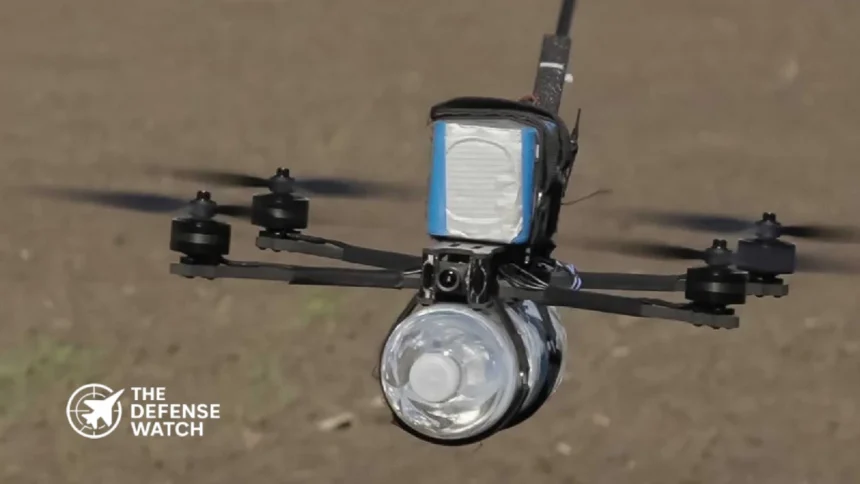
Ukrainian drone operators accounted for more than 70% of the simulated casualties suffered by a U.S. Army armored brigade during the opening days of Exercise Combined Resolve 26-07 in Germany, according to an analysis written by the American brigade’s commander and staff. The exercise demonstrated how persistent aerial surveillance, rapid targeting and coordinated drone strikes can expose armored formations before they complete their movements or establish defensive positions.
- Ukrainian drone operators exposed weaknesses in armored operations
- Why the casualty rate fell after three days
- Electronic warfare has limits against a mobile force
- The larger challenge is managing the information flow
- Implications for U.S. Army force modernization
- What the exercise does, and does not, prove
The results also showed that tactical changes could reduce the threat. By the end of the third day, the proportion of simulated casualties attributed to drones had fallen below 30%, according to the published account. The experience offers a practical lesson for armies preparing to operate under continuous unmanned aerial surveillance: electronic warfare equipment alone cannot protect a formation that remains easy to detect.
Ukrainian drone operators exposed weaknesses in armored operations
The exercise took place at the Joint Multinational Readiness Center in Hohenfels, Bavaria, during April and May 2026. The U.S. formation involved was the 3rd Armored Brigade Combat Team, 1st Cavalry Division, known as Greywolf, commanded by Col. Michael Ziegelhofer.
Its opposing force included personnel from Ukraine’s 412th Separate Brigade, Nemesis, a formation associated with Ukraine’s Unmanned Systems Forces. Ukrainian personnel brought experience from combat operations against Russian forces, including the use of unmanned aircraft for reconnaissance, direct attacks and target acquisition for artillery.
During the approximately 10-day exercise, opposing-force drones initiated more than 750 contacts with the U.S. brigade, according to the published account. That figure describes recorded drone contacts, not 750 confirmed strikes or destroyed vehicles.
The early phase exposed a central problem for mechanized forces. Armored vehicles, command posts and logistical elements can be located by aerial sensors before they come within range of conventional direct-fire weapons. Once a target is identified, drone operators can simulate an attack themselves or pass its location to artillery units.
The exercise therefore tested more than the survivability of tanks. It examined how effectively an entire brigade could conceal its movements, protect communications, coordinate fires and sustain its logistics while an opposing force continuously searched for targets.
Why the casualty rate fell after three days
Greywolf responded by changing its field procedures rather than relying exclusively on additional equipment. The brigade increased concealment, dispersed elements, reduced unnecessary radio transmissions and adjusted movement patterns to make detection more difficult.
The published analysis attributed the reduction in drone-related simulated casualties to these adaptations. By the third day, the drone-attributed share had dropped below 30%, even as opposing-force drone activity continued.
That result matters because it suggests the brigade could improve its performance through changes in how it operated, without first requiring a wholesale replacement of its armored vehicles.
The distinction is important. A drone does not need to destroy a tank to disrupt a formation. Detecting a vehicle can expose its location, direct artillery fire, force a change of route or delay an operation. In a contested environment, those effects can undermine tempo and coordination even when vehicles remain physically intact.
The exercise figures should nevertheless be interpreted carefully. They describe outcomes within a controlled training scenario, where simulated engagements are adjudicated under exercise rules. They do not establish that 70% of a real brigade would be destroyed by drones in combat.
Electronic warfare has limits against a mobile force
Electronic warfare was another important part of the exercise, but the reported experience exposed a limitation in how jamming systems support moving formations.
Greywolf’s electronic warfare equipment could provide protection around deployed positions, but systems that need to be repositioned cannot necessarily maintain continuous coverage as a brigade advances. This can create gaps between protected locations and leave moving vehicles exposed.
The analysis also discussed the difficulty of countering fiber-optic first-person-view drones. Unlike conventional radio-controlled drones, these systems transmit control signals through a physical fiber-optic cable. That makes them resistant to radio-frequency jamming directed at the control link, although it does not make them immune to other countermeasures.
This creates a more complicated defensive problem. A formation must contend with conventional radio-controlled drones, fiber-optic systems, aerial reconnaissance and the artillery strikes that may follow detection.
A layered approach is therefore necessary. Electronic warfare can disrupt some threats, while camouflage, dispersion, physical cover, direct counter-drone measures and disciplined movement reduce other vulnerabilities.
The exercise does not establish that any single measure will provide reliable protection against every type of unmanned aircraft.
The larger challenge is managing the information flow
The experience also illustrates a problem that emerges when large numbers of drones operate across multiple levels of command.
Reconnaissance aircraft can produce a continuous stream of observations, target reports and requests for fires. If every report must pass through a central headquarters, commanders risk creating a bottleneck that slows decisions and overwhelms staff.
The brigade’s subsequent offensive operations incorporated more than 700 unmanned aircraft across different levels of the formation, according to the published account. The scale of activity created demands for intelligence processing, airspace coordination and the allocation of reconnaissance and strike missions.
The lesson is not simply to deploy more drones. Units also need procedures for deciding which targets matter most, which information requires immediate action and which tasks subordinate commanders can handle independently.
Greater delegation can accelerate responses, but it must be balanced with coordination between drones, artillery, aviation and ground maneuver units. Without suitable procedures, an increase in available sensors can produce more information than headquarters can use effectively.
For the U.S. Army, this is an organizational as well as a technical challenge. Drone operations must be integrated with existing command structures rather than treated as a separate activity disconnected from maneuver and fires.
Implications for U.S. Army force modernization
The Hohenfels exercise provides a useful test case for U.S. Army modernization efforts, particularly the protection of armored formations against persistent surveillance and low-cost attack systems.
Three areas stand out.
First, concealment and dispersion must be routine practices. Armored units cannot assume that forest cover, distance from the front line or movement at night will guarantee concealment. Their procedures must account for an opponent searching continuously from the air.
Second, counter-drone protection must move with the force. Fixed or position-dependent defenses can protect important sites, but maneuver units also need protection during movement, resupply and changes of position. This requires coordination between electronic warfare, reconnaissance, air defense and ground forces.
Third, units need enough unmanned capability to contest the same battlefield. The exercise’s later phase showed the operational value of using drones for reconnaissance, target acquisition and support to maneuver. But expanding drone inventories also creates requirements for trained operators, communications, airspace management, spare parts and a reliable flow of usable intelligence.
These findings are consistent with the wider U.S. Army effort to incorporate lessons from Ukraine’s war against Russia. Associated Press reporting on earlier U.S. training described Ukrainian personnel working alongside American forces to demonstrate battlefield drone tactics, while U.S. officials discussed how unmanned capabilities could be distributed throughout the force.
The challenge is adapting those lessons to American force structure and operational requirements. Ukraine’s experience offers practical evidence, but the U.S. Army must determine how to integrate the methods with its own logistics, command systems, aviation and long-range fires.
What the exercise does, and does not, prove
The reported casualty figures provide a strong indication of how vulnerable an armored formation can become when an opposing force combines persistent drone reconnaissance with rapid targeting and simulated strikes.
They also show that improved tactics can make a measurable difference within the same exercise. The fall in the drone-attributed casualty share from more than 70% to below 30% suggests that concealment, dispersion and changes in movement can reduce exposure.
However, one exercise cannot determine the exact performance of drones or counter-drone systems in a real war. Results depend on the scenario, terrain, exercise rules, available equipment, operator proficiency and the capabilities assigned to each side.
Nor does the reported decline prove that the brigade would achieve the same result against an opponent with different sensors, electronic warfare systems, artillery or operational objectives.
The clearest lesson is that armored warfare is increasingly shaped by the contest to detect, identify and engage forces before they can complete their missions. Tanks and other armored vehicles remain important, but their effectiveness depends in part on whether the formation around them can survive observation, protect its communications and operate under persistent aerial pressure.
For the U.S. Army, the value of Combined Resolve 26-07 lies in exposing these problems under realistic training conditions, before soldiers have to confront them in combat.