Shield AI X-BAT Targets Europe With Polish Production Plan
Shield AI is positioning the X-BAT uncrewed strike fighter for the European market after signing a five-year letter of intent with Poland’s Polska Grupa Zbrojeniowa and Wojskowe Zakłady Lotnicze Nr 2 covering potential design, production, delivery and sustainment work in Poland. The agreement was signed during the MSPO defense exhibition in Kielce and could establish a Polish industrial role in the program, although it is not yet a production contract.
Takeaways
Shield AI is positioning the X-BAT as a runway-independent autonomous combat aircraft for Poland and other European markets.
The proposed partnership is significant because X-BAT combines three requirements that are increasingly important to air forces operating under threat from long-range missiles and attacks against fixed infrastructure: vertical takeoff and landing, autonomous flight and a substantial internal weapons capacity.
Shield AI says X-BAT is designed to operate without conventional runways, including from remote sites, ships and austere forward locations. The company is seeking to connect that operational concept with European industrial capacity through PGZ and its aviation subsidiary WZL-2.
Poland Could Become a Production and Sustainment Hub
Under the letter of intent, PGZ Group companies and Shield AI will define how Polish industry could participate in X-BAT design, production and delivery for customers in Poland and other countries.
The proposed cooperation also covers maintenance, repair and overhaul, training, supply-chain participation, technology transfer and technology development. Discussions extend to Shield AI’s Hivemind autonomy software and its V-BAT uncrewed aircraft.
The arrangement therefore goes beyond a conventional foreign military sale. If definitive agreements are reached, the objective would be to establish Polish industrial participation across several stages of the aircraft’s life cycle.
Shield AI has not announced a production quantity for Poland, a contract value, or a final production site. Those details remain subject to further agreements.
That distinction is important. The current announcement establishes an industrial framework for negotiations, rather than confirming that Poland has ordered X-BAT aircraft.
WZL-2 Brings F-16 and F-110 Experience
WZL-2 is particularly relevant to the proposed partnership because the Polish aviation facility already supports military aircraft including the F-16 and C-130.
The company is also preparing to expand its capabilities for the GE Aerospace F110 engine family that will power X-BAT. Shield AI and WZL-2 therefore see an opportunity to connect existing Polish aviation maintenance expertise with the new autonomous aircraft program.
This could reduce some of the industrial barriers associated with introducing a new combat aircraft architecture, although X-BAT’s autonomous flight systems, propulsion configuration and VTOL operating concept will create requirements that differ substantially from conventional fighter sustainment.
The Polish government has also been pursuing additional U.S. defense-industrial partnerships. In July, PGZ and WZL-2 signed an agreement with Anduril Industries concerning the assembly and later production of Barracuda-500M autonomous cruise missiles in Poland.
The X-BAT proposal therefore fits into a broader Polish effort to place more defense production and sustainment capability inside the country.
X-BAT’s Technical Architecture
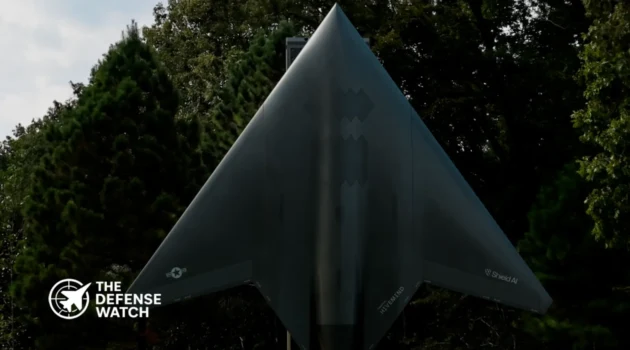
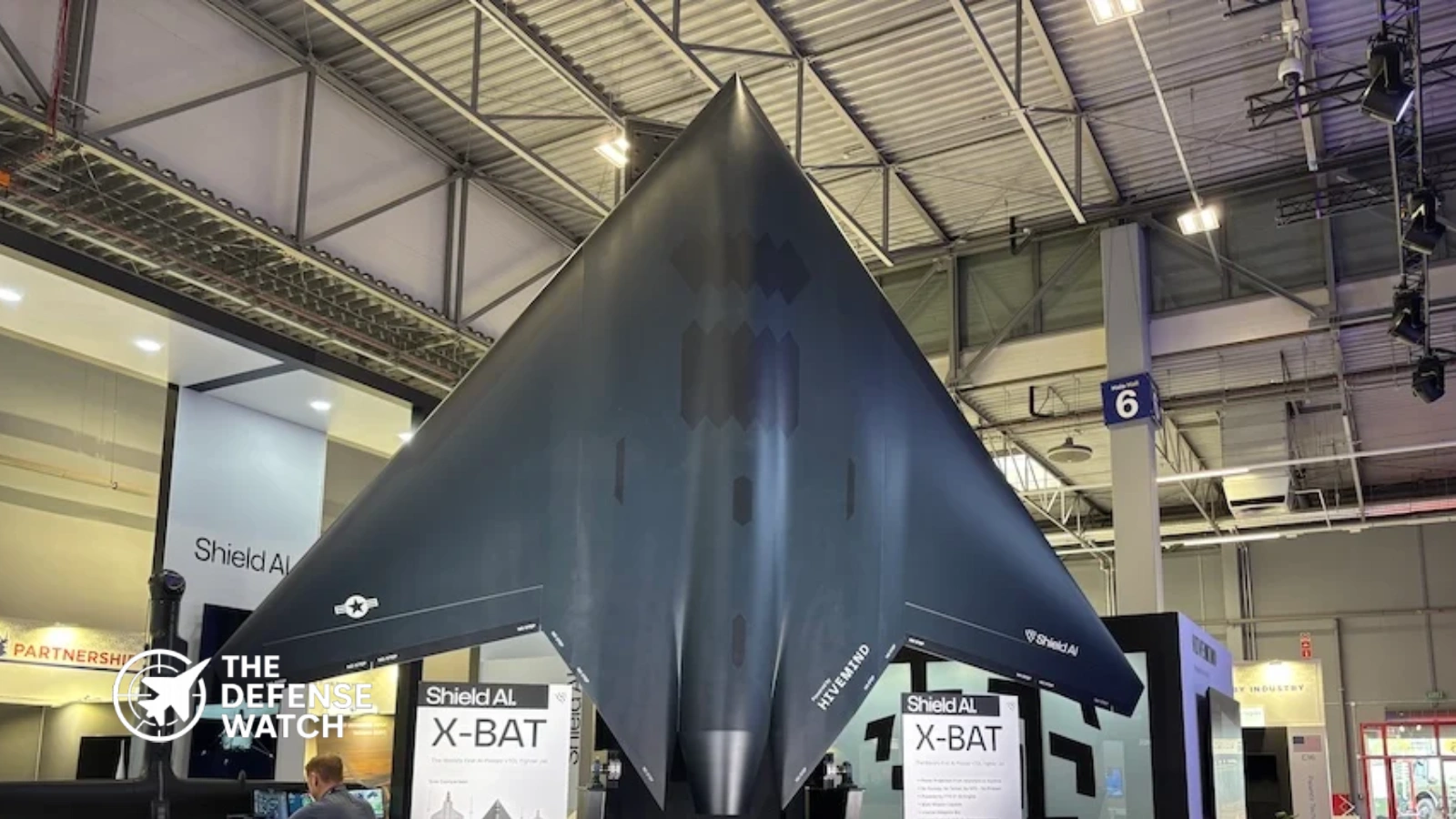
Shield AI describes X-BAT as an AI-piloted, low-observable, multirole strike fighter capable of vertical takeoff and landing.
The published specifications include:
X-BAT Characteristic Publicly Stated Information Aircraft type Uncrewed multirole strike fighter Flight concept Vertical takeoff and landing Autonomy Shield AI Hivemind Combat radius 1,000 nautical miles Maximum range More than 2,000 nautical miles Wingspan 39 feet Internal weapons capacity 2,000-pound class Internal bays Sized to match F-35 bay dimensions Electrical power 80 kW Propulsion GE Aerospace F110-GE-129E Thrust vectoring Axisymmetric Vectoring Exhaust Nozzle, AVEN Flight testing Planned to begin in 2026 Shield AI’s published X-BAT information lists a maximum range of more than 2,000 nautical miles, while its September announcement specifies a 1,000-nautical-mile combat radius. These are different performance measures and should not be treated as interchangeable.
The aircraft is also designed around substantial electrical power generation. Shield AI states that its 80-kilowatt electrical capacity can support electronic warfare systems, radar and intelligence, surveillance and reconnaissance payloads.
That electrical capacity matters because future autonomous combat aircraft are likely to depend heavily on onboard sensing, electronic warfare, communications and computing rather than simply carrying weapons.
GE Aerospace F110 Provides the Propulsion Foundation
The X-BAT’s VTOL capability depends on a modified propulsion arrangement built around GE Aerospace’s F110-GE-129E engine and AVEN thrust-vectoring technology.
In July, Shield AI and GE Aerospace completed integration, actuation and engine light-off testing of AVEN with the F110-GE-129E at GE Aerospace’s Peebles Test Operation in Ohio. The test campaign was an important ground milestone before flight testing.
AVEN is an axisymmetric thrust-vectoring nozzle originally developed during earlier research into advanced fighter maneuverability. Shield AI and GE Aerospace have refurbished and integrated the technology into the X-BAT propulsion system, with further engineering work planned as development continues.
The configuration is notable because X-BAT does not use a conventional vertical-lift system such as separate lift engines or a large mechanical lift fan.
Instead, the aircraft uses engine thrust and vectoring to support vertical flight. That approach can simplify the basic aircraft architecture, but it places demanding requirements on propulsion control, flight-control software, thermal management and autonomous flight control during takeoff and landing.
Runway Independence Is the Central Operational Concept
The strongest operational argument for X-BAT is its ability to operate without a conventional runway.
Fixed air bases remain essential to modern air forces, but they are also predictable targets for ballistic missiles, cruise missiles, loitering munitions and other long-range strike systems. A fighter force that depends on a limited number of large runways can therefore face significant operational constraints if those facilities are damaged or suppressed.
X-BAT’s VTOL architecture is intended to address that vulnerability by allowing aircraft to disperse across a larger number of operating locations.
Shield AI specifically highlights remote sites, maritime operations and austere bases as potential operating environments.
For Poland, this concept has particular relevance because of the country’s position on NATO’s eastern flank and its increasing emphasis on resilient military infrastructure.
The value is not simply that an aircraft can take off without a runway. The larger operational question is whether fuel, weapons, maintenance equipment, communications, data links and personnel can also be dispersed sufficiently to support the aircraft.
That makes logistics and sustainment just as important as the aircraft’s VTOL capability.
Autonomy Could Change How X-BAT Is Used
X-BAT is being developed around Shield AI’s Hivemind autonomy software.
The company says the aircraft will be capable of operating independently or as part of a force package with crewed aircraft. The design therefore fits into the broader development of autonomous collaborative aircraft, where uncrewed systems perform missions that could expose manned aircraft to greater risk.
The combination of autonomy and VTOL creates an important distinction from traditional unmanned aircraft.
Many current military UAVs are primarily designed for surveillance, communications relay or relatively low-risk strike missions. X-BAT is being developed as a combat aircraft with fighter-like performance requirements, internal weapons carriage, electronic warfare capabilities and operation in contested environments.
That creates considerably more demanding certification and operational challenges.
An autonomous system must reliably manage abnormal situations, navigation failures, sensor degradation, communications loss and dynamic changes in the tactical environment. For a VTOL aircraft, the most difficult moments also occur during takeoff and landing, when the aircraft has limited energy and little margin for control errors.
These requirements will have to be demonstrated through flight testing rather than inferred from the aircraft’s design.
Poland Already Has a Relationship With Shield AI
The proposed X-BAT industrial partnership builds on an existing Polish relationship with Shield AI.
In June, Poland’s Armament Agency signed a contract to acquire Shield AI’s V-BAT VTOL unmanned aircraft for Polish Navy operations. Shield AI said the systems are intended to support maritime domain awareness and ISR from a Polish Navy vessel, with deliveries planned for later in 2026.
That relationship provides a practical entry point for Poland into Shield AI’s broader autonomous aviation ecosystem.
V-BAT and X-BAT occupy very different capability classes, however. V-BAT is a Group 3-class VTOL ISR platform, while X-BAT is being designed as a much larger autonomous combat aircraft capable of carrying substantial internal weapons and operating at fighter-like ranges.
The common element is the autonomy architecture and the ability to operate without conventional runways.
European Market Competition
Shield AI’s push into Poland also places X-BAT within a rapidly developing European market for autonomous combat aircraft.
European governments are examining ways to increase aircraft numbers without relying exclusively on expensive crewed fighters. At the same time, the proliferation of long-range precision weapons is forcing air forces to consider dispersal, survivability and distributed operations.
For NATO members, the ability to operate combat aircraft from dispersed locations could complement existing fighter fleets rather than replace them.
Poland already operates F-16s and is receiving F-35s, while the country’s defense industry is expanding cooperation with U.S. companies. X-BAT could theoretically occupy a different role by providing an autonomous strike and electronic warfare capability that complements crewed aircraft.
However, no Polish acquisition of X-BAT has been announced as part of the current letter of intent.
The Key Development Milestone Is Still Flight Testing
The next major test for the X-BAT program is flight.
Shield AI and GE Aerospace have completed an important ground propulsion milestone, but the aircraft still needs to demonstrate that its engine, AVEN nozzle, flight-control architecture and Hivemind autonomy can operate together in actual flight.
Shield AI says flight testing is scheduled to begin in 2026.
Successful flight testing would establish a substantially stronger basis for international procurement discussions. It would also provide the first meaningful evidence that the aircraft can translate its proposed VTOL architecture and autonomous control system into operationally relevant performance.
For Poland, the industrial question will develop in parallel. The five-year letter of intent gives PGZ and WZL-2 a framework to negotiate production, sustainment, supply-chain and technology roles, but the final structure remains to be determined.
What the Poland Agreement Means for U.S. and NATO Defense Strategy
The proposed X-BAT partnership reflects a broader shift in how NATO countries are approaching autonomous combat aviation.
Rather than treating unmanned aircraft solely as expendable surveillance or strike systems, defense planners are increasingly considering larger autonomous platforms that can carry sensors, electronic warfare equipment and weapons while operating alongside crewed fighters.
For the United States, European industrial participation could also provide an additional production and sustainment pathway for an American-designed autonomous aircraft.
For Poland, the attraction is more direct: industrial participation could provide domestic expertise in autonomous aircraft, propulsion maintenance, systems integration and through-life support rather than leaving the country dependent on imported complete systems.
The most important caveat is that the current agreement does not establish those capabilities yet. Definitive agreements will determine which PGZ companies participate, where work is performed, how much technology is transferred and whether Polish production ultimately supports foreign customers.
The X-BAT program therefore remains at a developmental stage, but the Poland agreement marks a significant step in Shield AI’s effort to turn the aircraft into a potential European defense product.
What Happens Next
Shield AI, PGZ and WZL-2 now have to translate the letter of intent into detailed industrial arrangements.
The immediate technical priority is X-BAT flight testing. In parallel, the companies will need to establish the proposed Polish roles in manufacturing, maintenance, training, supply-chain participation and technology development.
No production quantity, contract value or final Polish production location has been disclosed.
For now, the significance of the agreement is less about a confirmed Polish X-BAT fleet and more about the industrial architecture being discussed around it. If the planned arrangements progress, Poland could become an important European node for an American-developed autonomous combat aircraft designed around runway-independent operations.