
- Home
- Defense Systems
- Attack & Multirole Drones (UAVs)
- MQ-20 Avenger Drone
MQ-20 Avenger Drone

Defense Systems Full Specifications
1. General Information
| Manufacturer | General Atomics Aeronautical Systems |
| Country of Origin | United States |
| Type / Role | Stealth Combat / ISR UAV |
| First Flight / Introduced | 2009 / In Development & Limited Use |
| Status | Operational / Evolving for CCA Integration |
| Unit Cost | USD 12–15 Million (Approx.) |
2. Performance
| Maximum Speed | 740 km/h |
| Cruise Speed | 560 km/h |
| Operational Range | 2,500+ km |
| Endurance | Up to 20 hours |
| Service Ceiling | 50,000 ft |
| Rate of Climb | 20 m/s |
3. Dimensions
| Length | 13 m |
| Wingspan | 20 m |
| Height | 4 m |
| Maximum Takeoff Weight (MTOW) | 8,250 kg |
4. Payload & Armament
| Payload Capacity | 1,360 kg |
| Hardpoints | 2 Internal + External Options |
| Weapons | Hellfire, JDAM, GBU-39 SDB, Paveway |
| Sensors | EO/IR, SAR, SIGINT Pods |
| Avionics | SATCOM, GPS/INS, Autonomous Mission Systems |
5. Propulsion
| Engine Type | Pratt & Whitney PW545B Turbofan |
| Engine Power | 4,600 lbf thrust |
| Propeller Type | N/A (Jet-powered) |
6. Communication & Control
| Control Type | Remote / Semi-Autonomous / AI-Aided |
| Data Link Range | LOS + SATCOM Beyond LOS |
| Navigation | GPS / INS |
| Ground Control Station | Portable or Fixed Facility |
7. Operational Use
| Primary Users | USAF |
| Combat Proven | Limited Operational Testing |
| Notable Operations | USAF CCA and autonomy demos |
PROS
- Stealth-optimized design with internal weapons bay
- High-speed jet performance for rapid engagements
- Supports AI-assisted autonomous operations
- Compatible with manned–unmanned teaming (e.g., F-22, F-35)
- Long-range ISR and strike flexibility
CONS
- Higher operational cost than turboprop UAVs
- Limited stealth compared to full-scale UCAVs
- Requires advanced data-link infrastructure
- Complex maintenance requirements for jet engine
- Relatively small production numbers
MQ-20 Avenger Stealth Combat Drone
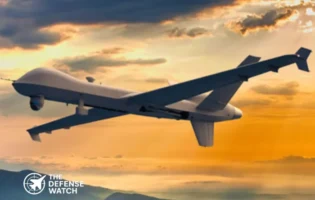
The MQ-20 Avenger, developed by General Atomics Aeronautical Systems, represents the next stage in U.S. unmanned combat aviation. Designed to operate in contested environments, the Avenger brings jet-powered performance, internal weapons carriage, and reduced radar visibility—capabilities that position it beyond traditional MALE-class UAVs. As demand grows for autonomous strike and ISR assets that can survive modern air defenses, the MQ-20 offers a uniquely adaptable solution.
Powered by a turbofan engine, the Avenger reaches speeds and altitudes that surpass the MQ-9 Reaper, enabling faster response times, improved survivability, and deeper penetration into hostile airspace. The aircraft supports a wide range of missions, including precision strike, electronic warfare, maritime patrol, and networked operations with manned aircraft—an area recently demonstrated in tests where an F-22 successfully controlled an MQ-20 as part of the U.S. Air Force’s Collaborative Combat Aircraft (CCA) efforts.
Its internal weapons bay carries precision-guided munitions while maintaining a lower radar signature, and external hardpoints allow expanded loadouts when stealth is less critical. Advanced ISR payloads—such as EO/IR systems, synthetic aperture radar, and electronic surveillance packages—enhance its targeting and reconnaissance flexibility. The aircraft’s long endurance and satellite-enabled control architecture provide strategic reach for operations across the Indo-Pacific and other extended theaters.
The MQ-20 is engineered to operate as part of next-generation manned–unmanned teams, contributing to distributed sensing, autonomous threat detection, AI-supported decision-making, and strike coordination. As the U.S. military evolves toward more survivable and affordable unmanned platforms, the Avenger remains a key bridging capability between current legacy drones and future stealth UCAV families.
MQ-20 Avenger Price
The MQ-20 Avenger is estimated to cost USD 12–15 million per unit, depending on payload configuration, data-link architecture, and mission systems. Actual procurement cost may vary based on order quantity and integration requirements.
Disclaimer Note
The information provided on TheDefenseWatch.com is for general informational purposes only. While we strive to ensure the accuracy, completeness, and timeliness of our content regarding defense and aerospace products, technologies, and specifications, we cannot guarantee that all information is 100% accurate or up-to-date due to the evolving nature of military technology and classified data.TheDefenseWatch.com does not warrant the reliability, suitability, or availability of the information for any specific purpose. Users are advised to consult official sources, such as manufacturers, government publications, or defense agencies, for precise and verified data before making decisions based on our content.We are not affiliated with any defense manufacturers, governments, or military organizations mentioned. Opinions, reviews, and ratings reflect expert analysis but are subjective and should not be considered endorsements. TheDefenseWatch.com is not responsible for any errors, omissions, or consequences arising from the use of this website’s content.External links are provided for convenience and do not imply endorsement. TheDefenseWatch.com reserves the right to update or modify content without prior notice. By using this website, you agree to our Privacy & Cookies Policy.

New Arrivals












Popular Comparisons
-
 J-10C vs JF-17 Thunder: Which Fighter Is More Capable?
View Comparison →
-
Tejas vs Gripen: Key Differences and Capabilities
View Comparison →
-
Tejas vs MiG-21 Bison: How India Replaced Its Iconic Supersonic Fighter
View Comparison →
-
F-35 vs F-16: Stealth, Sensors and Combat Roles
View Comparison →
-
Tejas Fighter Jet vs F-16 Fighting Falcon: Capability Compared
View Comparison →
-
Rafale Fighter Jet vs F-16 Fighting Falcon : Which Fighter Has the Edge?
View Comparison →
-
Su-57 Fighter Jet vs J-20 Fighter Jet: Stealth and Air Combat Compared
View Comparison →
-
Mirage 2000 vs Tejas Mk1A: Legacy Combat Power vs Indigenous Modernization
View Comparison →
-
Rafale Fighter Jet vs F-22 Raptor: Which Air Dominance Fighter Has the Edge?
View Comparison →
-
Tejas Fighter Jet vs. Rafale Fighter Jet: India’s Indigenous Fighter Meets France’s Proven Multirole Combat Aircraft
View Comparison →


- Destinus Produces 1,750 Ruta B1 Cruise Missiles as European Output Expands

- Boeing Wins $11.1 Million Contract Modification for Kuwait F/A-18 Training Support
- U.S. Navy Awards $23.1 Million Contract for Cybersecurity of Shipboard Power Systems
- Lockheed Martin Wins $43.7 Million F-35 Reprogramming Lab Upgrade Contract
- USS Colorado Arrives in Australia for AUKUS Submarine Maintenance
- U.S. Marines and Japanese Forces Train in Explosive Ordnance Disposal During Keen Sword 2027
- Lockheed Martin Tests In-Flight Retargeting of GMLRS Rocket
- Saab and GA-ASI Test LoyalEye Airborne Early Warning on MQ-9B
- Trump’s Russian Diesel Deal Could Benefit Moscow More Than US Consumers
- China Reports Fielding 40mm Cased Telescoped Ammunition




Fighter Jets
-
 F-100 Super Sabre
-
North American F-86 Sabre
-
Northrop YF-23 Fighter
-
Rafale F5 Fighter
-
SU-57 Felon Stealth Fighter
-
Boeing F/A-XX Fighter
-
JF-17 Thunder Fighter Jet
-
F-47 Fighter Jet
-
MIG-31 Fighter Jet
-
J-10CE Fighter Jet
-
Chengdu J-10 Fighter Jet
-
Chengdu J-10C Fighter Jet
-
Gripen E Fighter Jet
-
Tejas Mk1A Fighter Jet
-
Tejas Mk‑2 Fighter Jet
-
F-16V Viper Block 70 Fighter Jet
-
F-15EX Eagle II Fighter
-
F-15E Strike Eagle Fighter
-
F/A-18E/F Super Hornet Fighter Jet
-
Saab Gripen F Fighter Jet
-
JAS 39E/F Gripen Fighter Jet
-
JAS 39 Gripen Fighter Jet
-
F-35A Lightning II Fighter Jet
-
F/A-18F Super Hornet









Recent Compares
-
J-10C vs JF-17 Thunder: Which Fighter Is More Capable?
View Comparison →
-
Tejas vs Gripen: Key Differences and Capabilities
View Comparison →
-
Tejas vs MiG-21 Bison: How India Replaced Its Iconic Supersonic Fighter
View Comparison →
-
F-35 vs F-16: Stealth, Sensors and Combat Roles
View Comparison →
-
Tejas Fighter Jet vs F-16 Fighting Falcon: Capability Compared
View Comparison →
Latest Defense Systems
10 Compares Defense Systems
-
J-10C vs JF-17 Thunder: Which Fighter Is More Capable?
View Comparison →
-
Tejas vs Gripen: Key Differences and Capabilities
View Comparison →
-
Tejas vs MiG-21 Bison: How India Replaced Its Iconic Supersonic Fighter
View Comparison →
-
F-35 vs F-16: Stealth, Sensors and Combat Roles
View Comparison →
-
Tejas Fighter Jet vs F-16 Fighting Falcon: Capability Compared
View Comparison →
-
Rafale Fighter Jet vs F-16 Fighting Falcon : Which Fighter Has the Edge?
View Comparison →
-
Su-57 Fighter Jet vs J-20 Fighter Jet: Stealth and Air Combat Compared
View Comparison →
-
Mirage 2000 vs Tejas Mk1A: Legacy Combat Power vs Indigenous Modernization
View Comparison →
-
Rafale Fighter Jet vs F-22 Raptor: Which Air Dominance Fighter Has the Edge?
View Comparison →
-
Tejas Fighter Jet vs. Rafale Fighter Jet: India’s Indigenous Fighter Meets France’s Proven Multirole Combat Aircraft
View Comparison →
- Destinus Produces 1,750 Ruta B1 Cruise Missiles as European Output Expands
- Boeing Wins $11.1 Million Contract Modification for Kuwait F/A-18 Training Support
- U.S. Navy Awards $23.1 Million Contract for Cybersecurity of Shipboard Power Systems
- Lockheed Martin Wins $43.7 Million F-35 Reprogramming Lab Upgrade Contract
- USS Colorado Arrives in Australia for AUKUS Submarine Maintenance