China’s 40mm Telescoped Ammunition Targets Armor and Drones
China’s Changan Wangjiang defense company says a new 40mm cased telescoped ammunition round has entered service on multiple domestically developed weapons platforms, combining armor-piercing, high-explosive fragmentation and programmable airburst functions in a single ammunition family.
- China’s 40mm Telescoped Ammunition Targets Armor and Drones
- One ammunition design, three reported engagement modes
- Why China is pursuing telescoped ammunition
- What the Type 100 support vehicle connection tells us
- The counter-drone role comes with important limitations
- How it compares with Western telescoped ammunition
- What remains unconfirmed
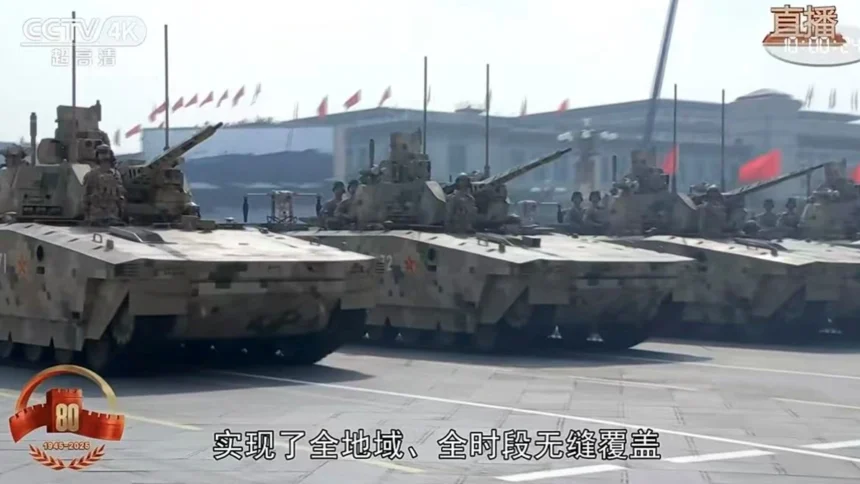
The company, a subsidiary of China South Industries Group, disclosed the ammunition in a video published on its official social media account on October 26. The footage included China’s Type 100 support vehicle and a new-generation airborne combat vehicle that appeared at the country’s September 3, 2025, military parade.
Changan Wangjiang claims the round can penetrate 130 millimeters of homogeneous steel armor at a distance of one kilometer. It also reports an accuracy figure of 0.5 meters by 0.5 meters at the same distance.
These figures have not been independently verified in the available reporting. The company has not publicly established the conditions under which the penetration and accuracy results were obtained, and the announcement does not identify the individual weapons systems that have received the ammunition or the number of rounds delivered.
The disclosure nevertheless provides a useful indication of China’s continuing work on medium-caliber ammunition intended to serve multiple battlefield roles.
One ammunition design, three reported engagement modes
The reported 40mm round uses a cased telescoped ammunition, or CTA, configuration. Unlike conventional ammunition, in which the projectile sits ahead of the cartridge case, the telescoped design encloses the projectile within the case, creating a more compact, approximately cylindrical round.
The arrangement can support more compact ammunition-handling systems and influence how ammunition is stored inside a turret or armored vehicle. Its practical benefits, however, depend on the complete weapon system, including the gun, loading mechanism, ammunition storage arrangement and the types of rounds carried.
Changan Wangjiang describes a two-stage ignition process. According to the company, the initial ignition moves the projectile into position and establishes a sealed chamber within the cartridge case. A second ignition then propels the projectile toward its target. Public information does not provide enough technical detail to independently assess the design’s internal ballistics or its performance compared with conventional ammunition.
The company identifies three principal functions for the new round.
Armor penetration: The manufacturer claims the projectile can penetrate 130mm of homogeneous steel armor at one kilometer. That figure should not be interpreted as proof that the round can defeat the frontal armor of modern main battle tanks. Armor performance depends on the projectile design, impact conditions, armor composition and the configuration of the target.
High-explosive fragmentation: The second reported mode is intended to engage personnel, field fortifications and other suitable targets through explosive effects and fragmentation. Its effectiveness would depend on the warhead design, detonation characteristics, target protection and engagement conditions.
Programmable airburst: The third mode is designed to detonate above or near a target, dispersing fragments over an area. This could be relevant to small, low-altitude aerial threats, including some drones, as well as exposed personnel. However, the announcement does not provide verified drone-interception results, engagement probabilities or details of the fire-control systems required to program and deliver the round accurately.
Combining these functions within one ammunition family could give a compatible vehicle greater flexibility when changing between target types. It does not establish that every individual round can perform all three functions, or that all three modes are available on every platform using the ammunition.
Why China is pursuing telescoped ammunition
The attraction of CTA technology is not new. Designers have pursued telescoped ammunition for decades to address the space and loading constraints associated with medium-caliber weapons.
Inside an armored vehicle, ammunition competes for limited space with crew stations, sensors, electronics, weapon mechanisms and other equipment. A more compact ammunition arrangement may allow designers to reconsider storage capacity and the layout of a turret or weapon station.
The cylindrical shape can also help support automated ammunition handling. But the total benefit depends on the dimensions of the complete weapon system and the space required by its loading mechanism. A compact cartridge alone does not guarantee that a vehicle can carry more ammunition.
Research involving Chinese institutions and Changan Wangjiang personnel has previously examined the internal ballistics and optimization of cased telescoped ammunition. A 2018 paper published in Defence Technology, for example, studied the modeling and optimization of the ammunition’s internal ballistic process. This establishes that the underlying engineering work predates the latest announcement, although it does not validate the performance of the newly publicized round.
China has also displayed earlier telescoped ammunition and associated weapon concepts. A 2020 report on the CS/AA5 40mm weapon system described a Chinese development effort involving cased telescoped rounds. The available evidence therefore suggests that the latest announcement builds on an established Chinese research and development effort rather than introducing the basic concept for the first time.
The important question is whether the newer ammunition has progressed from a demonstrated design to sustained operational use across a meaningful number of vehicles.
What the Type 100 support vehicle connection tells us
The footage accompanying the ammunition announcement included the Type 100 support vehicle, which China displayed alongside other new military equipment during its 2025 Victory Day parade.
China’s Ministry of National Defense has separately confirmed that the Type 100 main battle tank, also unveiled at the parade, has entered service with the People’s Liberation Army Army. That official statement concerns the tank, however, and should not be treated as confirmation of the number of Type 100 support vehicles in service or the deployment status of the new 40mm ammunition.
The support vehicle’s reported role is complementary to that of the tank. A main battle tank is primarily designed around its main armament and the engagement of demanding ground targets. A dedicated fire support vehicle can provide a different mix of weapons and engagement options against lighter vehicles, exposed personnel and other targets that do not necessarily require the tank’s main gun.
A medium-caliber weapon using programmable airburst ammunition could potentially add a further function by allowing crews to engage suitable small aerial threats. That would be particularly relevant to formations facing reconnaissance drones and other low-altitude systems.
However, the exact weapon installation, ammunition capacity, targeting sensors and fire-control arrangements associated with the Chinese support vehicle have not been established by the ammunition announcement. Nor does the footage independently demonstrate that the vehicle has successfully engaged drones or armored targets with the new round.
The airborne combat vehicle shown in the same video also points to a possible application for compact medium-caliber weapons on air-transportable platforms. Its appearance does not establish the vehicle’s full operational configuration, its fielding numbers or the precise ammunition types it carries.
The counter-drone role comes with important limitations
Programmable airburst ammunition has attracted interest because it offers an alternative to relying exclusively on direct-impact projectiles against small aerial targets.
A conventional projectile must intersect a target or produce the required effect close enough to damage it. An airburst round can instead detonate at a selected point, dispersing fragments across a defined area. This can create an engagement opportunity when a small target is difficult to hit directly.
But the approach has practical limits.
A useful airburst capability requires more than a suitable projectile. The weapon must receive accurate targeting information, calculate an appropriate firing solution and set the ammunition’s fuze correctly. The target’s speed, direction, altitude and distance all affect the engagement.
Small drones also present a range of different problems. Their size, flight characteristics and materials vary, and some operate in groups or at distances where a vehicle-mounted cannon may not be the most suitable response. A 40mm airburst round could form one part of a layered counter-drone system, but the available information does not establish that it can replace dedicated air-defense weapons or electronic warfare systems.
Changan Wangjiang has not disclosed sufficient test data to determine the new round’s effectiveness against different drone classes, its maximum engagement distance against aerial targets or its performance against multiple targets.
Those omissions matter when assessing the ammunition’s practical value beyond its advertised functions.
How it compares with Western telescoped ammunition
China is not the only country pursuing cased telescoped ammunition.
The British and French defense industries have developed the 40mm Cased Telescoped Armament System, or 40CTAS, through CTA International, a joint venture between BAE Systems and Nexter, now part of KNDS France.
According to the manufacturer’s published documentation, the system combines a 40mm cannon, an ammunition-handling system and fire-control equipment capable of supporting different ammunition types, including programmable airburst rounds. It is intended for land and naval applications, including armored vehicles and certain air-defense roles.
The comparison illustrates an important distinction. A telescoped cartridge is only one component of a larger weapon system. Operational capability depends on the gun, ammunition feed, fuze programming, fire-control equipment, sensors and integration with the host platform.
| Attribute | Chinese 40mm round | Western 40CTAS |
|---|---|---|
| Ammunition concept | Cased telescoped | Cased telescoped |
| Manufacturer or developer | Changan Wangjiang | CTA International |
| Reported functions | Armor-piercing, high-explosive fragmentation and programmable airburst | Multiple ammunition types, including armor-piercing and airburst options |
| Platform integration | Manufacturer says the round is used on multiple Chinese platforms, but does not identify the full list | Published system documentation describes an integrated cannon, ammunition-handling system and fire-control equipment |
| Public performance evidence | The latest penetration and accuracy figures are manufacturer claims reported by Global Times | Manufacturer publishes system and ammunition documentation |
| Independent comparison | Insufficient public evidence for a direct performance ranking | Insufficient evidence here for a direct performance ranking against the Chinese round |
The available information does not support declaring either system superior. A meaningful comparison would require compatible test conditions, comparable projectile types, clearly defined armor standards, fuze-performance data and evidence of operational reliability.
It would also need to account for the number and types of rounds a vehicle can carry, the time required to switch ammunition types, maintenance requirements and the cost of producing the complete weapon system.
What remains unconfirmed
The most consequential part of the Chinese announcement is the claim that the 40mm ammunition is already being used by multiple domestic platforms. If sustained fielding is confirmed, it would indicate that the development has progressed beyond a public demonstration.
Yet the scale of that fielding remains unclear.
The company has not publicly identified all compatible vehicles or weapons, disclosed production quantities, provided a delivery schedule or explained whether the ammunition is in routine operational service, limited initial fielding or another stage of introduction.
The reported penetration and accuracy figures also need additional evidence. The 130mm armor-penetration claim does not specify the precise test conditions or the type of armor standard used. The reported 0.5-meter by 0.5-meter accuracy figure is not accompanied by a detailed test methodology, sample size or information about the firing platform.
These gaps prevent a reliable assessment of the round’s performance against comparable ammunition or its effectiveness in actual combat conditions.
China’s announcement nevertheless shows continued investment in ammunition intended to combine multiple battlefield functions within a compact format. The potential advantages are relevant to armored vehicles operating under tight space constraints and to forces seeking additional options against small aerial threats.
Whether those advantages translate into a meaningful operational improvement will depend on verified performance, reliable production and integration with the vehicles and fire-control systems expected to use the ammunition.