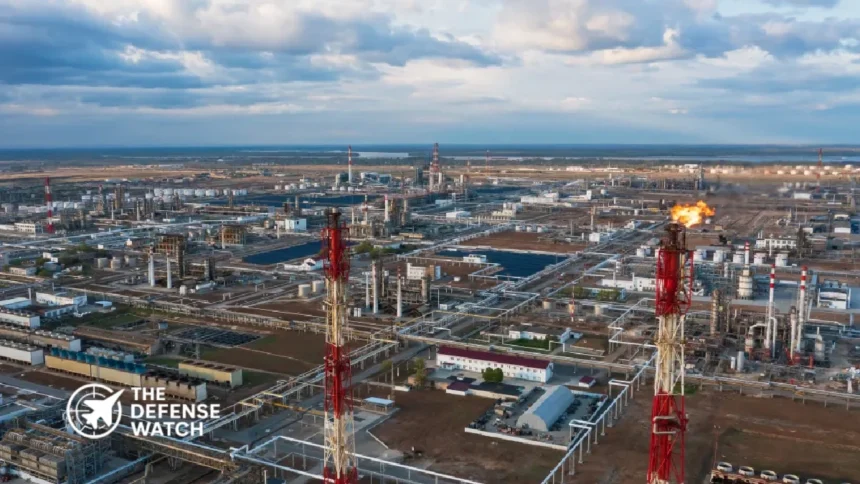
The first Russian diesel shipment bound for the United States since 2022 is heading toward the American market, but the limited volume of expected deliveries raises questions about whether President Donald Trump’s agreement with Russian President Vladimir Putin can meaningfully reduce fuel prices.
- The first shipment puts the agreement to the test
- Why American consumers may see little relief
- Russia’s refining problems complicate the supply promise
- The financial benefit to Moscow is more complicated than the headline figures suggest
- The Ukraine war creates a strategic cost for Washington
- What the agreement reveals about energy security
- The key test is what arrives, and what Washington gains
The agreement, announced on October 9, 2026, allows Russian diesel exports to resume under temporarily relaxed US sanctions. Trump has presented the arrangement as a way to increase fuel supplies and ease costs for American consumers, including truckers, farmers and businesses that depend on diesel.
However, energy analysts and Russia specialists have questioned whether the promised deliveries are large enough to produce substantial price reductions. They also warn that easing restrictions could improve Moscow’s export opportunities while the war against Ukraine continues.
The issue extends beyond energy prices. The arrangement creates a potential source of revenue for Russia and raises questions about the relationship between US economic policy, sanctions enforcement and Washington’s efforts to influence the course of the war.
The first shipment puts the agreement to the test
According to Reuters reporting published October 23, shipping data showed that the Malta-flagged tanker Agioi Fanendes had loaded approximately 40,000 metric tons of ultra-low-sulfur diesel at Russia’s Primorsk port on October 22.
The vessel was initially reported to be heading toward New York, with an expected arrival date of November 7. The shipment’s commercial buyer and seller had not been publicly identified in the Reuters report.
The cargo is an early test of whether the agreement can translate political commitments into physical fuel deliveries. Announced export volumes do not automatically establish how much additional diesel will reach American consumers, when it will arrive or how much it will affect wholesale prices.
Trump announced that Russia would supply more than 300,000 metric tons of diesel to US and international markets, followed by 500,000 tons in November and a further 1 million tons afterward. These figures describe announced supply plans, not a verified record of completed deliveries.
On October 9, the US Treasury Department’s Office of Foreign Assets Control issued General License 135, authorizing specified transactions involving the sale, delivery, offloading and importation of Russian-origin diesel fuel.
The authorization provides a legal mechanism for qualifying transactions to proceed despite applicable Russia-related sanctions. It does not, by itself, guarantee that the announced volumes will be shipped, purchased or delivered on schedule.
The distinction matters because the deal’s economic value depends on actual supply, not the headline volume announced by either government.
Why American consumers may see little relief
Diesel prices are influenced by several interconnected factors, including crude oil costs, refinery capacity, inventories, transportation expenses and international demand.
The US market is also facing a broader supply disruption linked to the conflict involving Iran and restrictions affecting energy shipments through the Middle East. These pressures have reduced the availability of refined petroleum products and pushed diesel prices higher.
The International Energy Agency’s September 2026 oil market assessment reported that disruptions to Middle Eastern exports and damage to Russian refining capacity had tightened global diesel supplies. Gulf diesel and gasoil exports fell to approximately 390,000 barrels per day in August, little more than one-quarter of their prewar level.
Russian deliveries could add supply, but their effect depends on how much additional fuel enters the market and where it is sold.
Goldman Sachs estimated that the first two months of deliveries could reduce wholesale diesel prices on the US Gulf Coast by approximately $1 to $2 per barrel, equivalent to roughly 2 to 5 cents per gallon. That estimate suggests a limited potential benefit rather than a broad reduction in consumer costs.
There is also a geographical complication. A shipment delivered to a US East Coast terminal does not automatically reduce prices by the same amount across the country. Transportation costs, regional inventories, refinery operations and local distribution networks influence how changes in wholesale prices reach retailers.
For truck operators, agricultural businesses and freight companies, even a small reduction can offer some relief. But the proposed deliveries are unlikely, on their own, to resolve the supply pressures driving the wider diesel market.
The agreement’s timing also matters politically. Trump announced the arrangement less than a month before the November 3 US midterm elections, when high fuel prices were a prominent domestic economic concern.
The available evidence does not establish how much of any eventual price movement would result from Russian imports rather than changes in global supply, refinery output or other government measures.
Russia’s refining problems complicate the supply promise
Russia has traditionally been a major exporter of refined petroleum products. Its ability to maintain those exports has come under pressure from Ukrainian attacks on oil infrastructure and restrictions intended to protect domestic fuel supplies.
In an analysis published September 17, the International Energy Agency reported that Russian diesel production was estimated to have fallen by nearly 30 percent compared with the previous year.
The agency also reported that Russian refinery throughput dropped to approximately 3.8 million barrels per day in June, its lowest level in more than two decades. Repeated attacks damaged processing facilities, while sanctions limited access to some replacement equipment and suppliers.
These disruptions help explain why Russia restricted diesel exports earlier in 2026. Domestic demand, including seasonal agricultural requirements, has competed with the government’s interest in maintaining export revenue.
The new agreement may give Russian producers greater flexibility to resume overseas sales. Yet the volume they can supply will depend on refinery recovery, domestic fuel requirements, export restrictions and the security of transport routes.
The United States therefore faces a supply problem that cannot be solved simply by changing sanctions policy. Russia must still have sufficient exportable diesel, and commercial buyers must be willing and able to take delivery.
The first shipment demonstrates that the export route is being tested. It does not establish that Russia can sustain every volume announced by Trump.
The financial benefit to Moscow is more complicated than the headline figures suggest
The deal offers Russia an opportunity to sell diesel into markets where access has been constrained by Western sanctions. However, the financial benefit should not be confused with the total value of the announced shipments.
In an October 13 analysis, Sergey Vakulenko of the Carnegie Russia Eurasia Center argued that the agreement would be unlikely to produce a substantial increase in global diesel supply without a wider reduction in disruption to Russian refining operations.
Carnegie also examined the potential financial gains. Its analysis estimated that five million metric tons of diesel sold over six months could have a gross value of approximately $7 billion at prevailing prices. But that figure is not equivalent to $7 billion in additional Russian revenue because much of the fuel might otherwise have been exported through existing commercial channels.
The more relevant question is how much the change in US policy improves Russia’s net earnings.
Sanctions can increase transaction costs, restrict access to shipping services and complicate payments. Relaxing specific restrictions can reduce some of those barriers, potentially improving the economics of exports even if the total volume of fuel sold changes little.
That does not mean every dollar generated by diesel sales will go directly to the Russian government. Export revenue initially accrues to the companies involved, while the state’s financial benefit depends on taxation, ownership, energy-sector policies and broader economic conditions.
Nevertheless, petroleum exports remain an important source of Russian income. Additional commercial opportunities can help support an economy operating under the financial pressures associated with the war and Western sanctions.
The scale of that benefit remains uncertain. The available evidence does not establish the final shipment volume, the identities of all commercial participants or the additional net revenue Moscow will receive from the arrangement.
The Ukraine war creates a strategic cost for Washington
The agreement’s most consequential implications may concern US policy toward Russia rather than the immediate price of diesel.
Since Russia launched its full-scale invasion of Ukraine in February 2022, Washington and its allies have used financial restrictions and energy-related sanctions to increase the economic costs of Moscow’s military campaign.
The diesel arrangement introduces a limited exception to that approach. It allows qualifying transactions involving Russian-origin diesel while the conflict remains unresolved.
The White House has an economic incentive to seek additional supplies during a period of high fuel prices. It also appears to view commercial engagement as a possible avenue for improving relations with Moscow and encouraging progress in negotiations over Ukraine.
However, the relationship between economic concessions and diplomatic outcomes remains uncertain.
Carnegie senior fellow Tatiana Stanovaya argued in an October assessment that economic cooperation could proceed without Russia changing its demands regarding Ukraine or reducing military pressure. The Institute for the Study of War has also warned that Moscow could use economic engagement with Washington to seek further concessions in negotiations.
These are analyst assessments, not proof that the agreement will produce a particular diplomatic outcome.
The central issue is whether Washington receives a measurable strategic benefit in return for relaxing restrictions. A fuel arrangement could have greater value if it contributed to a verifiable reduction in hostilities, improved negotiations or secured other concrete concessions.
Without such an outcome, the immediate economic benefits may be concentrated among fuel suppliers and commercial participants, while the United States assumes the political cost of easing restrictions on a country it continues to oppose over its invasion of Ukraine.
Ukraine’s refinery campaign is part of the calculation
Ukrainian attacks on Russian oil infrastructure have become an important element of Kyiv’s effort to impose economic costs on Moscow.
The International Energy Agency’s September analysis documented the damage to Russian refining capacity and the resulting pressure on fuel production and exports. Those disruptions have also contributed to Russia’s efforts to protect domestic supplies through export restrictions.
The diesel agreement has consequently become connected to a wider dispute over attacks on energy infrastructure.
Ukrainian President Volodymyr Zelenskyy has argued that allowing Russia to restore export earnings while its forces continue attacking Ukrainian infrastructure risks weakening pressure on Moscow.
According to Defense News, Kyiv temporarily paused attacks on Russian refineries at Trump’s request but later resumed its campaign after continued Russian strikes on Ukrainian energy infrastructure. The accounts of the proposed restraint and subsequent events have been reported by the parties involved and should be distinguished from independently established terms of a formal ceasefire.
For Ukraine, refinery attacks provide one means of imposing costs on Russia’s war effort. For Moscow, restoring production and export earnings would help reduce those pressures.
Washington’s policy therefore involves competing objectives: lowering domestic fuel costs, preserving diplomatic channels with Russia and maintaining pressure over the invasion of Ukraine.
Whether the diesel arrangement advances those objectives simultaneously remains an open question.
What the agreement reveals about energy security
The dispute also illustrates a wider vulnerability in energy security. A disruption in one region can quickly affect fuel prices in countries with substantial domestic production because refined petroleum products are traded through interconnected international markets.
Diesel is particularly important to freight transportation, agriculture, construction and industrial activity. When supplies tighten, higher costs can spread through supply chains and contribute to inflation.
The current market pressure reflects several factors, including disruptions to Middle Eastern exports, constrained refining capacity and reduced Russian output. The IEA’s September assessment indicates that the loss of supply from Russia and the Gulf has been substantial enough to tighten global diesel availability.
Russian imports may provide some additional flexibility, but they do not remove the underlying vulnerabilities.
For the United States, a more durable response would depend on the combined effects of domestic refinery performance, alternative import sources, inventories, transport capacity and the eventual recovery of disrupted international supply routes.
The administration’s decision also demonstrates the trade-offs involved when governments use sanctions as both economic pressure and a diplomatic bargaining tool. A temporary relaxation can improve access to a commodity, but it may also change expectations about the consistency of future sanctions policy.
For companies considering transactions involving Russian-origin fuel, the precise terms of the Treasury authorization and other applicable restrictions remain important. A general license should not be interpreted as a blanket suspension of all sanctions on Russia.
The key test is what arrives, and what Washington gains
The Russian diesel agreement has moved beyond political statements into the initial stages of physical delivery. But the size and timing of the shipments, their effect on US prices and their ultimate financial value to Russia remain uncertain.
The first tanker is evidence of an attempted return to the US market, not proof that the wider supply commitments will be fulfilled.
For American consumers, the likely benefit depends on whether additional fuel reaches the market in sufficient quantities to influence wholesale prices. For Russia, the benefit depends on export volumes, commercial terms and the extent to which eased restrictions improve earnings compared with alternative export arrangements.
For Ukraine and its supporters, the concern is whether Moscow gains economic breathing room without making meaningful concessions toward ending the war.
Those outcomes will determine whether the agreement delivers more than a limited adjustment to fuel supplies. Until shipment volumes, price effects and diplomatic results can be assessed, claims of a major economic or strategic success remain premature.