
- Home
- Defense Systems
- Attack & Multirole Drones (UAVs)
- MQ-1C Gray Eagle Drone
MQ-1C Gray Eagle Drone

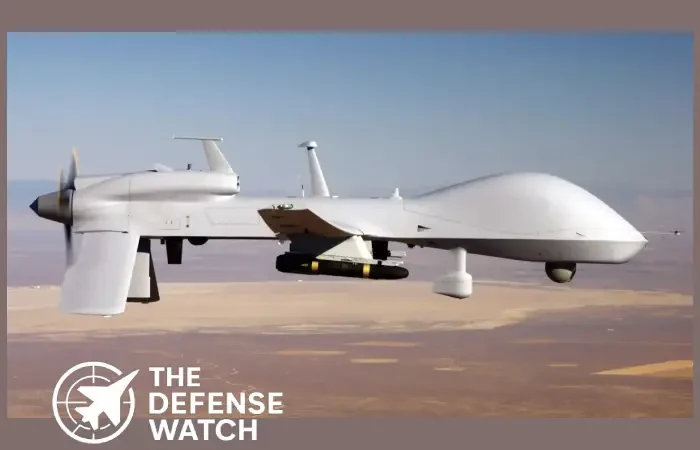
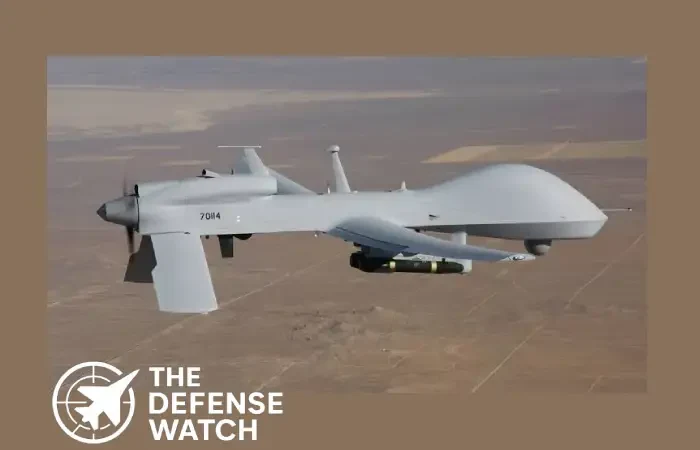
Defense Systems Full Specifications
1. General Information
| Manufacturer | General Atomics Aeronautical Systems |
| Country of Origin | United States |
| Type / Role | Attack / Multirole UAV |
| First Flight / Introduced | 2001 |
| Status | In Service |
| Unit Cost | USD 16 Million (Approx.) |
2. Performance
| Maximum Speed | 480 km/h |
| Cruise Speed | 310 km/h |
| Operational Range | 1,850 km |
| Endurance | 24 – 40 hours |
| Service Ceiling | 50,000 ft |
| Rate of Climb | 12 m/s |
3. Dimensions
| Length | 11 m |
| Wingspan | 20 m |
| Height | 3.8 m |
| Maximum Takeoff Weight (MTOW) | 4,760 kg |
4. Payload & Armament
| Payload Capacity | 1,700 kg |
| Hardpoints | 6 |
| Weapons | AGM-114 Hellfire Missiles, Paveway II Bombs |
| Sensors | EO/IR, Synthetic Aperture Radar, Laser Designator |
| Avionics | Satcom, GPS/INS, Targeting Pod |
5. Propulsion
| Engine Type | Honeywell TPE331-10 Turboprop |
| Engine Power | 900 shp |
| Propeller Type | 3-Blade Constant-Speed |
6. Communication & Control
| Control Type | Remote / Autonomous |
| Data Link Range | 200 km LOS / SATCOM BLOS |
| Navigation | GPS / INS |
| Ground Control Station | Portable or Fixed Facility |
7. Operational Use
| Primary Users | U.S. Army, Italy, UK (Limited Variants) |
| Combat Proven | Yes |
| Notable Operations | Afghanistan, Iraq, Syria |
PROS
- Long endurance for persistent ISR missions
- Strong payload capacity and armed strike capability
- Advanced multi-sensor suite with SAR and EO/IR
- Proven combat performance in multiple theaters
- Satellite datalink enables global remote operations
CONS
- High operating costs compared to smaller UAVs
- Vulnerable to advanced air-defense systems
- Requires established runway for operations
- Limited speed and maneuverability
- Heavy reliance on satellite communications
MQ-1C Gray Eagle: U.S. Army’s Multi-Mission ISR Strike Drone
The MQ-1C Gray Eagle is the U.S. Army’s premier long-endurance unmanned aerial vehicle (UAV), engineered to deliver persistent surveillance, precision strike capability, and real-time intelligence across modern battlefields. Developed by General Atomics Aeronautical Systems, the Gray Eagle expands on the legacy of the Predator family while tailoring its performance to Army ground operations, enabling units to conduct deep reconnaissance, target acquisition, and armed overwatch.
Designed for 24+ hours of continuous flight, the MQ-1C combines a durable airframe with a powerful Honeywell turboprop engine, significantly enhancing reliability and altitude performance compared to earlier UAVs. With an operational range exceeding 1,800 kilometers, the platform can maintain surveillance corridors, track high-value targets, or provide close support to maneuver forces.
The drone carries a 1,700 kg payload capacity, supporting a mix of AGM-114 Hellfire missiles, laser-guided munitions, and a full suite of EO/IR sensors, synthetic aperture radar, moving target indicators, and secure datalinks. Its advanced satellite communications allow beyond-line-of-sight control, giving commanders deep operational reach without exposing aircrews.
The MQ-1C has seen extensive deployment in conflict zones such as Iraq, Afghanistan, and Syria, where it has demonstrated its value in counterterrorism, convoy protection, base security, and precision-strike missions. Its modular architecture supports continuous upgrades, including improved survivability, automated takeoff and landing, and emerging AI-enabled processing.
For U.S. Army brigades seeking real-time situational awareness and precision engagement, the Gray Eagle remains a critical asset—balancing endurance, firepower, and advanced sensors in a single, combat-proven platform.
FAQs
What are the capabilities of the MQ-1C Gray Eagle?
The MQ-1C Gray Eagle is a long-endurance, armed reconnaissance drone designed for the U.S. Army. It offers 24–40 hours endurance, advanced EO/IR and radar sensors, satellite communications, and the ability to carry AGM-114 Hellfire missiles. Its primary capabilities include persistent ISR, precision strike, convoy overwatch, and real-time battlefield intelligence support.
What drone do Navy SEALs use?
Navy SEALs typically employ small, rugged, portable drones such as the PD-100 Black Hornet nano-UAV, RQ-20 Puma, and Skydio X2D for close-range ISR and reconnaissance. For larger-area surveillance, they may access broader U.S. SOCOM UAV assets, but operational details remain classified.
What is the difference between the MQ-1 Predator and the Gray Eagle?
The MQ-1 Predator was a U.S. Air Force-operated UAV primarily focused on ISR and light strike missions. The MQ-1C Gray Eagle, developed specifically for the U.S. Army, features a more powerful engine, greater endurance, higher payload capacity, upgraded avionics, and satellite communications. The Gray Eagle also integrates seamlessly with Army ground units for tactical operations, while the Predator served broader USAF mission sets before retirement.
How much does an MQ-1C unit cost?
The approximate unit cost of an MQ-1C Gray Eagle is around USD 16 million, depending on configuration, sensors, and included support systems such as the Ground Control Station.
What is the #1 drone in the world?
There is no single universally accepted “#1 drone,” as rankings vary by mission type. In military circles, the MQ-9 Reaper is often considered the most capable multirole combat UAV due to its range, payload, and global operational record. For reconnaissance-focused missions, platforms like the RQ-4 Global Hawk lead in altitude and endurance, while tactical units may prioritize smaller systems like the Switchblade 600 or Black Hornet.
Disclaimer Note
The information provided on TheDefenseWatch.com is for general informational purposes only. While we strive to ensure the accuracy, completeness, and timeliness of our content regarding defense and aerospace products, technologies, and specifications, we cannot guarantee that all information is 100% accurate or up-to-date due to the evolving nature of military technology and classified data.TheDefenseWatch.com does not warrant the reliability, suitability, or availability of the information for any specific purpose. Users are advised to consult official sources, such as manufacturers, government publications, or defense agencies, for precise and verified data before making decisions based on our content.We are not affiliated with any defense manufacturers, governments, or military organizations mentioned. Opinions, reviews, and ratings reflect expert analysis but are subjective and should not be considered endorsements. TheDefenseWatch.com is not responsible for any errors, omissions, or consequences arising from the use of this website’s content.External links are provided for convenience and do not imply endorsement. TheDefenseWatch.com reserves the right to update or modify content without prior notice. By using this website, you agree to our Privacy & Cookies Policy.


New Arrivals




Popular Comparisons
-
 Tejas vs Gripen: Key Differences and Capabilities
View Comparison →
-
Tejas vs MiG-21 Bison: How India Replaced Its Iconic Supersonic Fighter
View Comparison →
-
F-35 vs F-16: Stealth, Sensors and Combat Roles
View Comparison →
-
Tejas Fighter Jet vs F-16 Fighting Falcon: Capability Compared
View Comparison →
-
Rafale Fighter Jet vs F-16 Fighting Falcon : Which Fighter Has the Edge?
View Comparison →
-
Su-57 Fighter Jet vs J-20 Fighter Jet: Stealth and Air Combat Compared
View Comparison →
-
Mirage 2000 vs Tejas Mk1A: Legacy Combat Power vs Indigenous Modernization
View Comparison →
-
Rafale Fighter Jet vs F-22 Raptor: Which Air Dominance Fighter Has the Edge?
View Comparison →
-
Tejas Fighter Jet vs. Rafale Fighter Jet: India’s Indigenous Fighter Meets France’s Proven Multirole Combat Aircraft
View Comparison →
-
F-22 Raptor vs. F-35 Joint Strike Fighter: Which Fifth Generation Fighter Has the Edge?
View Comparison →


- US Military Weighs MOAB for Potential Future Strikes on Iran, CNN Reports

- Saab Wins $120 Million Order for New Gripen Flight Control Computer
- L3Harris Delivers First VAMPIRE Counter-Drone Systems to U.S. Army
- Lockheed Martin Invests $300 Million in Texas Munitions Expansion, Plans 6,000 U.S. Jobs
- Lockheed Martin Taps Avio for ER GMLRS and PrSM Rocket Motor Production
- Lockheed Martin Wins $16.1 Million Contract Modification for F-35 Processor Support
- Lockheed Martin Wins $74.3 Million Contract Modification for AN/SLQ-32(V)6 Electronic Warfare Systems
- Hegseth Says Autonomous Warfare Has Long Been the Pentagon’s End Goal
- US Rejects Automatic Body Camera Activation for ICE Officers
- Iron Dome Architect Develops New Counter-Swarm Drone Defense System






Fighter Jets
-
 MIG-31 Fighter Jet
-
J-10CE Fighter Jet
-
Chengdu J-10 Fighter Jet
-
Chengdu J-10C Fighter Jet
-
Gripen E Fighter Jet
-
Tejas Mk1A Fighter Jet
-
Tejas Mk‑2 Fighter Jet
-
F-16V Viper Block 70 Fighter Jet
-
F-15EX Eagle II Fighter
-
Boeing F/A-XX Fighter
-
F-15E Strike Eagle Fighter
-
F/A-18E/F Super Hornet Fighter Jet
-
Saab Gripen F Fighter Jet
-
JAS 39E/F Gripen Fighter Jet
-
JAS 39 Gripen Fighter Jet
-
F-35A Lightning II Fighter Jet
-
F/A-18F Super Hornet
-
J-50 Fighter Jet
-
Spanish EF-18 Hornet Fighter
-
F-47 Fighter Jet
-
F-35i Adir Fighter Jet
-
F-16 Fighting Falcon
-
AIDC T-5 Brave Eagle
-
F-CK-1 Ching-Kuo Fighter








Recent Compares
-
Tejas vs Gripen: Key Differences and Capabilities
View Comparison →
-
Tejas vs MiG-21 Bison: How India Replaced Its Iconic Supersonic Fighter
View Comparison →
-
F-35 vs F-16: Stealth, Sensors and Combat Roles
View Comparison →
-
Tejas Fighter Jet vs F-16 Fighting Falcon: Capability Compared
View Comparison →
-
Rafale Fighter Jet vs F-16 Fighting Falcon : Which Fighter Has the Edge?
View Comparison →
Latest Defense Systems
10 Compares Defense Systems
-
Tejas vs Gripen: Key Differences and Capabilities
View Comparison →
-
Tejas vs MiG-21 Bison: How India Replaced Its Iconic Supersonic Fighter
View Comparison →
-
F-35 vs F-16: Stealth, Sensors and Combat Roles
View Comparison →
-
Tejas Fighter Jet vs F-16 Fighting Falcon: Capability Compared
View Comparison →
-
Rafale Fighter Jet vs F-16 Fighting Falcon : Which Fighter Has the Edge?
View Comparison →
-
Su-57 Fighter Jet vs J-20 Fighter Jet: Stealth and Air Combat Compared
View Comparison →
-
Mirage 2000 vs Tejas Mk1A: Legacy Combat Power vs Indigenous Modernization
View Comparison →
-
Rafale Fighter Jet vs F-22 Raptor: Which Air Dominance Fighter Has the Edge?
View Comparison →
-
Tejas Fighter Jet vs. Rafale Fighter Jet: India’s Indigenous Fighter Meets France’s Proven Multirole Combat Aircraft
View Comparison →
-
F-22 Raptor vs. F-35 Joint Strike Fighter: Which Fifth Generation Fighter Has the Edge?
View Comparison →
- US Military Weighs MOAB for Potential Future Strikes on Iran, CNN Reports
- Saab Wins $120 Million Order for New Gripen Flight Control Computer
- L3Harris Delivers First VAMPIRE Counter-Drone Systems to U.S. Army
- Lockheed Martin Invests $300 Million in Texas Munitions Expansion, Plans 6,000 U.S. Jobs
- Lockheed Martin Taps Avio for ER GMLRS and PrSM Rocket Motor Production