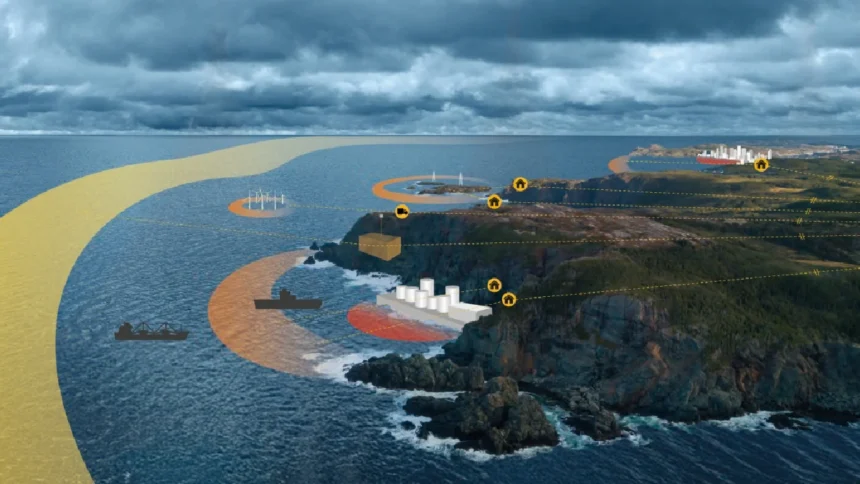
Saab Ocean Barrier Targets Maritime and Underwater Threats
Swedish defense company Saab has introduced Ocean Barrier, an integrated underwater surveillance system designed to help governments and maritime operators monitor underwater activity around ports, naval bases, coastlines and offshore infrastructure.
The system combines sensor data, surveillance functions and operator capabilities within a connected architecture. Saab says Ocean Barrier is intended to provide persistent maritime awareness, allowing operators to detect, track and analyze underwater activity across large maritime areas.
The launch addresses a growing security challenge for countries that depend on ports, subsea infrastructure and offshore installations. Monitoring these environments requires more than individual sensors because operators must also correlate information, identify potentially suspicious activity and share relevant data with command systems.
Saab has positioned Ocean Barrier as a scalable solution that can be configured for individual facilities or broader maritime surveillance requirements.
Three Defensive Layers Define the System
Ocean Barrier uses three defensive perimeters, identified by Saab as Detect, Prevent and Protect. According to the company, these components can operate independently or as part of a larger integrated system, depending on the operational environment.
The architecture is intended to accommodate different security requirements, from monitoring a single harbor or naval installation to overseeing larger coastal areas and national waters.
Saab also describes the system as sensor-agnostic, meaning it is designed to integrate information from different sensor types and existing surveillance networks rather than relying exclusively on a single proprietary sensor family.
This approach could help operators combine existing infrastructure with additional surveillance capabilities as their requirements change. However, Saab’s announcement does not identify the full range of compatible sensors, provide detailed detection specifications or disclose the system’s pricing.
The company has also not publicly detailed the specific response mechanisms associated with each of the three defensive perimeters. The available information therefore establishes the system’s broad architecture but does not provide enough detail to assess the performance of each layer independently.
REPMUS 2026 Demonstration Focused on Data Integration
Saab demonstrated Ocean Barrier at REPMUS 2026, an international exercise and development event focused on maritime unmanned systems.
According to Saab, the system successfully integrated data from different sensor systems and autonomously transferred tracked objects to the exercise’s central command system using a NATO-standard protocol.
The demonstration is relevant because underwater surveillance depends on the ability to move information between sensors, operators and command networks.
A sensor may detect an object or activity, but that information becomes more useful when other systems can receive it, correlate it with additional observations and incorporate it into a wider operational picture.
The reported demonstration provides evidence that Saab tested Ocean Barrier’s data integration and automated information-sharing functions in an exercise environment. It does not, by itself, establish how the system performs during prolonged real-world surveillance, in difficult underwater conditions or against sophisticated attempts to evade detection.
Saab has not disclosed detailed test results, detection distances, false-alarm rates or the number and types of sensors used during the demonstration.
Protecting Critical Maritime Infrastructure
Ports, naval bases and offshore installations rely on secure maritime access and the protection of infrastructure extending below the waterline. Subsea cables, pipelines and other underwater assets can be difficult to monitor continuously because conventional surface surveillance does not provide a complete picture of activity beneath the sea.
An integrated underwater surveillance system can help address this gap by bringing information from different sources into a shared monitoring environment.
For naval installations, such capabilities could support the monitoring of harbor approaches and restricted waters. At commercial ports, they could contribute to security operations around sensitive infrastructure. Offshore operators could also use underwater monitoring to improve awareness around installations, although the specific configurations required would depend on local conditions and security needs.
Saab’s announcement does not identify a confirmed customer, operational deployment or procurement contract for Ocean Barrier. The company has also not disclosed a delivery schedule or an initial production order.
The system’s practical value will therefore depend on how it is configured, the sensors available to operators and the effectiveness of its integration with existing security and command arrangements.
Modular Architecture Supports Future Integration
Saab says Ocean Barrier uses a modular and cyber-secure architecture designed to accommodate new sensors, technologies and analytical capabilities as requirements evolve.
Modularity can be useful in maritime security because surveillance networks often combine equipment introduced at different times. Integrating additional sensors and analytical tools without replacing the entire system could allow operators to expand coverage or adapt to emerging threats.
Cybersecurity is another important consideration. Connected surveillance systems depend on reliable data exchange, making the protection of communications, software and operator networks an important part of overall system security.
However, Saab has not published detailed information about Ocean Barrier’s cybersecurity controls, communications architecture or resilience against electronic and cyber attacks. The company’s description of the system as cyber-secure should therefore be understood as a manufacturer claim rather than an independently verified assessment of its security performance.
The same distinction applies to its broader surveillance capabilities. The announcement describes the intended functions and architecture, but it does not provide enough technical data to establish detection performance, operational endurance or effectiveness against specific underwater threats.
What Ocean Barrier Could Mean for Maritime Security
Ocean Barrier reflects an approach to underwater surveillance that emphasizes the integration of sensors and command systems rather than treating each sensor as a separate capability.
For potential customers, that approach could offer a way to connect existing surveillance assets while adding capabilities as operational needs change. The ability to transfer tracked objects automatically to a central command system may also help reduce the need for manual information exchange between otherwise separate systems.
Nevertheless, integration alone does not guarantee effective protection. Operational results will depend on sensor coverage, data quality, the ability to distinguish relevant activity from normal maritime traffic, and the procedures used to investigate and respond to alerts.
The REPMUS 2026 demonstration offers an initial indication of Ocean Barrier’s ability to connect sensor data and share tracked objects with a central command system. Publicly available information does not yet establish its performance in operational deployments or identify the customers that may adopt it.
For now, Saab has introduced a modular underwater surveillance architecture aimed at improving maritime awareness. Its broader significance will depend on future customer decisions, disclosed technical performance and evidence of how the system operates outside an exercise environment.