U.S. Secretary of War Pete Hegseth has welcomed Air Force Brig. Gen. Melissa S. Cunningham back into military service, reversing a career interruption linked to the Pentagon’s former COVID-19 vaccination requirement.
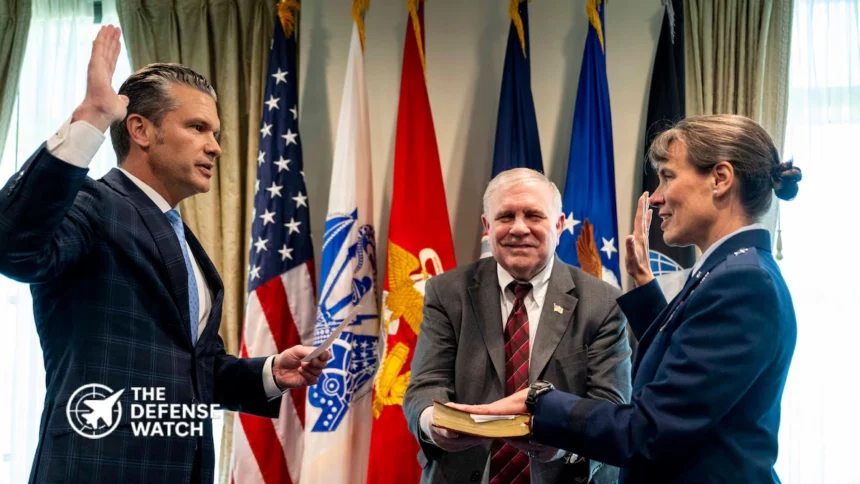
Cunningham, a 26-year military veteran, was sworn back into the Air Force during a ceremony at the Pentagon, according to the Department of War. She had retired in 2022 after declining to receive the COVID-19 vaccine when it was mandatory for U.S. service members. The ceremony was reported by Pentagon News on October 23, 2026.
Her return is part of a wider Trump administration effort to reinstate military personnel who left the armed forces after refusing the vaccine. The policy raises questions about how the military restores experienced personnel, reviews previous separation decisions and manages the administrative consequences of reversing those decisions.
From early retirement to active service
The Pentagon’s COVID-19 vaccination requirement took effect in August 2021. The department subsequently separated thousands of service members who did not comply, while other personnel left the military under circumstances connected to the policy.
Cunningham’s retirement in 2022 occurred during that period. Her reinstatement now brings a senior officer with more than two decades of military experience back into the Air Force.
During the swearing-in ceremony, Hegseth praised Cunningham for maintaining her position despite the professional consequences. His remarks framed her return as part of the administration’s effort to restore personnel whose careers were interrupted by the previous vaccination policy.
The distinction between returning to service and restoring an entire career is important. Reinstatement can address an officer’s employment status, but the available public reporting does not establish Cunningham’s new assignment, expected duties, promotion prospects or precise position within the Air Force’s leadership structure.
The Pentagon has also not publicly detailed the full administrative arrangements governing her individual return.
The policy behind the reinstatement
President Donald Trump signed Executive Order 14184, titled Reinstating Service Members Discharged Under the Military’s COVID-19 Vaccination Mandate, on January 27, 2025.
The order established a process for eligible former service members who had been discharged for refusing the vaccine to request reinstatement. The administration also outlined provisions for restoring former rank and providing back pay and benefits to qualifying personnel.
The order followed the repeal of the military’s COVID-19 vaccine mandate in January 2023. Congress had directed the Pentagon to rescind the requirement through the fiscal 2023 National Defense Authorization Act.
However, ending the mandate did not automatically return former personnel to military service. Individuals still had to pursue the relevant administrative process, and the services had to handle personnel records, eligibility and the practical arrangements for bringing people back.
In May 2026, the Department of War announced the creation of a COVID-19 Reinstatement and Reconciliation Task Force to coordinate those efforts. The department said nearly 170 service members had been reinstated or re-accessed by April 2026, while more than 800 additional former personnel had expressed interest in returning. It also set April 1, 2027, as the deadline for individuals to take advantage of the reinstatement policies, subject to the applicable requirements.
Cunningham’s return is a prominent example of the program involving a general officer rather than only enlisted personnel or junior officers.
What Cunningham’s return means for Air Force personnel policy
The immediate significance of Cunningham’s reinstatement is personnel-related rather than operational.
The Air Force invests substantial time and resources in developing experienced officers. Returning a senior officer can preserve institutional knowledge, but the practical value depends on the individual’s qualifications, assignment, remaining service eligibility and the needs of the force.
For a general officer, those considerations extend beyond basic staffing. Senior officers may bring experience in command, planning, personnel management and organizational decision-making. However, the Pentagon has not released enough information about Cunningham’s career history or new assignment to assess how her return will affect specific Air Force operations.
Her case also illustrates the difference between reversing an individual separation and evaluating the wider effects of a personnel policy.
The reinstatement initiative requires the services to process requests, review records and determine the appropriate administrative treatment of returning personnel. Depending on the circumstances, this can involve rank, benefits, back pay and the correction of records associated with the original separation.
The department’s May 2026 announcement specifically addressed reviews of former service members who had voluntarily left the military but believed that actions related to the vaccination requirement had effectively ended their careers. Those cases are subject to individual review rather than automatic reinstatement.
The readiness question extends beyond headcount
The administration has presented the reinstatement effort as a way to recover military experience lost under the former mandate.
That objective is relevant to a force that must recruit, train and retain personnel across multiple specialties. Experienced officers and enlisted personnel can take years to replace, particularly when their roles require extensive operational knowledge or specialized training.
Nevertheless, the number of people returning does not, by itself, establish a measurable improvement in military readiness.
Assessing the program’s impact would require information about the personnel who return, their specialties, the positions they fill, the time needed to restore their qualifications and the costs associated with reinstatement. Publicly available figures do not yet provide a complete assessment of those factors.
Cunningham’s return also should not be treated as evidence that the Air Force has changed its broader standards for medical readiness. The reinstatement program concerns personnel affected by the former COVID-19 vaccination requirement. Other service obligations and applicable military policies remain separate questions.
The case is therefore best understood as part of a wider personnel and administrative process, not as evidence of a specific change in combat capability.
What remains unclear
Several details about Cunningham’s reinstatement remain unconfirmed in the available public reporting.
The Pentagon has not provided a comprehensive public account of her new duties, the terms of her return or the extent to which her military records and benefits have been restored. It is also unclear whether her reinstatement will lead to a new operational or staff assignment.
Those details matter when evaluating the practical consequences of returning a senior officer to active service.
The broader program will be easier to assess as the military services publish more information about completed reinstatements, personnel outcomes and the number of eligible former service members who ultimately return.
For now, Cunningham’s case demonstrates that the administration’s policy is reaching senior military personnel whose careers were interrupted by the former vaccine requirement. Its wider effect on Air Force staffing and readiness will depend on how the reinstatement process develops and how returning personnel are employed.