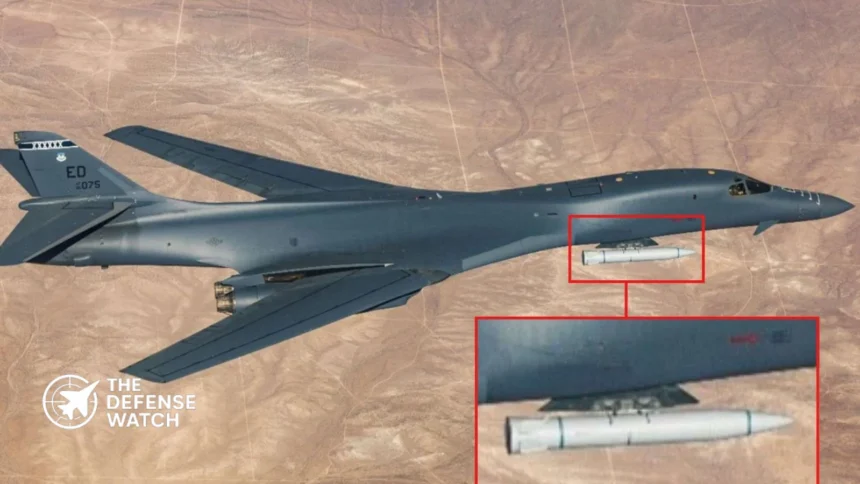
Boeing has completed a critical design review of its Load Adaptable Modular (LAM) pylon for the U.S. Air Force’s B-1B Lancer bomber, moving the external weapons carriage program closer to hardware production, aircraft integration and testing.
Announced on November 17, 2026, the milestone advances an effort to restore the bomber’s ability to carry weapons externally while expanding its capacity for future long-range strike missions. Boeing says the system could potentially double the B-1’s payload capacity and support advanced munitions, including hypersonic weapons.
The development is particularly relevant to the Air Force’s plans to preserve the B-1B’s conventional strike capability while preparing for the introduction of the B-21 Raider.
However, completing the design review does not mean that the aircraft has received operational approval to carry hypersonic missiles. Further engineering, integration and flight testing remain necessary.
Six Existing Hardpoints Provide the Foundation
The LAM pylon is designed to use six existing external hardpoints beneath the B-1B’s fuselage. These attachment points were originally intended to accommodate the AGM-86 Air-Launched Cruise Missile (ALCM).
The aircraft was initially designed with external weapons carriage capability, but this function was subsequently removed as the B-1B transitioned to a conventional-only mission under arms control requirements.
Boeing’s proposed arrangement repurposes the legacy mounting infrastructure rather than requiring an entirely new external carriage architecture.
The modular design is intended to accommodate different payload configurations, reducing the need to develop a separate mounting solution for every new weapon.
According to Boeing, the system could support additional advanced munitions and future standoff weapons, giving the Air Force more flexibility when adapting the bomber to changing mission requirements.
This flexibility could be particularly useful for integrating larger weapons that cannot easily be accommodated within the aircraft’s existing internal weapon bays.
From Flight Demonstration to Manufacturing Preparation
The LAM pylon is not an entirely new concept.
The U.S. Air Force’s 412th Test Wing confirmed in August 2024 that a B-1B assigned to the 419th Flight Test Squadron had flown with the modular pylon during testing at Edwards Air Force Base, California.
The original demonstration examined how a modular external mounting system could support different weapons and improve the flexibility of aircraft weapons testing.
The B-1B was selected partly because it was available at Edwards, while the Air Force noted that the pylon concept could potentially be adapted for other aircraft.
Boeing subsequently completed a preliminary design review in May 2026, followed by the critical design review announced on November 17.
The latest milestone establishes a formal system design baseline accepted by the U.S. Air Force B-1 program office. Boeing says the next phase involves preparing hardware and software for manufacturing, integration and testing.
The progression is important because it moves the project beyond preliminary engineering. Nevertheless, the aircraft must still demonstrate that the complete external carriage configuration can operate safely under relevant flight conditions.
Hypersonic Weapons Are a Major Part of the Requirement
One of the most significant potential applications of the LAM pylon is the integration of large hypersonic weapons.
The B-1B offers a combination of long-range reach, high-speed flight and substantial weapons capacity. Restoring external carriage could provide another option for transporting weapons that exceed the practical dimensions or configuration limits of existing internal arrangements.
The AGM-183A Air-Launched Rapid Response Weapon (ARRW) has been associated with the Air Force’s broader hypersonic integration efforts.
The Air Force has previously used the B-52H Stratofortress as a platform for hypersonic weapons testing. A suitably configured B-1B could provide another aircraft for carrying and evaluating large experimental weapons.
However, the distinction between testing and operational deployment is important. Publicly available information does not establish that the B-1B has completed operational certification for the AGM-183A or that the LAM pylon has been cleared for routine hypersonic strike missions.
The pylon is therefore best understood as an enabling component of a wider weapons integration effort, rather than evidence that the B-1B is already equipped with an operational hypersonic strike capability.
The Air Force Is Funding a Wider External Carriage Upgrade
The LAM pylon also fits into a broader U.S. Air Force effort to increase the B-1B’s weapons capacity before the B-21 becomes a fully established combat platform.
The Air Force’s fiscal year 2027 aircraft procurement justification documents identify the effort as the External Heavy-Stores Pylon program.
The documents describe increased external weapons carriage as a way to provide additional strike capacity in the near term and mitigate risks during the transition to the next-generation bomber fleet.
The same budget documentation provides a useful indication of the program’s planned financial scale.
B-1B External Pylons Program
Projected total program obligation authority across the budget years shown, not a single-year award.
The budget document also identifies two principal equipment categories:
- Group A kits: Installation equipment, including aircraft wiring harnesses and associated hardware.
- Group B kits: Load Adaptable Modular equipment pylons.
The Air Force’s planned investment indicates that external weapons carriage is being treated as a broader aircraft modification effort rather than an isolated engineering demonstration.
The service also identifies Extended Multi-Purpose Rotary Launchers (E-MPRLs) among the equipment planned for procurement, reflecting the wider effort to increase weapons employment capacity.
Why the Upgrade Matters Before the B-21 Arrives
The B-1B remains an important component of the U.S. long-range conventional strike fleet.
Although the aircraft entered operational service decades ago, its combination of range, speed and large weapons capacity continues to offer value for missions involving conventional precision weapons and long-range standoff munitions.
The LAM pylon could increase that value by providing additional external carriage options without requiring the Air Force to wait for a completely new bomber platform.
There are three important implications.
First, additional weapons capacity. External carriage could allow the B-1B to transport a greater variety or quantity of weapons, depending on the final configuration and aircraft limitations.
Second, greater weapons flexibility. A modular mounting arrangement could simplify the integration of different payload types, particularly weapons with dimensions that make internal carriage difficult.
Third, reduced transition pressure. The Air Force can use existing bomber infrastructure to preserve and expand strike capacity while the B-21 program progresses toward a larger operational role.
There are also limitations. External weapons can affect aircraft drag, fuel consumption and aerodynamic performance. Structural loading, separation characteristics, flight-control considerations and weapons compatibility must all be evaluated before a new configuration receives operational clearance.
The final number and types of weapons the B-1B will be authorized to carry externally have not been established publicly.
What Remains Before Operational Deployment?
The November 17 milestone advances the design, but several steps remain between the completed review and an operationally available capability.
These include:
- Manufacturing and assembling the external carriage hardware.
- Integrating the required aircraft wiring and associated systems.
- Conducting ground evaluations and structural assessments.
- Performing flight testing with representative external payloads.
- Validating weapon compatibility and safe separation.
- Obtaining the necessary Air Force approvals for operational use.
Boeing has not announced a definitive operational fielding date in its November announcement.
The company has said the pylon could help keep the B-1 relevant through 2040 and beyond. That is a stated program objective, not a guarantee of the aircraft’s eventual service-life extension.
For the Air Force, the central question is how much additional usable weapons capacity can be delivered without imposing unacceptable engineering, maintenance or operational costs.
The LAM pylon provides a route toward restoring a capability that was built into the original B-1 design but subsequently removed. Its eventual value will depend on the weapons it can safely accommodate, the number of aircraft modified and how quickly the system completes testing.
Enjoying our coverage?
Make The Defense Watch a preferred source on Google to see more of our geopolitical and defense insights when relevant to you.