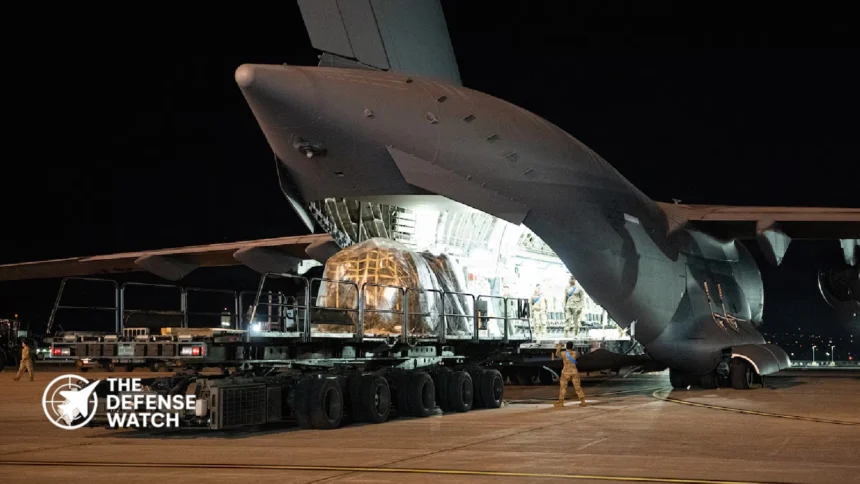
The U.S. Army’s 11th Airborne Division has demonstrated its ability to deploy airborne forces across nearly 3,000 miles of the Pacific without stopping, combining in-flight parachute preparation, airborne insertion and continuous battlefield communications during a major multinational training exercise.
The operation, called Arctic Aloha, took place during Joint Pacific Multinational Readiness Center (JPMRC) Rotation 27-01. Alaska-based paratroopers flew from Joint Base Elmendorf-Richardson to Hawaii, where they conducted a joint forcible entry operation designed to simulate the seizure of critical infrastructure in a contested environment.
The November exercise tested more than the division’s ability to move personnel over long distances. It also examined how airborne forces can remain connected to operational headquarters while moving toward an objective thousands of miles away.
According to the U.S. Army, the operation involved a battalion task force assembled from soldiers flying from Alaska and Japan. The deployment included approximately 300 paratroopers, according to a separate Army report.
In-Flight Rigging Allows Soldiers to Prepare During Transit
One of the central elements of Arctic Aloha was in-flight rigging, a procedure that allows airborne soldiers to put on, adjust and inspect their parachutes and combat equipment after an aircraft has already departed.
Instead of carrying their full parachute and combat equipment throughout the entire journey, soldiers completed these preparations during the flight.
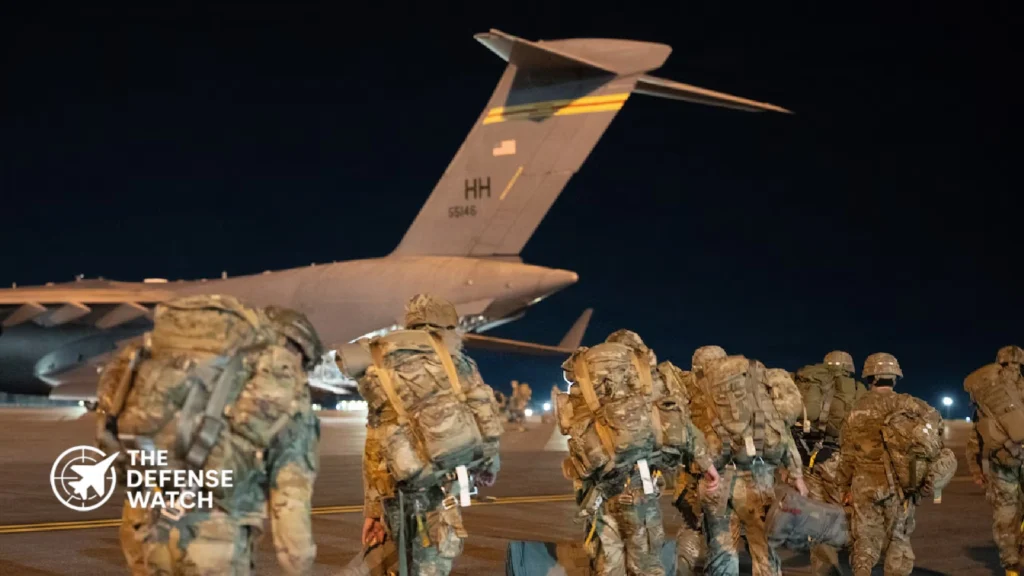
The Army said this approach allowed troops to spend nearly eight hours in flight without carrying the full weight of their parachutes and combat equipment, helping preserve their physical endurance before the jump.
For long-distance airborne deployments, this capability addresses an important operational problem: soldiers must arrive ready to conduct a demanding parachute assault rather than expend much of their physical energy during the journey.
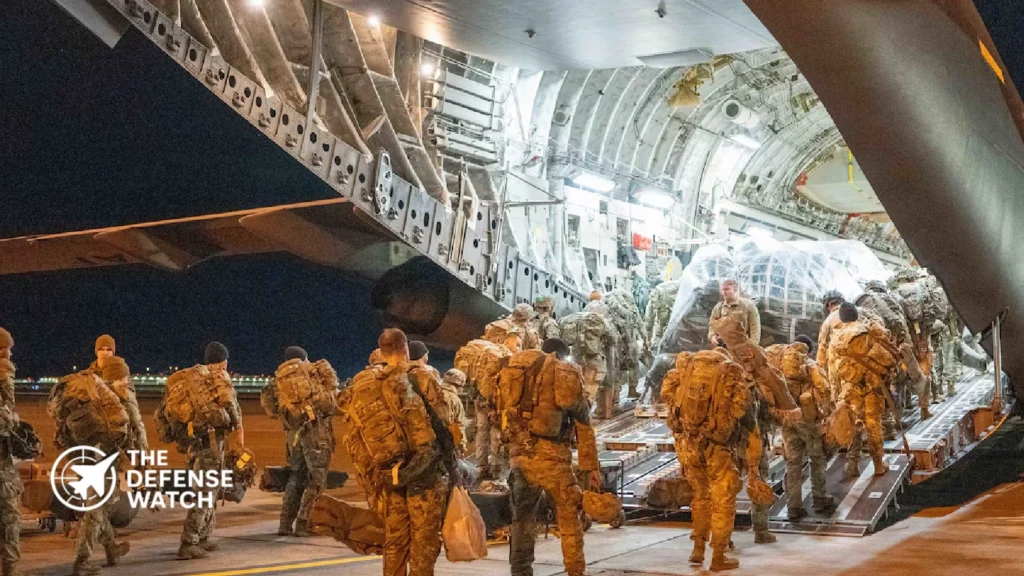
The exercise also involved an unusual coordination requirement. The main body departing Alaska conducted an in-flight link-up with an infantry company arriving from Japan after its participation in Operation Keen Sword.
The two elements then formed a unified battalion task force for the airborne insertion into Hawaii.
Maintaining Mission Command Across the Pacific
The nearly 3,000-mile flight also served as a test of airborne mission command.
During the journey, the 11th Airborne Division maintained a continuous digital connection with I Corps, U.S. Army Pacific headquarters and joint forces monitoring the operation from Joint Base Pearl Harbor-Hickam in Hawaii.
This allowed commanders to monitor the simulated battlefield and coordinate the conditions required for the airborne assault before the aircraft reached its destination.
Col. Matthew Adamczyk, the division’s deputy commanding officer for operations, said the exercise demonstrated the ability to project a battalion task force or larger from Alaska while maintaining links with corps and division headquarters.
This element is particularly relevant to Pacific operations, where military forces may need to move between widely separated islands, operate from limited infrastructure and coordinate with multiple headquarters.
Maintaining communications during transit helps commanders synchronize the arrival of airborne forces with supporting operations already underway in the theater.
However, the Army’s account does not disclose the specific communications equipment, network architecture or resilience measures used during the exercise. It therefore does not establish how the system would perform against sophisticated electronic warfare or communications disruption in an actual conflict.
How the Exercise Applied the Army’s New Warfighting Guidance
Arctic Aloha also provided a practical demonstration of the Army’s operational framework, How the Army Fights, released on October 7, 2026.
Developed under the direction of Army Vice Chief of Staff Gen. Christopher LaNeve, the guidance organizes land power around four connected elements:
- Convergence: Synchronizing effects across multiple domains to create operational advantages.
- Strike: Using lethal and nonlethal fires to degrade enemy capabilities.
- Close Battle: Defeating opposing forces, seizing important terrain and consolidating gains.
- Endurance: Protecting, sustaining and projecting combat power over time and distance.
During Arctic Aloha, I Corps coordinated space, cyber and electronic warfare assets to establish the conditions for the operation.
Meanwhile, theater forces and the 25th Infantry Division conducted simulated strikes against enemy air defenses.
Once those conditions were established, 11th Airborne Division paratroopers entered the close battle through an airborne assault intended to seize important infrastructure and secure the objective area.
The sequence illustrates how the Army intends to connect long-range effects, joint coordination and ground maneuver rather than treating an airborne insertion as an isolated tactical event.
Why the 11th Airborne Division Matters in the Indo-Pacific
The 11th Airborne Division occupies an unusual position within the U.S. Army’s force structure.
Based in Alaska, it is organized to conduct operations in both Arctic and Indo-Pacific environments. Its mission includes expeditionary operations, multidomain activities and large-scale combat operations in extreme cold, mountainous and high-latitude terrain.
The division includes the 1st Mobile Brigade Combat Team (Air Assault), based at Fort Wainwright, and the 2nd Mobile Brigade Combat Team (Airborne), based at Joint Base Elmendorf-Richardson.
Its geographic position gives the Army a force trained to operate in the Arctic while maintaining the ability to deploy into the Pacific theater.
The division’s participation in Arctic Aloha also reflects the growing importance of connecting forces stationed in different countries and operating areas.
The exercise brought together an infantry company returning from Japan and the main body departing Alaska, demonstrating how separately positioned units could assemble into a single operational formation.
For U.S. Indo-Pacific Command, this type of integration is relevant because potential operations across the region may require forces to move between distant staging locations before entering a contested area.
From Tropical Hawaii to Arctic Warfare
The operation was not designed as a one-way deployment demonstration.
Following the Hawaii insertion, the paratroopers were scheduled to return to Alaska and conduct another airborne assault directly into brigade field training at the Richardson Training Area.
The sequence forms part of the division’s preparation for JPMRC 27-02, scheduled for February 2027 at the Donnelly Training Area in interior Alaska.
That upcoming rotation will expose the 2nd Mobile Brigade Combat Team (Airborne) to severe winter conditions, with temperatures in the training area sometimes falling to 40 degrees below zero, according to the Army.
The contrast between Hawaii’s tropical island environment and Alaska’s extreme winter conditions reflects the division’s requirement to operate across different climates and geographic environments.
The Army is also using these training rotations to improve coordination between the 11th Airborne Division, the 25th Infantry Division and other joint-service formations.
What the Deployment Demonstrates, and What It Does Not
Arctic Aloha provides evidence that the 11th Airborne Division can coordinate a long-distance deployment, prepare soldiers for parachute operations during flight and maintain communications with supporting headquarters.
These are important components of expeditionary warfare in the Indo-Pacific, where distance, limited infrastructure and dispersed operating locations create substantial deployment challenges.
However, the exercise should not be interpreted as proof that the Army can conduct an uncontested airborne assault against a fully capable adversary.
The operation used simulated enemy air defenses, with supporting forces tasked with establishing conditions for the insertion. The Army has not publicly disclosed detailed results concerning opposition effectiveness, communications resilience, aircraft survivability or the ability to sustain forces after landing.
These factors remain central to the practical effectiveness of airborne operations in a contested environment.
An airborne force can seize terrain or infrastructure, but its ability to hold an objective depends on follow-on reinforcement, ammunition, medical support, air cover and reliable resupply.
The exercise therefore demonstrates an important part of the Army’s Pacific deployment concept, rather than independently validating the entire process of conducting sustained combat operations across the theater.
For the 11th Airborne Division, the next challenge is demonstrating that the same coordination and deployment capabilities can be maintained across different environments and under increasingly demanding training conditions.
Enjoying our coverage?
Make The Defense Watch a preferred source on Google to see more of our geopolitical and defense insights when relevant to you.