Australia Receives First Two Additional MH-60R Seahawk Helicopters
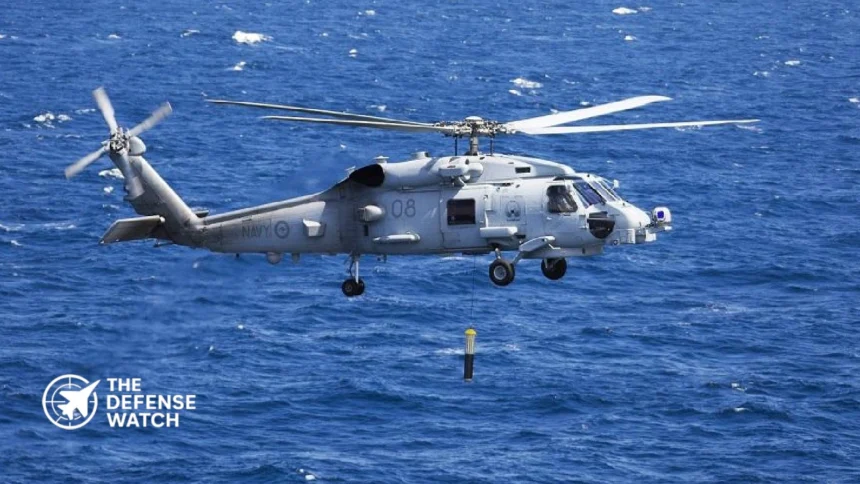
Australia has received the first two helicopters from a new 13-aircraft acquisition of MH-60R Seahawk maritime combat helicopters, beginning an expansion of the Royal Australian Navy’s rotary-wing fleet from 23 to 36 aircraft.
The helicopters arrived at HMAS Albatross in Nowra, New South Wales, on November 19, 2026. According to Australia’s Department of Defence, the delivery is intended to increase the Navy’s capacity to conduct anti-submarine warfare, anti-surface warfare, maritime surveillance and other shipborne aviation missions.
The acquisition is part of Australia’s broader effort to expand naval aviation capacity while maintaining a common fleet of maritime combat helicopters. The additional aircraft will also support operations from amphibious and afloat support vessels, extending the availability of helicopter capabilities beyond the Navy’s existing frigate and destroyer deployments.
Two aircraft begin a 13-helicopter expansion
The two newly arrived helicopters are the first aircraft in the additional 13-unit MH-60R procurement program.
Sikorsky Australia, a Lockheed Martin company, confirmed that the aircraft arrived aboard a Royal Australian Air Force C-17 transport aircraft after completing required flight testing in the United States.
The company identified the helicopters as the first Lot II MH-60R aircraft. They will undergo integration activities before entering Royal Australian Navy service.
The remaining 11 helicopters are scheduled to arrive by early 2028, according to Sikorsky Australia.
The expansion builds on Australia’s original acquisition of 24 MH-60R helicopters, delivered between 2013 and 2016. The current operational fleet stands at 23 aircraft, with the additional procurement also addressing an aircraft lost during operations in October 2021.
Why Australia is expanding its Seahawk fleet
The additional helicopters are being acquired under the Improved Embarked Logistics Support Helicopter project, designated SEA9100 Phase 1.
The project originally covers 12 helicopters for the Navy’s amphibious and afloat support fleet, plus one aircraft to replace the helicopter lost in 2021. This brings the planned fleet to 36 aircraft.
The acquisition addresses a force-structure requirement to provide maritime helicopters across a wider range of naval vessels. Australia’s Defence Department identifies amphibious ships and afloat support vessels as important recipients of the expanded capability.
The larger fleet is intended to support a broader distribution of aviation assets rather than relying exclusively on the existing maritime combat helicopter force.
This matters because shipborne helicopters extend the surveillance and weapons capabilities of surface vessels. They can operate beyond a ship’s immediate sensor horizon, investigate contacts and contribute to the protection of naval formations.
MH-60R Seahawk: Australia’s airborne submarine-hunting capability
The Sikorsky MH-60R Seahawk is a maritime combat helicopter developed for anti-submarine warfare and anti-surface warfare.
Manufactured by Sikorsky, with Lockheed Martin supplying major avionics and mission-system technologies, the aircraft combines radar, sonar, electro-optical sensors and electronic support systems.
Its mission systems allow aircrews to search for submarines and surface vessels, process information and exchange tactical data with other naval units through digital datalinks.
Its principal operational roles include:
- Anti-submarine warfare: Detecting, tracking and engaging underwater threats using airborne acoustic sensors and lightweight torpedoes.
- Anti-surface warfare: Locating and engaging surface vessels using its available weapon systems.
- Intelligence, surveillance and reconnaissance: Collecting and sharing information about maritime activity.
- Search and rescue: Supporting emergency response operations at sea.
- Logistics and personnel transfer: Moving personnel, equipment and supplies between ships and other locations.
The Australian Navy lists the AGM-114 Hellfire missile, Mark 54 lightweight torpedo and Advanced Precision Kill Weapon System among the helicopter’s weapons. Its configuration supports different mission requirements rather than limiting the aircraft to submarine hunting alone.
A wider role across the Australian fleet
The MH-60R is designed to operate from naval vessels, allowing ships to deploy airborne sensors and weapons without relying entirely on land-based maritime patrol aircraft.
Australia operates the helicopter from its Anzac-class frigates and Hobart-class air warfare destroyers. The Navy’s amphibious and afloat support fleet is also part of the expanded aviation requirement.
This arrangement gives naval commanders additional options for maritime surveillance, submarine detection, surface-threat monitoring and support missions.
The helicopter complements Australia’s P-8A Poseidon maritime patrol aircraft, which provides longer-range maritime surveillance and anti-submarine warfare capabilities from land bases. The two platforms serve different operational environments, with the MH-60R providing a deployable aviation capability directly from naval vessels.
Nowra becomes more important to Australia’s naval aviation industry
The fleet expansion also has an industrial dimension.
Australia plans to sustain the enlarged MH-60R fleet through its existing aviation support infrastructure at HMAS Albatross in Nowra, working with Lockheed Martin Australia and Sikorsky Australia.
The Australian Government says the additional acquisition forms part of a $2.5 billion investment in the Seahawk fleet over the decade. It is also expected to support the creation of 75 new skilled jobs in the Shoalhaven region.
The work will involve maintenance, engineering, logistics and supply-chain support.
Local sustainment is particularly important for a helicopter fleet expected to operate across multiple naval deployments. Maintenance capacity, spare-parts availability and technical workforce development all influence how many aircraft can be kept ready for operations.
The existing Australian support arrangement already involves Sikorsky Australia, which provides depot-level maintenance and supply support, alongside other industry partners supporting engines and training systems.
The expansion therefore builds on an established domestic sustainment structure instead of introducing an entirely new helicopter type and associated support system.
What the expansion means for Indo-Pacific operations
Australia’s maritime geography places considerable demands on its naval forces. The country has extensive maritime approaches and maintains operational interests across the Indian and Pacific oceans.
The larger MH-60R fleet will provide additional flexibility for deploying airborne maritime combat capabilities alongside Australian surface vessels.
Anti-submarine warfare is particularly relevant to regional naval operations, where submarines can threaten surface ships, maritime logistics and access to important sea routes.
An embarked MH-60R can help a ship investigate underwater contacts and extend its anti-submarine warfare coverage. Its ability to share sensor information also supports coordination between aircraft and other naval units.
However, increasing the number of helicopters does not automatically translate into an equivalent increase in operational availability. Aircraft readiness depends on trained aircrew, maintenance capacity, spare parts, ship compatibility and the availability of supporting mission equipment.
The expansion should therefore be assessed as a combination of additional aircraft and the resources needed to operate them effectively.
Australia’s growing Seahawk fleet also complements its wider maritime modernization program, which includes new surface combatants, submarine investments and expanded regional cooperation.
The two new aircraft are an initial delivery milestone. The remaining 11 helicopters, the completion of integration work and the development of additional sustainment capacity will determine how quickly the enlarged fleet becomes available for routine naval operations.
Delivery timeline and remaining milestones
The expansion will be implemented in stages rather than through a single delivery event.
| Milestone | Status or schedule |
|---|---|
| First two additional MH-60Rs | Arrived November 19, 2026 |
| Remaining 11 aircraft | Scheduled by early 2028 |
| Initial Operational Capability | December 2026, according to project documentation |
| Final Operational Capability | December 2030, according to project documentation |
The operational milestones are project targets, not confirmation that all 13 additional aircraft will immediately enter service upon arrival.
The delivery of the first two helicopters gives the Royal Australian Navy the beginning of its planned fleet expansion. The next challenge will be integrating the aircraft, maintaining sufficient trained personnel and ensuring that Australia’s naval aviation infrastructure can support the larger fleet.
Enjoying our coverage?
Make The Defense Watch a preferred source on Google to see more of our geopolitical and defense insights when relevant to you.