
- Home
- Defense Systems
- Fighter Jets
- F-15J Eagle Fighter Jet
F-15J Eagle Fighter Jet
Defense Systems Full Specifications
General Information
| Name | F-15J Eagle |
| Manufacturer | Mitsubishi Heavy Industries (licensed production), Original Developer : McDonnell Douglas (now Boeing) |
| Country of Origin | Air superiority fighter / interceptor |
| Type / Role | Air superiority fighter / interceptor |
| Generation | 4th |
| Status | In active service |
| First Flight | 1981 (F-15J) |
| Introduction / In Service Since | 1981 |
| Number Built | Approximately 213 F-15J/DJ aircraft, including US-built examples |
| Operators | Japan Air Self-Defense Force |
Dimensions & Structure
| Length | 19.4 m |
| Wingspan | 13.1 m |
| Height | 5.6 m |
| Wing Area | Approximately 56.5 m² |
| Empty Weight | Approximately 12,700 kg |
| Maximum Takeoff Weight (MTOW) | Approximately 25,000 kg |
| Internal Weapons Bay | No |
| External Hardpoints | 9 conventional stations |
Performance
| Maximum Speed | Mach 2.5 |
| Range | Approximately 4,600 km |
| Combat Radius | Not publicly established |
| Service Ceiling | Approximately 19,000 m |
| Rate of Climb | Approximately 254 m/s (F-15C-family reference) |
| Thrust-to-Weight Ratio | Configuration and loading dependent |
| G Limits | Approximately +9 G |
Powerplant
| Engine Type | Pratt & Whitney F100 afterburning turbofan |
| No. of Engines | 2 |
| Thrust (each) | Approximately 86 kN dry, 104 kN with afterburner |
| Thrust Vectoring | No |
| Fuel Capacity | Configuration dependent, exact figure not established here |
Armament
| Gun | 1 × 20mm M61A1 Vulcan |
| Missiles (Air-to-Air) | AIM-7 Sparrow, AIM-9 Sidewinder, AAM-3, AAM-4 and AAM-5, depending on configuration |
| Missiles (Air-to-Ground) | Limited, configuration dependent |
| Bombs | Compatible with selected external stores and upgraded configurations |
| Hardpoints | 9 conventional stations |
| Payload Capacity | Exact F-15J-specific figure not consistently published |
Avionics & Systems
| Radar | AN/APG-63 family; AN/APG-82(V)1 AESA for JSI upgrades |
| Radar Range | Not publicly disclosed |
| Electronic Warfare (EW) System | Japanese warning and countermeasure systems; AN/ALQ-239 DEWS for JSI |
| Targeting System | Configuration-dependent radar and fire-control systems |
| Helmet Display | Configuration dependent |
| Navigation | Inertial navigation and GPS-supported systems |
| Autopilot / AI Assistance | Conventional flight-control and autopilot systems; no publicly confirmed AI pilot |
| Communication | Military UHF/VHF communication systems |
Stealth & Technology
| Radar Cross Section (RCS) | Not publicly disclosed |
| Stealth Features | No dedicated stealth design |
| Infrared Signature Reduction | No dedicated low-observable infrared system publicly established |
| Sensor Fusion | Improved mission processing in upgraded configurations |
| Networking Capabilities | Modernized tactical communication and data-link capabilities, configuration dependent |
Variants
| Special Export Versions | F-15J, F-15DJ, F-15J MSIP, F-15JSI |
Operational History
| Major Conflicts / Deployments | Domestic air defense and regional air surveillance |
| Notable Operators | Japan Air Self-Defense Force |
| Combat Proven? | No widely documented air-to-air combat victories |
| Mission Types | Air interception, air superiority, airspace defense, training and quick-reaction alert |
Cost & Program
| Unit Cost | Historical production price; current price not publicly established |
| Development Cost | Part of the original US F-15 development program |
| Program Name | F-15J acquisition and Japan Super Interceptor (JSI) |
| Funding Countries | Japan, with US government and industry involvement in modernization |
Additional Information
| Upgrades Planned | JSI radar, mission computer and electronic warfare modernization |
| Future Replacement | F-35A/B and future GCAP fighter program |
| Export Restrictions | US-origin defense technology and Japanese export-control requirements |
| Notable Achievements | Long-standing backbone of Japanese air defense |
| Competitors | Su-35, J-16, Rafale, Eurofighter Typhoon and F-35 |
PROS
- High maximum speed of approximately Mach 2.5.
- Long published flight range of approximately 4,600 km.
- Powerful twin-engine configuration.
- Large air-to-air weapons capacity.
- Upgrade potential through modern radar and electronic warfare systems.
CONS
- Large radar signature compared with modern stealth fighters.
- Original airframe design dates to the 1970s.
- No internal weapons bay or low-observable design.
- Modernization and maintenance can be expensive.
- Older aircraft require continued structural and avionics upgrades.
F-15J Eagle Fighter Jet: Specifications, Cost and Capabilities
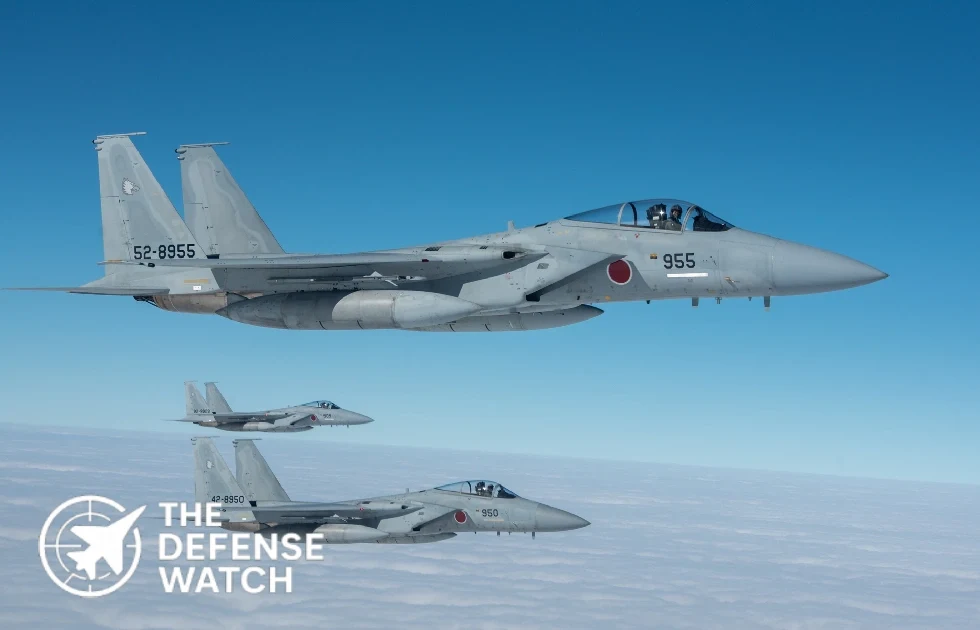
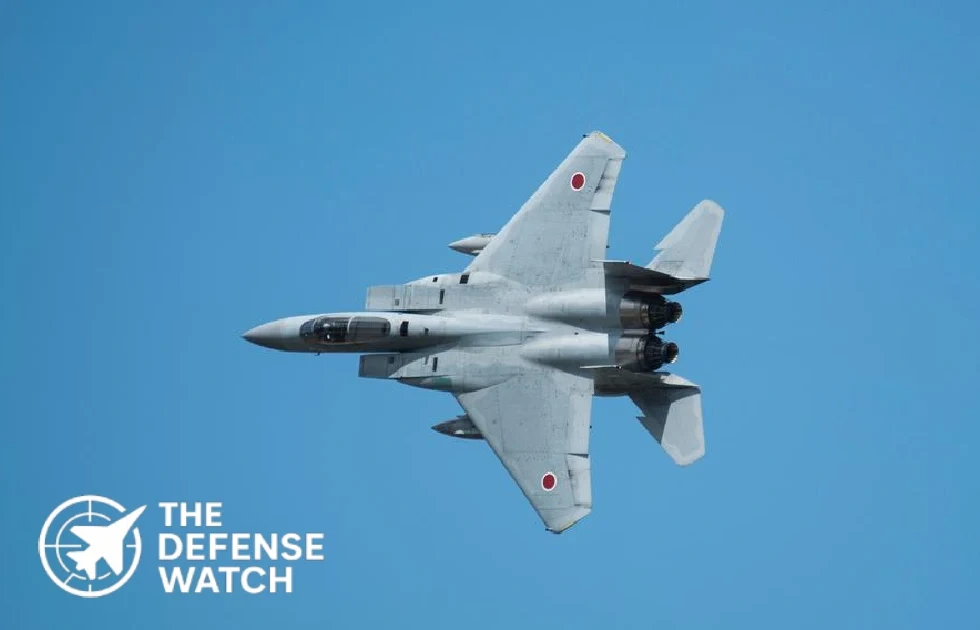
The F-15J Eagle is a twin-engine, supersonic air superiority fighter developed for Japan’s Air Self-Defense Force (JASDF). Based on the American F-15C Eagle, it was introduced to strengthen Japan’s air defense capabilities and protect its national airspace against potential aerial threats.
The aircraft combines high-speed performance, long-range interception capability, and a substantial air-to-air weapons load. Its twin-engine configuration provides strong acceleration and maneuverability, making it suitable for rapid-response missions and sustained air defense operations.
Manufacturer
The F-15J was originally developed by McDonnell Douglas, now part of Boeing, in the United States. Japan selected the aircraft as a replacement for its F-104J fighters. Mitsubishi Heavy Industries (MHI) became the primary Japanese contractor and manufactured most F-15J aircraft under license. The first aircraft was delivered to the JASDF in 1981.
Speed and Range
Powered by two Pratt & Whitney F100 turbofan engines, manufactured under license in Japan by IHI, the F-15J reaches a maximum speed of approximately Mach 2.5. Its published maximum flight range is approximately 4,600 kilometers, although actual mission range depends on fuel, payload, altitude, and flight profile.
Weapons and Technology
The F-15J carries a 20mm M61A1 Vulcan cannon and supports several air-to-air missiles, including AIM-7 Sparrow, AIM-9 Sidewinder, and Japanese-developed AAM-series weapons, depending on configuration.
Its avionics have received successive modernization upgrades. The Japan Super Interceptor (JSI) program introduces the AN/APG-82(V)1 AESA radar, advanced mission computer, and digital electronic warfare equipment. These improvements are intended to strengthen target detection, tracking, electronic protection, and long-range engagement capabilities.
Cost and Price
There is no publicly established current unit price for the F-15J. Its acquisition costs reflect historical production arrangements, while the JSI modernization represents a separate investment in extending the aircraft’s operational usefulness.
The aircraft remains an important component of Japan’s air defense network, particularly for intercepting and identifying foreign military aircraft approaching Japanese airspace. Its continued modernization reflects Japan’s decision to retain capable fourth-generation fighters alongside newer F-35 aircraft.
Variants
| Variant | Description |
|---|---|
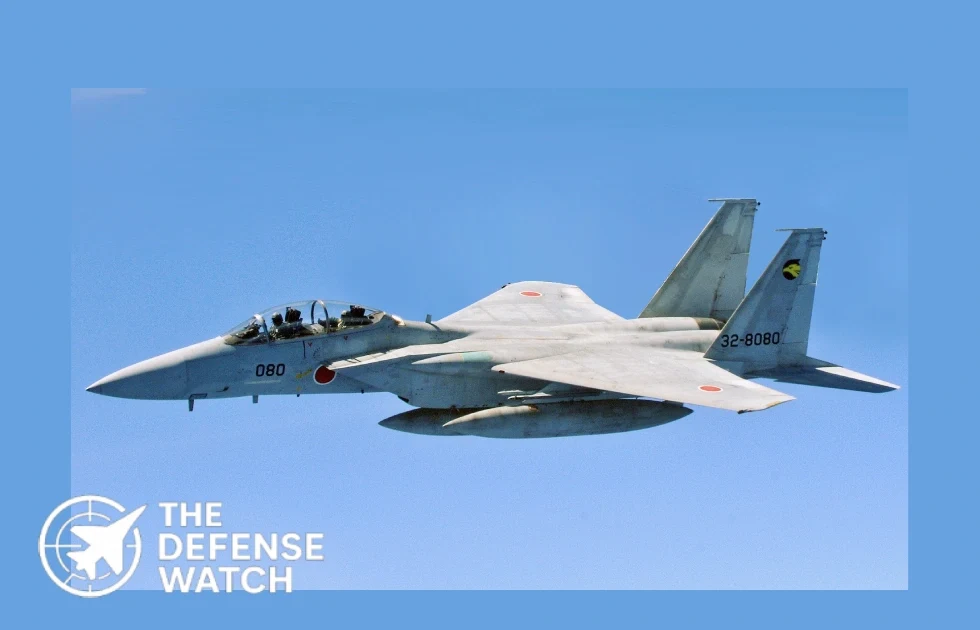
| F-15J | Single-seat Japanese air superiority fighter |
| F-15DJ | Two-seat Japanese training and combat-capable variant |
| F-15J MSIP | Aircraft upgraded under the Multi-Stage Improvement Program |
| F-15JSI | Japan Super Interceptor modernization configuration |
Disclaimer Note
The information provided on TheDefenseWatch.com is for general informational purposes only. While we strive to ensure the accuracy, completeness, and timeliness of our content regarding defense and aerospace products, technologies, and specifications, we cannot guarantee that all information is 100% accurate or up-to-date due to the evolving nature of military technology and classified data.TheDefenseWatch.com does not warrant the reliability, suitability, or availability of the information for any specific purpose. Users are advised to consult official sources, such as manufacturers, government publications, or defense agencies, for precise and verified data before making decisions based on our content.We are not affiliated with any defense manufacturers, governments, or military organizations mentioned. Opinions, reviews, and ratings reflect expert analysis but are subjective and should not be considered endorsements. TheDefenseWatch.com is not responsible for any errors, omissions, or consequences arising from the use of this website’s content.External links are provided for convenience and do not imply endorsement. TheDefenseWatch.com reserves the right to update or modify content without prior notice. By using this website, you agree to our Privacy & Cookies Policy.

New Arrivals












Popular Comparisons
-
 J-10C vs JF-17 Thunder: Which Fighter Is More Capable?
View Comparison →
-
Tejas vs Gripen: Key Differences and Capabilities
View Comparison →
-
Tejas vs MiG-21 Bison: How India Replaced Its Iconic Supersonic Fighter
View Comparison →
-
F-35 vs F-16: Stealth, Sensors and Combat Roles
View Comparison →
-
Tejas Fighter Jet vs F-16 Fighting Falcon: Capability Compared
View Comparison →
-
Rafale Fighter Jet vs F-16 Fighting Falcon : Which Fighter Has the Edge?
View Comparison →
-
Su-57 Fighter Jet vs J-20 Fighter Jet: Stealth and Air Combat Compared
View Comparison →
-
Mirage 2000 vs Tejas Mk1A: Legacy Combat Power vs Indigenous Modernization
View Comparison →
-
Rafale Fighter Jet vs F-22 Raptor: Which Air Dominance Fighter Has the Edge?
View Comparison →
-
Tejas Fighter Jet vs. Rafale Fighter Jet: India’s Indigenous Fighter Meets France’s Proven Multirole Combat Aircraft
View Comparison →


- Lockheed Martin Scales GMLRS Production as U.S. Army Expands Rocket Demand

- Lockheed Martin Links F-35 Simulators With Six Airborne F/A-18s in Training First
- NATO Launches Space Data Marketplace to Expand Allied Intelligence Access
- Raytheon Wins $12.3 Million Contract Modification to Sustain U.S. Navy Rolling Airframe Missile System
- General Dynamics Wins $20.5 Million Navy Contract for AN/BYG-1 Submarine Combat System Software
- V2X Wins $219 Million Bahrain Base Support Contract Extension
- Navy Awards Lockheed Martin $93.2 Million F-35 Sustainment Contract
- Pentagon Launches America’s Corps of Cadets to Expand Military Officer Development
- Pentagon Challenges States to Design America’s Next Military Base
- U.S. Naval Research Laboratory Completes First INSPIRE Field Campaign




Fighter Jets
-
 F-15EX Eagle Fighter Jet
-
F-47A Fighter Jet
-
F-100 Super Sabre
-
North American F-86 Sabre
-
Northrop YF-23 Fighter
-
Rafale F5 Fighter
-
SU-57 Felon Stealth Fighter
-
Boeing F/A-XX Fighter
-
JF-17 Thunder Fighter Jet
-
F-47 Fighter Jet
-
MIG-31 Fighter Jet
-
J-10CE Fighter Jet
-
Chengdu J-10 Fighter Jet
-
Chengdu J-10C Fighter Jet
-
Gripen E Fighter Jet
-
Tejas Mk1A Fighter Jet
-
Tejas Mk‑2 Fighter Jet
-
F-16V Viper Block 70 Fighter Jet
-
F-15EX Eagle II Fighter
-
F-15E Strike Eagle Fighter
-
F/A-18E/F Super Hornet Fighter Jet
-
Saab Gripen F Fighter Jet
-
JAS 39E/F Gripen Fighter Jet
-
JAS 39 Gripen Fighter Jet













Recent Compares
-
J-10C vs JF-17 Thunder: Which Fighter Is More Capable?
View Comparison →
-
Tejas vs Gripen: Key Differences and Capabilities
View Comparison →
-
Tejas vs MiG-21 Bison: How India Replaced Its Iconic Supersonic Fighter
View Comparison →
-
F-35 vs F-16: Stealth, Sensors and Combat Roles
View Comparison →
-
Tejas Fighter Jet vs F-16 Fighting Falcon: Capability Compared
View Comparison →
Latest Defense Systems
10 Compares Defense Systems
-
J-10C vs JF-17 Thunder: Which Fighter Is More Capable?
View Comparison →
-
Tejas vs Gripen: Key Differences and Capabilities
View Comparison →
-
Tejas vs MiG-21 Bison: How India Replaced Its Iconic Supersonic Fighter
View Comparison →
-
F-35 vs F-16: Stealth, Sensors and Combat Roles
View Comparison →
-
Tejas Fighter Jet vs F-16 Fighting Falcon: Capability Compared
View Comparison →
-
Rafale Fighter Jet vs F-16 Fighting Falcon : Which Fighter Has the Edge?
View Comparison →
-
Su-57 Fighter Jet vs J-20 Fighter Jet: Stealth and Air Combat Compared
View Comparison →
-
Mirage 2000 vs Tejas Mk1A: Legacy Combat Power vs Indigenous Modernization
View Comparison →
-
Rafale Fighter Jet vs F-22 Raptor: Which Air Dominance Fighter Has the Edge?
View Comparison →
-
Tejas Fighter Jet vs. Rafale Fighter Jet: India’s Indigenous Fighter Meets France’s Proven Multirole Combat Aircraft
View Comparison →
- Lockheed Martin Scales GMLRS Production as U.S. Army Expands Rocket Demand
- Lockheed Martin Links F-35 Simulators With Six Airborne F/A-18s in Training First
- NATO Launches Space Data Marketplace to Expand Allied Intelligence Access
- Raytheon Wins $12.3 Million Contract Modification to Sustain U.S. Navy Rolling Airframe Missile System
- General Dynamics Wins $20.5 Million Navy Contract for AN/BYG-1 Submarine Combat System Software