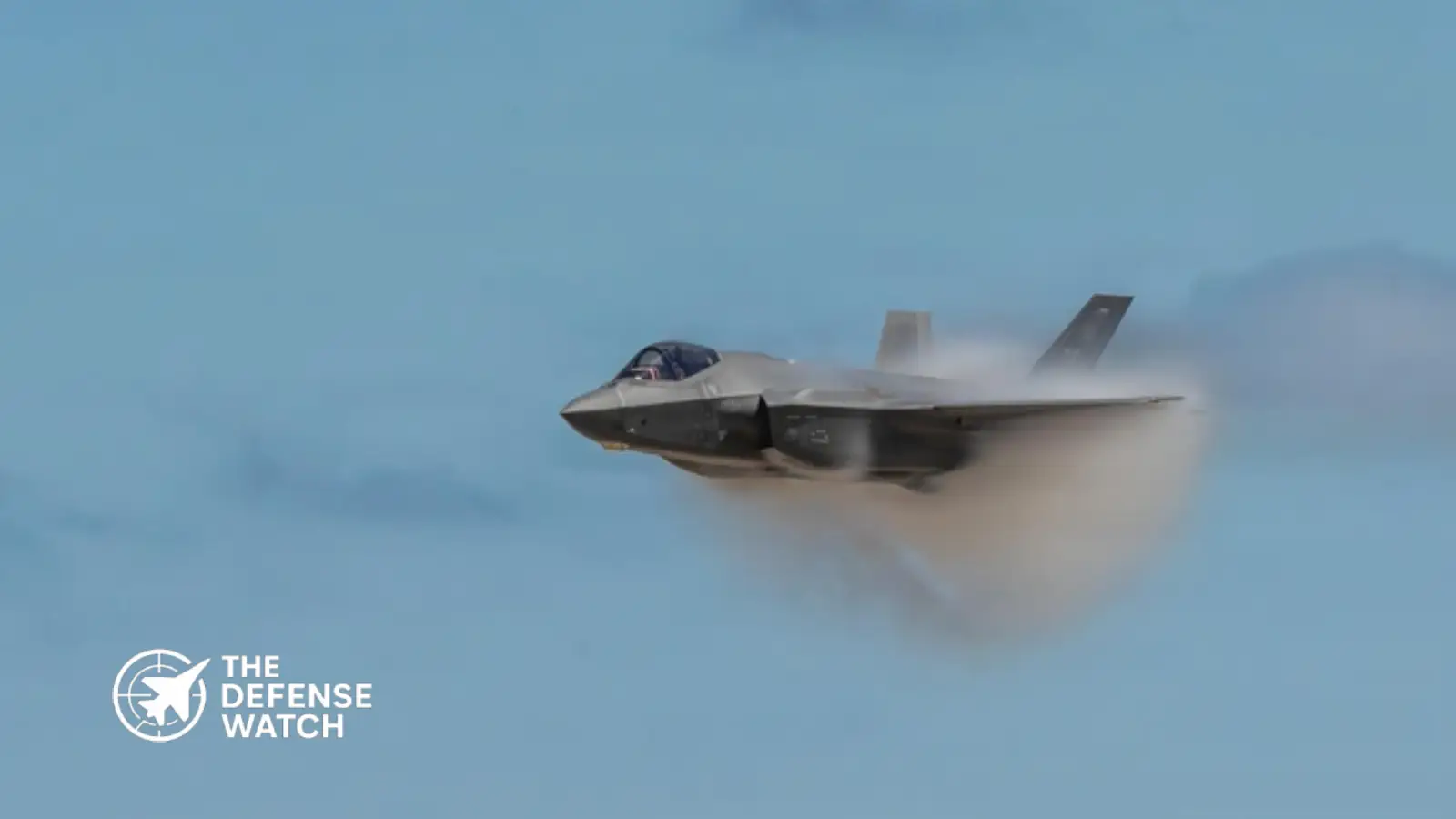
The U.S. Navy has awarded Lockheed Martin a $93.2 million contract order to strengthen maintenance, avionics testing and specialized repair capabilities for the F-35 Lightning II fleet, with work scheduled to continue through January 2030.
The order, issued through Naval Air Systems Command (NAVAIR), covers new avionics test equipment, software updates for electronic warfare subsystem support, cybersecurity improvements and additional repair capacity for selected aircraft components.
The award is intended to support F-35 operations across the U.S. Air Force, Navy and Marine Corps, as well as international participants in the multinational fighter program.
Lockheed Martin Corp., based in Fort Worth, Texas, received the $93,246,155 order under an existing basic ordering agreement, N0001924G0010. The new order carries the designation N0001927F1052 and was not competitively procured.
What the $93.2 Million Contract Covers
Rather than financing new aircraft production, the contract focuses on the infrastructure needed to maintain and restore existing F-35 systems.
Its scope includes several specialized equipment and maintenance activities:
- Panoramic Cockpit Display Electronics Unit test sets: Equipment supporting testing and maintenance of the aircraft’s panoramic cockpit display electronics.
- Communication, Navigation, and Identification Processor test program sets: Updated testing capabilities for systems associated with aircraft communications, navigation and identification.
- Phase Two electronic warfare subsystem operating system upgrades: Software-related work supporting the electronic warfare subsystem.
- Air Interceptor System Golden units: Specialized reference or test units included in the contract’s equipment package.
- Ejection seat repair capacity: Expansion of specialized repair capabilities for aircraft ejection seats.
The order also includes engineering services, program management, technical documentation, planning, readiness reviews and introduction-to-service support.
These activities are important because maintaining a sophisticated combat aircraft involves more than replacing damaged components. Depot facilities must also be able to diagnose faults, validate repaired equipment and confirm that systems meet required operating standards before returning them to service.
The contract announcement does not disclose the number of test sets, the specific cybersecurity vulnerabilities being addressed or the expected increase in repair throughput.
Why Avionics Testing and Depot Capacity Matter
The F-35 combines flight controls, communications, navigation, electronic warfare and mission systems within an integrated aircraft architecture.
That integration creates demanding maintenance requirements. A problem affecting an individual electronic component can require specialized diagnostic equipment and technical support before maintainers can determine whether the component can be repaired or needs replacement.
Dedicated test equipment allows depot personnel to evaluate individual systems outside the aircraft. Updated test program sets provide the procedures and software needed to conduct those checks as aircraft configurations and subsystem software evolve.
The panoramic cockpit display electronics are particularly relevant to the aircraft’s broader avionics architecture.
According to L3Harris Technologies, the Panoramic Cockpit Display Electronics Unit is among the advanced processing components associated with the F-35 Technology Refresh 3 program.
The display electronics support the aircraft’s large panoramic cockpit display, which provides pilots with mission and aircraft information.
However, the Navy’s new contract should not be interpreted as a separate aircraft modernization or a new TR-3 production award. Its stated purpose is to provide testing, maintenance and related support capabilities for depot operations.
The electronic warfare operating system work also deserves attention. The contract identifies Phase Two upgrades, but does not provide enough technical detail to establish whether these involve new threat libraries, additional electronic attack functions or changes to the aircraft’s operational electronic warfare performance.
The distinction matters because software maintenance and operational capability enhancements are not necessarily the same activity.
F-35 Sustainment Remains a Readiness Challenge
The award comes as the F-35 program continues to face pressure to improve aircraft availability and control long-term maintenance costs.
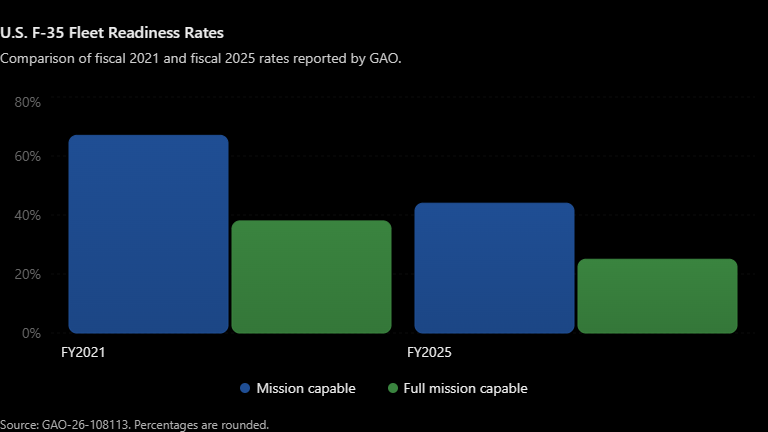
A June 2026 report by the U.S. Government Accountability Office (GAO), titled F-35 Sustainment: Actions Needed to Ensure Updated Strategy Improves Persistent Readiness Challenges, identified continuing problems with aircraft readiness, spare parts availability and industrial repair capacity.
According to GAO, the U.S. F-35 fleet’s mission-capable rate declined from 67% in fiscal 2021 to 44% in fiscal 2025.
The full mission-capable rate, which measures the percentage of time aircraft can perform all their assigned missions, fell from 38% to 25% over the same period.
GAO also reported that the F-35 Joint Program Office had introduced a revised sustainment strategy, known as the Global Support Solution Reset.
The initiative requires an estimated $13.7 billion in additional funding through fiscal 2031 compared with previous plans. It is intended to address persistent problems involving spare parts, maintenance processes and contractor dependence.
One of its priorities is expanding depot-level component repair capacity and improving the speed at which repaired parts become available to operational units.
Lockheed Martin’s latest order addresses several related areas, particularly avionics testing and specialized component repair.
However, the contract alone does not establish how much it will improve overall fleet readiness. Its contribution will depend on the equipment being delivered, the availability of trained maintenance personnel and the ability of depot facilities to integrate the new capabilities into existing operations.
Five Locations Will Support the Work
The contract distributes work across five locations in the United States and the United Kingdom.
| Work location | Share of work |
|---|---|
| Malabar, Florida | 63% |
| Nashua, New Hampshire | 23% |
| San Diego, California | 7% |
| Guildford, United Kingdom | 6% |
| Cherry Point, North Carolina | 1% |
Malabar accounts for the largest share, followed by Nashua. Together, the two locations represent 86% of the contracted effort.
The inclusion of Guildford also reflects the international industrial participation associated with the F-35 program.
The order provides support for the U.S. military services and F-35 cooperative program partners, meaning the maintenance and technical support effort extends beyond a single U.S. service.
Funding and Contract Schedule
The Navy announcement identifies three funding sources, with the full contract amount obligated at the time of award.
| Funding source | Amount |
|---|---|
| FY2026 Air Force aircraft procurement | $41,033,354 |
| FY2026 Navy aircraft procurement | $41,033,350 |
| F-35 cooperative program partners | $11,179,451 |
| Total | $93,246,155 |
The contract combines cost-plus-fixed-fee and firm-fixed-price elements. It was placed under an existing basic ordering agreement and was not competitively procured.
Work is expected to continue until January 2030.
Naval Air Systems Command, headquartered in Patuxent River, Maryland, is the contracting activity.
For Lockheed Martin, the order adds another sustainment responsibility within a program that depends on a large international network of suppliers, maintenance facilities and technical support organizations.
For the Pentagon, the more immediate objective is improving the ability to test, repair and return aircraft components to service.
The broader challenge remains whether investments in depot infrastructure, repair capacity and technical support can translate into measurable improvements in F-35 availability as the fleet continues to expand.
Enjoying our coverage?
Make The Defense Watch a preferred source on Google to see more of our geopolitical and defense insights when relevant to you.