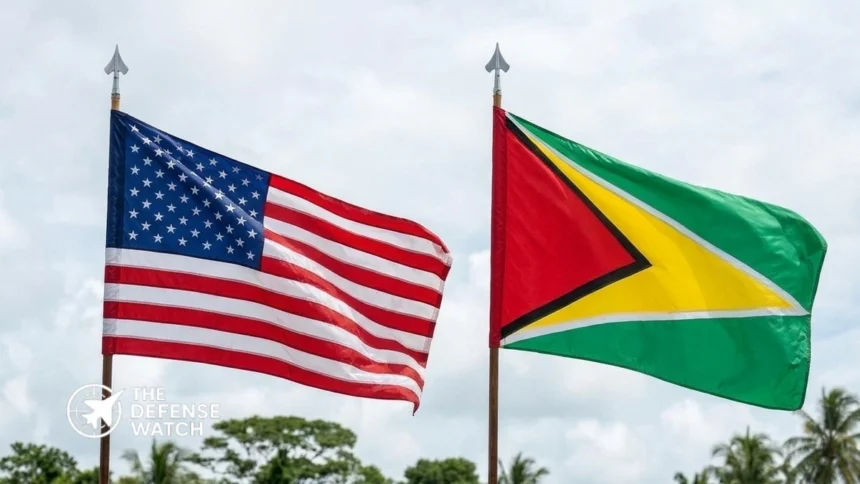
The United States and Guyana have agreed to deepen military cooperation, expanding plans for joint training, airspace awareness and security operations as Georgetown seeks to strengthen its ability to protect national territory and offshore economic interests.
U.S. Secretary of War Pete Hegseth and Guyanese President Mohamed Irfaan Ali signed a joint declaration establishing an enhanced defense partnership at the Pentagon on Oct. 21, 2026, according to the U.S. Department of War and Guyanese media reports. The agreement builds on an existing security relationship rather than creating a wholly new military alliance.
The announcement identifies several areas for closer cooperation, including multidomain military training, interoperability between the two countries’ armed forces and efforts to counter narcotics trafficking and related security threats.
The declaration sets a broader direction for cooperation, but the publicly available reporting does not establish a new permanent U.S. military presence in Guyana, a specific arms purchase, or a defined schedule for delivering additional equipment.
What the new partnership covers
According to reporting by Guyana’s National Communications Network, the declaration commits Washington to providing defense expertise, multidomain training and combined exercises with the Guyana Defence Force. It also identifies improved air-domain awareness as an objective.
These priorities address different but connected security requirements.
- Military training: Combined exercises can improve coordination, planning and the ability of U.S. and Guyanese personnel to operate together.
- Air-domain awareness: Better surveillance and information sharing could help Guyana identify and track activity in and around its airspace.
- Counter-narcotics operations: Cooperation is intended to strengthen responses to trafficking networks and other transnational criminal threats.
- Defense expertise: U.S. assistance could support institutional development and improvements to Guyana’s operational planning and security capabilities.
The precise systems, funding arrangements, training schedules and implementation milestones have not been established by the reporting available for this article. The declaration should therefore be understood as a framework for closer cooperation, not evidence that every proposed capability is already operational.
Hegseth also linked the partnership to wider U.S. efforts to coordinate regional security initiatives. Guyana has participated in U.S.-led efforts to improve cooperation against transnational criminal organizations, giving the military declaration a broader regional context.
Why Guyana is a priority for Washington
Guyana’s location on the northern coast of South America gives it importance for Caribbean security, maritime surveillance and regional defense cooperation. Its growing offshore oil and gas sector has also increased the economic importance of protecting its maritime approaches and exclusive economic zone.
Guyana’s government has already identified maritime monitoring as a priority. In March 2026, President Ali said his government was discussing with the United States and other partners the development of systems to monitor and protect the country’s exclusive economic zone. He also cited the cost of the required infrastructure.
The new declaration provides a wider framework in which those discussions could advance. Better coordination between air and maritime surveillance, intelligence sharing and military response capabilities could help Guyana identify security incidents more effectively. However, the declaration does not by itself confirm that a particular surveillance network, radar system or patrol aircraft will be acquired.
The country’s security concerns also include its long-running territorial dispute with Venezuela over the Essequibo region. Guyana has sought international support for its sovereignty and territorial integrity, while maintaining defense relationships with several partners, including the United States, the United Kingdom, Brazil and Colombia.
The partnership’s practical value will depend partly on how effectively Guyana can turn training and technical cooperation into sustained national capabilities. Surveillance equipment requires trained personnel, maintenance, reliable communications and systems that allow authorities to act on the information they receive.
From bilateral cooperation to regional security
The agreement also fits into Washington’s wider effort to coordinate security cooperation across Latin America and the Caribbean.
Hegseth referred to narcoterrorism and military influence from outside the Western Hemisphere as shared concerns. He also connected the partnership to the Trump administration’s regional security policy. These statements describe the U.S. government’s strategic rationale, rather than independently demonstrating the scale or immediacy of any particular threat to Guyana.
Guyana’s participation in the U.S.-led Shield of the Americas initiative provides an existing political framework for regional cooperation. The Guyanese government has described its objectives as including action against transnational crime, drug trafficking and related security threats.
The defense declaration may help connect those regional priorities with practical military activities, including exercises, planning and improved coordination between security organizations.
Critical minerals are another element of the relationship. INews Guyana reported that Hegseth discussed Guyana’s pursuit of a memorandum of understanding with the United States on critical minerals, linking the issue to collective security and the defense industrial base. The available reporting does not establish the terms of a completed minerals agreement or identify specific defense production projects arising from it.
That distinction matters because a discussion of shared industrial interests is not the same as a funded procurement program or an established supply contract.
What the declaration does not establish
Despite the expanded language on military cooperation, several important details remain open.
- U.S. military basing: The announcement does not establish that Washington will build or operate a permanent military base in Guyana.
- Weapons procurement: No specific new weapons package, aircraft order, radar contract or naval acquisition is identified in the reporting reviewed.
- Funding: The available reports do not provide a total financial commitment or a detailed division of costs between the two governments.
- Implementation schedule: No comprehensive timetable for exercises, equipment deliveries or capability milestones has been established in the cited reporting.
- Operational commitments: The declaration should not be interpreted as an automatic U.S. commitment to intervene militarily in every future security incident involving Guyana.
These limits do not make the agreement insignificant. They define what can be concluded from the announcement and what still requires further documentation.
For Guyana, the immediate objective is to strengthen its ability to monitor its territory, protect economic interests and respond to security threats. For the United States, closer cooperation offers another way to build regional security relationships and coordinate responses to transnational threats.
The extent of the change will become clearer as both governments publish details about implementation, funding, training activities and any future equipment commitments.