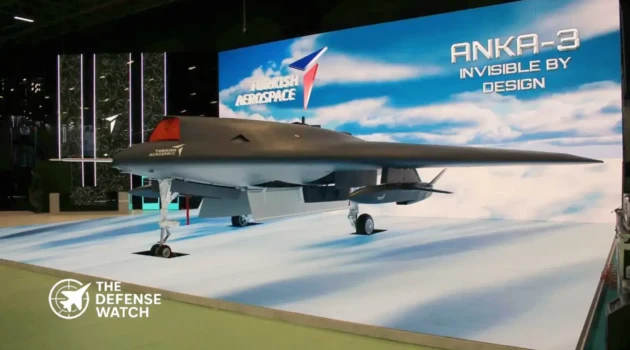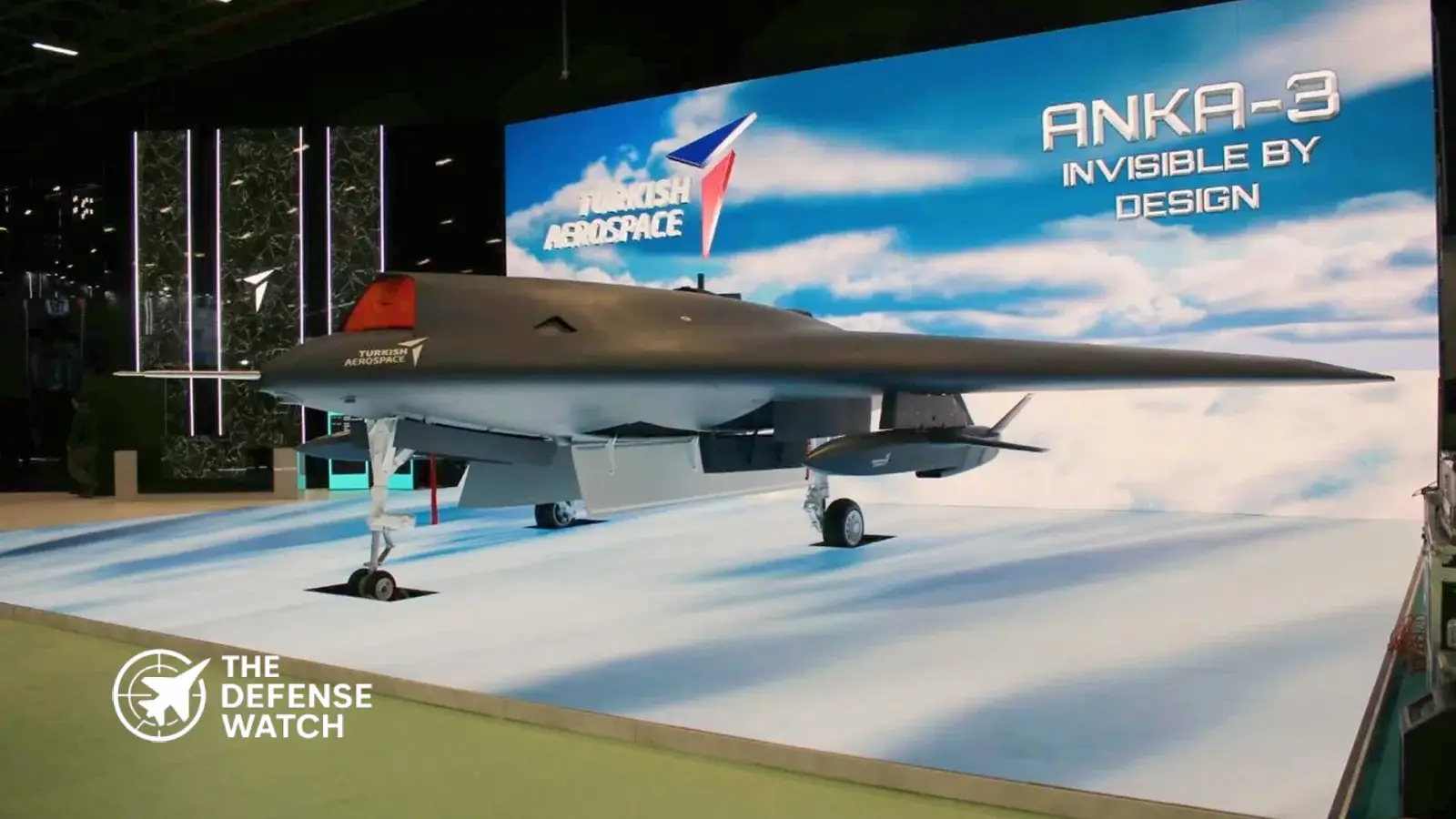
Executive Summary: Türkiye has presented the Anka-3 stealth unmanned combat aerial vehicle (UCAV) carrying two Süper Şimşek strike UAVs at SAHA Expo 2026. Turkish Aerospace Industries (TUSAŞ) showcased the configuration to demonstrate distributed strike capabilities in contested airspace. The system enables the stealthy mothership to remain outside high-threat zones while deploying expendable forward effectors for decoying, jamming, electronic warfare, and precision strikes.
Development and Exhibition Context
Turkish Aerospace Industries displayed a full-scale Anka-3 equipped with two Süper Şimşek UAVs under its wings during SAHA Expo 2026. This presentation highlights Türkiye’s shift toward low-observable, distributed unmanned operations designed for heavily defended airspace.
The Anka-3, a tailless flying-wing UCAV, serves as a mothership capable of launching smaller, expendable effectors. These forward-deployed UAVs can trigger enemy radars, conduct jamming, act as decoys, or execute kinetic strikes, preserving the higher-value Anka-3 platform at safer standoff distances.
This configuration aligns with Türkiye’s broader “Sadık Kanat” (loyal wingman) or OKU (Autonomous Wingman) concept, integrating with platforms such as the TF Kaan fighter and other Turkish UAVs like the Aksungur.
Anka-3 Technical Specifications and Capabilities
The Anka-3 features a low-observable flying-wing design with no vertical stabilizers, reducing radar cross-section while providing internal volume for fuel and weapons. Key specifications include:
- Dimensions: Approximately 7.9–8.9 m length, 12.5–13.1 m wingspan
- Maximum Takeoff Weight (MTOW): 6,500–7,250 kg
- Payload Capacity: 1,200–1,600 kg (internal bays plus external hardpoints)
- Propulsion: Single Ivchenko-Progress AI-322 turbofan (with indigenous TF6000/TF10000 development ongoing)
- Performance: Max speed Mach 0.7, cruise ~250 knots, endurance ~10 hours, service ceiling 40,000 ft (12,000 m)
The platform includes two internal weapon bays and five external hardpoints, allowing operators to balance stealth and payload. It supports ISR, electronic warfare, and strike missions, with satellite communications and autonomous teaming capabilities.
Süper Şimşek Strike UAV Characteristics
The Süper Şimşek evolved from the earlier Şimşek target drone into a multi-role tactical UAV. It is designed for high-subsonic operations as a decoy, jammer, or strike asset.
- Dimensions: ~4 m length, 1.75 m wingspan, 0.75 m height
- MTOW: 200 kg
- Payload: Up to 50 kg (warhead, jammers, signature enhancers, EO/IR sensors)
- Performance: Max speed ~Mach 0.85–0.9, service ceiling 35,000 ft, endurance ~80 minutes, range up to 700–900 km (air-launched)
Payload options include RF/IR signature augmentation to simulate larger aircraft (e.g., fighters), electronic attack modules, and precision seekers for air-to-surface or air-to-air engagements.
Comparison Table
System Range Payload Status Key Technology Anka-3 (with Süper Şimşek) ~700–900 km (effectors); carrier standoff 1,200–1,600 kg (carrier); 50 kg per effector Presented 2026 (prototype/advanced testing) Stealth flying-wing, loyal wingman teaming, distributed EW/strike Legacy Anka/Aksungur (MALE) Limited to permissive airspace Lower per platform, direct carriage Operational Conventional ISR/strike, non-stealth Typical Competitor MALE (e.g., MQ-9 class) Medium-altitude persistence ~1,000+ kg direct Operational Propeller-driven, vulnerable in contested airspace Technical Advantages
- Survivability: Anka-3 remains outside dense SAM engagement zones while effectors penetrate forward.
- Force Multiplication: Two (or more) expendable Süper Şimşek UAVs enable saturation, deception, and suppression of enemy air defenses (SEAD/DEAD).
- Mission Flexibility: Rapid reconfiguration of effector payloads for decoy, jamming, ISR, or kinetic roles.
- Autonomy and Teaming: Supports manned-unmanned teaming (MUM-T) with TF Kaan and other platforms; autonomous release and coordinated operations demonstrated.
- Attritable Cost: Lower-cost effectors preserve high-value stealth UCAV and manned assets.
Strategic Context
The Anka-3/Süper Şimşek combination addresses modern air defense challenges, including integrated air defense systems (IADS) with long-range SAMs, radars, and electronic warfare assets. By emphasizing distributed, attritable effects, Türkiye aligns with broader NATO and global trends toward massed unmanned systems that exhaust expensive interceptor inventories and complicate enemy targeting.
This development enhances Türkiye’s indigenous defense capabilities, reduces reliance on foreign systems, and positions it as a contributor to allied concepts in high-intensity conflict scenarios. Integration with future indigenous engines and advanced sensors will further strengthen operational effectiveness in regional security dynamics.