

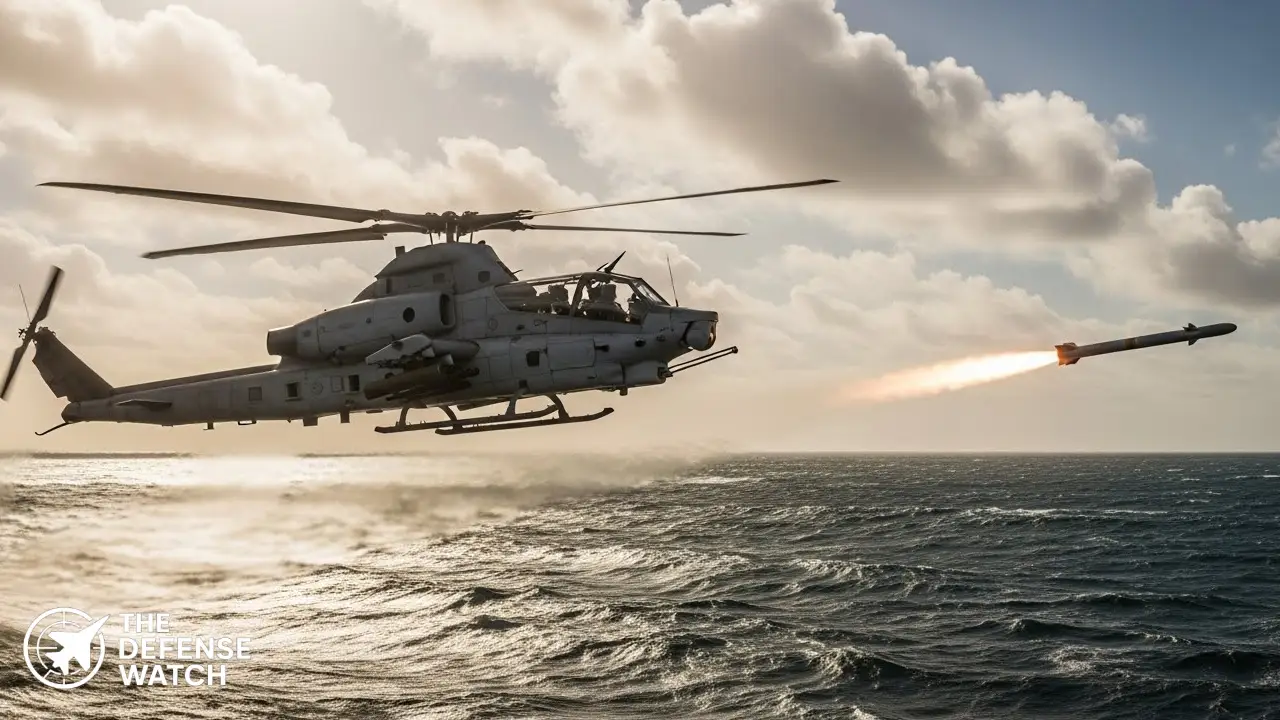
On November 25, 2025, an AH-1Z Viper attack helicopter of the 22nd Marine Expeditionary Unit (22nd MEU) launched an air-to-air missile during a maritime exercise over the Caribbean Sea. The strike — involving an AIM-9 Sidewinder — formed part of U.S. Southern Command’s ongoing Operation Southern Spear, aimed at strengthening regional maritime security and counter-narcotics operations.
Background: AH-1Z Viper and Evolving USMC Mission
The AH-1Z Viper — also known as “Zulu Cobra” — represents the most advanced rotary-wing attack platform in the U.S. Marine Corps’ arsenal. Built for expeditionary and ship-borne operations, the Viper features a four-blade composite rotor system, digital glass cockpit avionics, and modular weapon-pylon architecture that supports 20 mm cannon, unguided rockets, precision-guided missiles such as the AGM-114 Hellfire or JAGM, and, as demonstrated, the AIM-9 Sidewinder air-to-air missile.
Historically, the AH-1Z has focused on close air support, anti-armor, and maritime strike operations — predominantly targeting surface threats. But the Caribbean exercise this month underscores a broader tactical shift: adapting rotary-wing assets for hybrid threat scenarios, including potential aerial threats such as hostile aircraft or armed smuggling drones.
Meanwhile, Operation Southern Spear — the U.S. Southern Command’s regional initiative — aims to disrupt illicit trafficking networks and bolster maritime security across a corridor long exploited by transnational criminal organizations. The deployment of Marine aviation units, including attack helicopters, suggests the USMC is increasingly integrating high-end combat capabilities into what has traditionally been a law-enforcement-dominated mission set.
Details of the November 25 Launch
During the drill, AH-1Z Viper from the 22nd MEU fired an AIM-9 Sidewinder missile at a simulated target, under controlled conditions over the Caribbean Sea. The missile launch was conducted from a ship-borne platform — reportedly the amphibious transport dock USS Fort Lauderdale (LPD-28) — demonstrating the Marine Corps’ ability to project rapid-reaction air-to-air capability from sea-based assets.

Although no real-world engagement was reported, the training event illustrated the Viper’s readiness to address dynamic threats in a maritime-littoral context. Deploying a short-range infrared-guided missile like the Sidewinder allows the Viper to engage low-flying or maneuverable platforms — including potentially hostile aircraft, unmanned aerial systems, or unconventional aerial threats often associated with illicit trafficking operations. According to defense-industry sources, the AIM-9 Sidewinder offers a flight range of up to 15 kilometers and a top speed around Mach 2.3, carrying a 25-pound WDU-31B blast-fragmentation warhead effective against aerial targets.
USMC public affairs and U.S. Southern Command characterized the exercise as a planned component of Operation Southern Spear. While officials did not release specific metrics — such as the number of successful shots fired or interception probabilities — the event itself signals a doctrinal expansion: treating trafficker vessels or aircraft not merely as soft targets, but as potentially armed and evasive threats requiring credible multi-domain deterrence.
Strategic Context: From Littoral Strike to Hybrid Threat Response
The introduction of air-to-air missiles on Marine attack helicopters is a notable development in U.S. military aviation doctrine. Traditionally, helicopters like the AH-1Z have been optimized for ground-target destruction or close air support — roles where Hellfires, rockets, or cannon would suffice. The Sidewinder launch in the Caribbean suggests a broader recognition that modern maritime security challenges often include aerial or air-launched threats, such as smuggling aircraft, UAVs, and potentially hostile small aircraft operating in littoral zones.
This tactical evolution aligns with a broader USMC modernization push. Earlier in 2025, the Marine Corps confirmed plans to equip AH-1Z Vipers with a new long-range strike munition — part of the Red Wolf family — enabling over-the-horizon precision strikes potentially exceeding 200 nautical miles. That upgrade, designed to counter anti-access / area-denial threats, underlines the Viper’s shifting role: from frontline close support to a multi-domain strike asset capable of flexible mission assignments in contested environments.
What This Means for Caribbean Security and Regional Operations
The November 25 live-fire event demonstrates that the U.S. Marine Corps is not merely maintaining readiness, but actively adapting to evolving operational demands in the Western Hemisphere. For regional maritime security — historically dominated by Coast Guard and naval surface forces — the presence of attack helicopters capable of air-to-air and precision strike engagements complicates the operational calculations of criminal networks or potential adversaries.
For littoral states bordering the Caribbean, the recalibrated capability of USMC rotary-wing aviation may act as a deterrent against aerial trafficking, smuggling, or covert flights. It also signals to allied and partner nations that U.S. maritime security operations can extend beyond surface interdiction to include layered air defense and rapid reaction force posture.
What’s Next
In the near term, observers should watch for additional integration of high-end weapons systems — like Red Wolf — on AH-1Z platforms operating in the region. Further live-fire exercises or real-world interdiction missions under Operation Southern Spear may shed light on how often and how effectively such capabilities are employed.
Moreover, evolving regional dynamics — including shifting migration, trafficking routes, and potential contestation by external actors — could further drive demand for flexible, expeditionary, and multi-domain strike assets. If the Viper’s new role proves effective, we may see more Marine aviation deployments across littoral theaters beyond the Caribbean.


6 comments
[…] armed with air-to-air missiles like the AIM-120 AMRAAM and AIM-9 Sidewinder, and precision guided bombs for strike missions, the Ukrainian Air Force jets now appear to be […]
[…] African officials describe the drills as essential for cooperation in a complex maritime environment. The exercise theme reflects its stated aim to support the safety of maritime trade […]
[…] accompanying M992A3 ammunition carrier ensures sustained firing operations by transporting projectiles, propellant charges, and fuzes under […]
[…] In an interview published January 24 by the New York Post, Trump described a classified system used in the raid, referring to it as “the Discombobulator” and saying he was “not allowed to talk about it”. He added that Venezuelan forces equipped with Russian and Chinese missiles were unable to fire during the operation. […]
[…] AH-1Z Viper stands as the Marine Corps most advanced attack helicopter. It has a four-bladed composite rotor system, digital cockpit […]
[…] rounds. The main elements include:• AIM-7 Sparrow missile motors and related ancillary gear • AIM-9 Sidewinder motors and support equipmentThese components are intended to help Ukraine refurbish or […]