

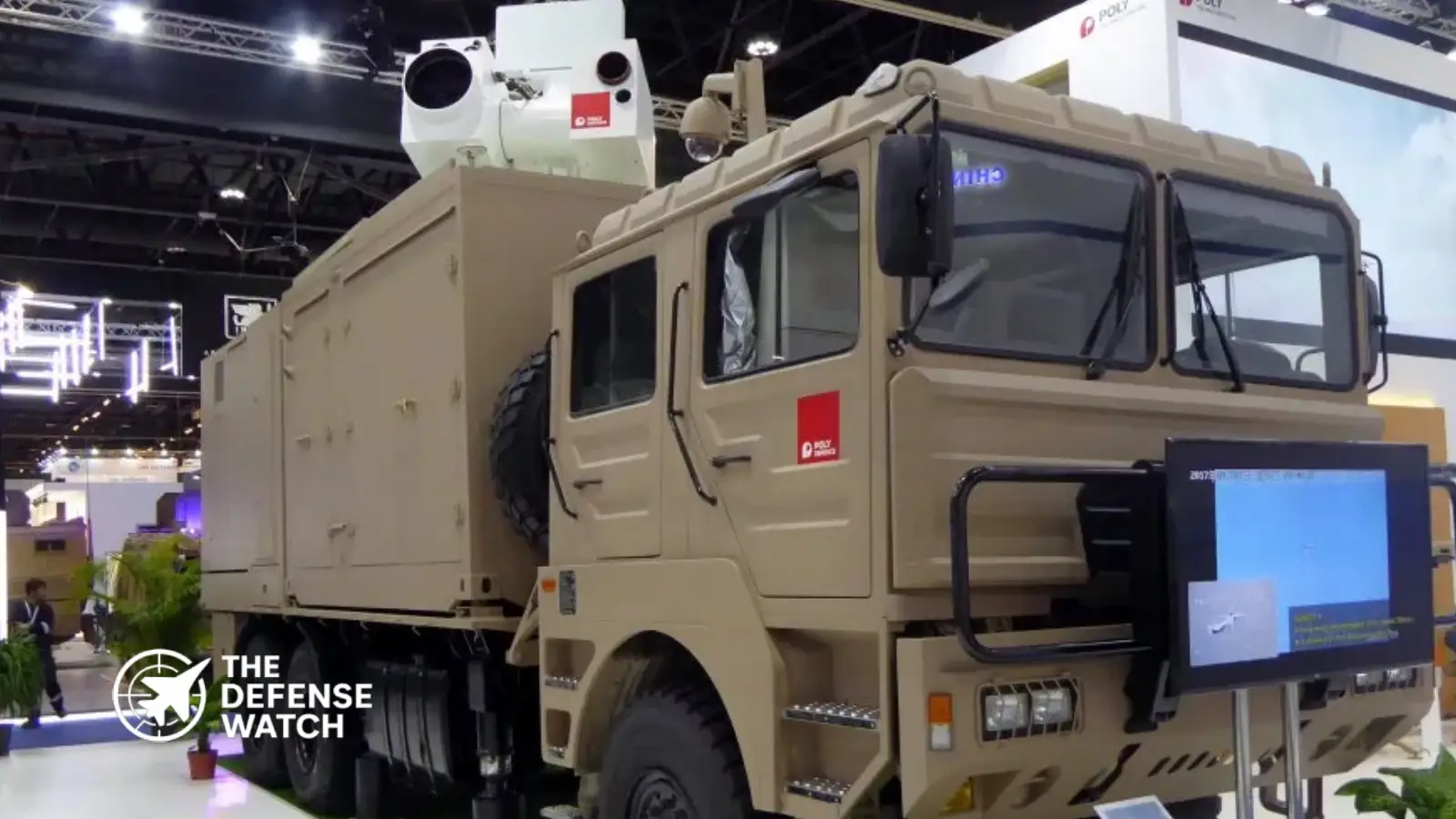
Executive Summary: China’s Poly Technologies Silent Hunter directed-energy weapon system has drawn renewed attention following its association with Abu Dhabi Airport in the United Arab Emirates. The truck-mounted laser is engineered primarily for high-efficiency interception of small, low-flying drones and similar threats. Its presence underscores growing Gulf interest in cost-effective, rapid-response air defense solutions amid evolving regional security dynamics.
Silent Hunter Laser System Overview
The Silent Hunter (also known as the Low-Altitude Laser Defending System or LASS/LW-30) is a Chinese-developed fiber-optic laser air defense system optimized for counter-unmanned aerial system (C-UAS) missions. Developed as an evolution of earlier 30 kW systems, it is available in mobile and fixed configurations.
The system is typically mounted on a 6×6 wheeled chassis, providing high mobility for the protection of critical infrastructure such as airports, military bases, ports, and government facilities. It employs an electrically powered fiber laser with scalable output, commonly cited in the 30 kW range but with officials noting potential between 30-100 kW depending on configuration.
Key reported performance parameters include:
- Interception range: Up to approximately 4 km against small drones (targets <2m diameter, speed <60 m/s).
- Power modes: Variable settings (e.g., 10 kW, 20 kW, 30 kW) offering flexible engagement envelopes from several hundred meters to the maximum range.
- Effects: Thermal ablation or structural damage to drone airframes and components; secondary capability to blind or damage optical sensors at relevant distances.
- Advantages: Low per-shot cost compared to missiles, minimal collateral damage, rapid retargeting, and high accuracy against slow-moving low-altitude threats.
Exhibition History and UAE Context
The Silent Hunter was first publicly unveiled by Poly Technologies at the International Defence Exhibition and Conference (IDEX) in Abu Dhabi in 2017. It has been showcased at subsequent IDEX events and other international exhibitions, highlighting China’s push to market directed-energy solutions to Middle Eastern customers.
Its recent association with Abu Dhabi Airport aligns with the UAE’s broader efforts to modernize air and missile defense capabilities against drone and low-altitude threats, a priority shared across Gulf states facing asymmetric aerial risks.
Operational Use and Export Interest
Beyond exhibitions, the system has seen reported operational interest and deployment. Saudi Arabia has been linked to acquisitions, with unconfirmed reports of field testing—though some accounts noted performance challenges in desert conditions related to target detection and environmental factors.
Open-source reporting also indicates Russian forces have employed variants of the Silent Hunter or closely related Chinese laser systems against Ukrainian drones, demonstrating real-world C-UAS application in high-intensity conflict.
Analysis: Directed-energy weapons like the Silent Hunter represent a logical evolution in air defense economics. Traditional kinetic interceptors are effective but expensive for use against low-cost attritable drones. Laser systems offer near-unlimited “magazine depth” limited primarily by power generation and thermal management, along with engagement speeds measured in seconds. However, their performance remains sensitive to atmospheric conditions (dust, humidity, fog), line-of-sight requirements, and target resilience.
For operators in the Gulf, integration with layered defenses—combining radar, electronic warfare, and kinetic systems—could enhance overall effectiveness against swarming or massed low-altitude incursions. The mobile 6×6 platform enhances survivability and repositioning flexibility compared to static installations.
Broader Implications for Regional Defense
The UAE and other Gulf nations continue to diversify defense suppliers amid shifting geopolitical dynamics. Chinese systems offer an alternative or complement to Western platforms, often with potentially lower acquisition and operating costs for high-volume drone defense scenarios.
This development fits into a global trend where nations accelerate directed-energy programs. The U.S., Israel, and others are also fielding or testing similar high-energy laser systems for C-UAS and other missions. China’s progress in this domain, evidenced by repeated international marketing and reported exports, positions it as a notable player in the emerging DEW market.
Feature Image Suggestion: High-resolution photo of the Silent Hunter 6×6 truck-mounted turret system, preferably in a desert or exhibition setting, with clear view of the laser emitter and tracking sensors. Overlay text option: “Silent Hunter Laser C-UAS System.
