
- Home
- Defense Systems
- Fighter Jets
- Thunderbirds F-16C Fighting Falcon
Thunderbirds F-16C Fighting Falcon


Defense Systems Full Specifications
General Information
| Name | Thunderbirds F-16C Fighting Falcon |
| Manufacturer | Lockheed Martin |
| Country of Origin | United States |
| Type / Role | Air-demonstration / Multirole fighter (baseline design) |
| Generation | 4th |
| Status | Active |
| First Flight | 1978 (F-16C variant) |
| Introduction / In Service Since | Thunderbirds since 1983 |
| Number Built | 4,600+ F-16s overall |
| Operators | USAF Thunderbirds |
Dimensions & Structure
| Length | 49 ft 5 in |
| Wingspan | 32 ft 8 in |
| Height | 16 ft 8 in |
| Wing Area | 300 sq ft |
| Empty Weight | ~19,000 lb |
| Maximum Takeoff Weight (MTOW) | 42,300 lb |
| Internal Weapons Bay | None |
| External Hardpoints | 9 (not used by Thunderbirds) |
Performance
| Maximum Speed | Mach 2+ |
| Range | ~2,280 miles (ferry) |
| Combat Radius | ~340 miles (baseline F-16C) |
| Service Ceiling | 50,000+ ft |
| Rate of Climb | 50,000 ft/min |
| Thrust-to-Weight Ratio | 1.095 |
| G Limits | +9G / –3G |
Powerplant
| Engine Type | Pratt & Whitney F100-PW-229 |
| No. of Engines | 1 |
| Thrust (each) | 29,100 lbf (afterburner) |
| Thrust Vectoring | No |
| Fuel Capacity | ~7,000 lb internal |
Armament
| Gun | 20mm M61A1 (disabled for demo use) |
| Missiles (Air-to-Air) | N/A |
| Missiles (Air-to-Ground) | N/A |
| Bombs | N/A |
| Hardpoints | 9 |
| Payload Capacity | ~17,000 lb (combat model) |
Avionics & Systems
| Radar | APG-68 (not used in demos) |
| Radar Range | Classified |
| Electronic Warfare (EW) System | Standard F-16C suite |
| Targeting System | Not equipped |
| Helmet Display | HMD optional (not used) |
| Navigation | GPS/INS |
| Autopilot / AI Assistance | Standard F-16 autopilot |
| Communication | UHF/VHF secure radios |
Stealth & Technology
| Radar Cross Section (RCS) | Moderate |
| Stealth Features | None |
| Infrared Signature Reduction | Minimal |
| Sensor Fusion | Limited |
| Networking Capabilities | Link-16 (baseline F-16C) |
Variants
| Special Export Versions | F-16I, KF-16, Block 70/72 |
Operational History
| Major Conflicts / Deployments | None (demo aircraft) |
| Notable Operators | USAF Thunderbirds |
| Combat Proven? | No (demo only) |
| Mission Types | Air-demonstration, public outreach |
Cost & Program
| Unit Cost | ~$30–35 million (equivalent to F-16C) |
| Development Cost | Part of broader F-16 program |
| Program Name | F-16 Fighting Falcon |
| Funding Countries | United States |
Additional Information
| Upgrades Planned | Avionics reliability improvements |
| Future Replacement | None planned; ongoing use expected |
| Export Restrictions | Not exported (Thunderbirds only) |
| Notable Achievements | Premier U.S. air-demo platform |
| Competitors | Blue Angels F/A-18E/F (role only) |
PROS
- Outstanding high-G maneuverability
- Proven, reliable single-engine design
- Excellent pilot visibility
- Advanced flight control system
- Strong U.S. maintenance and logistics support
CONS
- Limited range compared to larger twin-engine fighters
- Non-stealth design
- Aging fourth-generation airframe
- High maintenance demand during demonstrations
- Not equipped with the full modern sensor suite of newer platforms
Thunderbirds F-16C: Precision Air-Demo Fighter
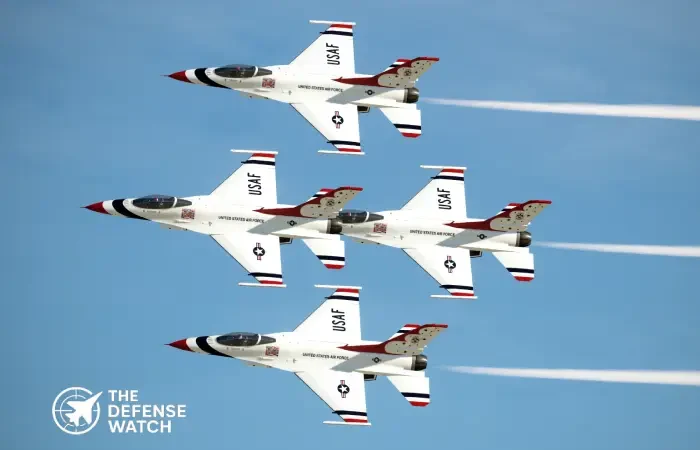
The Thunderbirds F-16C Fighting Falcon is one of the most recognizable fighter aircraft in the world, serving as the U.S. Air Force’s premier air-demonstration jet. While the F-16C platform is a fully combat-capable multirole fighter, the Thunderbirds variant is custom-configured for performance flying, showcasing American aerospace engineering at its finest. Built by Lockheed Martin, the jet reflects the same core strengths of the operational F-16 fleet—speed, stability, and high-G maneuverability.
Powered by a single Pratt & Whitney F100-PW-229 afterburning turbofan, the Thunderbirds F-16C delivers exceptional thrust-to-weight performance and the responsiveness needed for tight formations and precision aerobatics. With speeds exceeding Mach 2 and a service ceiling above 50,000 feet, the platform remains one of the most agile fourth-generation fighters in the world.
A Demonstration Jet Built on Combat DNA
Although the Thunderbirds aircraft operate without live weapons, they retain the fundamental capabilities of a frontline F-16C, including advanced flight controls, high-output hydraulic systems, and a digital cockpit. For demonstration purposes, internal guns are disabled, and avionics are modified for reliability, safety, and smoke-system integration.
Performance & Role
The Thunderbirds F-16C executes some of the most demanding maneuvers flown by any aerial demonstration team, including formation rolls, high-G turns, inverted passes, and precision diamond formations. Its design emphasizes stability at low altitude, instantaneous turn rate, and excellent visibility—crucial elements for both combat pilots and demonstration crews.
F-16C Price
The Thunderbirds F-16C Fighting Falcon is not a commercial product and carries no civilian price. Its military unit cost aligns with operational F-16C variants, generally exceeding $30–35 million, depending on configuration and upgrade package.
Disclaimer Note
The information provided on TheDefenseWatch.com is for general informational purposes only. While we strive to ensure the accuracy, completeness, and timeliness of our content regarding defense and aerospace products, technologies, and specifications, we cannot guarantee that all information is 100% accurate or up-to-date due to the evolving nature of military technology and classified data.TheDefenseWatch.com does not warrant the reliability, suitability, or availability of the information for any specific purpose. Users are advised to consult official sources, such as manufacturers, government publications, or defense agencies, for precise and verified data before making decisions based on our content.We are not affiliated with any defense manufacturers, governments, or military organizations mentioned. Opinions, reviews, and ratings reflect expert analysis but are subjective and should not be considered endorsements. TheDefenseWatch.com is not responsible for any errors, omissions, or consequences arising from the use of this website’s content.External links are provided for convenience and do not imply endorsement. TheDefenseWatch.com reserves the right to update or modify content without prior notice. By using this website, you agree to our Privacy & Cookies Policy.

New Arrivals




Popular Comparisons
-
 J-10C vs JF-17 Thunder: Which Fighter Is More Capable?
View Comparison →
-
Tejas vs Gripen: Key Differences and Capabilities
View Comparison →
-
Tejas vs MiG-21 Bison: How India Replaced Its Iconic Supersonic Fighter
View Comparison →
-
F-35 vs F-16: Stealth, Sensors and Combat Roles
View Comparison →
-
Tejas Fighter Jet vs F-16 Fighting Falcon: Capability Compared
View Comparison →
-
Rafale Fighter Jet vs F-16 Fighting Falcon : Which Fighter Has the Edge?
View Comparison →
-
Su-57 Fighter Jet vs J-20 Fighter Jet: Stealth and Air Combat Compared
View Comparison →
-
Mirage 2000 vs Tejas Mk1A: Legacy Combat Power vs Indigenous Modernization
View Comparison →
-
Rafale Fighter Jet vs F-22 Raptor: Which Air Dominance Fighter Has the Edge?
View Comparison →
-
Tejas Fighter Jet vs. Rafale Fighter Jet: India’s Indigenous Fighter Meets France’s Proven Multirole Combat Aircraft
View Comparison →


- China Reports Fielding 40mm Cased Telescoped Ammunition

- Saab Launches Ocean Barrier Underwater Surveillance System
- Saab Names Canadian Partners for Gripen E Fighter Production
- U.S. Air Force Tests XQ-67A Drone Systems for Dispersed Combat Operations
- Lockheed Martin Wins $9.76 Million Contract for Canadian CH-148 Cyclone Electronic Warfare Software
- Lockheed Martin Wins $13.3 Million F-35 Engine Upgrade Contract Modification
- Army Trains Patriot Crews for Nighttime Missile Reloads
- Hegseth Reinstates Air Force Brigadier General Forced to Retire Over COVID-19 Vaccine Mandate
- Pentagon Reports Strong Interest in Competition for Next Great American Base
- DIA 2026 Space Report Warns China May Field Orbital Directed-Energy Weapons by Late 2020s




Fighter Jets
-
 F-100 Super Sabre
-
North American F-86 Sabre
-
Northrop YF-23 Fighter
-
Rafale F5 Fighter
-
SU-57 Felon Stealth Fighter
-
Boeing F/A-XX Fighter
-
JF-17 Thunder Fighter Jet
-
F-47 Fighter Jet
-
MIG-31 Fighter Jet
-
J-10CE Fighter Jet
-
Chengdu J-10 Fighter Jet
-
Chengdu J-10C Fighter Jet
-
Gripen E Fighter Jet
-
Tejas Mk1A Fighter Jet
-
Tejas Mk‑2 Fighter Jet
-
F-16V Viper Block 70 Fighter Jet
-
F-15EX Eagle II Fighter
-
F-15E Strike Eagle Fighter
-
F/A-18E/F Super Hornet Fighter Jet
-
Saab Gripen F Fighter Jet
-
JAS 39E/F Gripen Fighter Jet
-
JAS 39 Gripen Fighter Jet
-
F-35A Lightning II Fighter Jet
-
F/A-18F Super Hornet







Recent Compares
-
J-10C vs JF-17 Thunder: Which Fighter Is More Capable?
View Comparison →
-
Tejas vs Gripen: Key Differences and Capabilities
View Comparison →
-
Tejas vs MiG-21 Bison: How India Replaced Its Iconic Supersonic Fighter
View Comparison →
-
F-35 vs F-16: Stealth, Sensors and Combat Roles
View Comparison →
-
Tejas Fighter Jet vs F-16 Fighting Falcon: Capability Compared
View Comparison →
Latest Defense Systems
10 Compares Defense Systems
-
J-10C vs JF-17 Thunder: Which Fighter Is More Capable?
View Comparison →
-
Tejas vs Gripen: Key Differences and Capabilities
View Comparison →
-
Tejas vs MiG-21 Bison: How India Replaced Its Iconic Supersonic Fighter
View Comparison →
-
F-35 vs F-16: Stealth, Sensors and Combat Roles
View Comparison →
-
Tejas Fighter Jet vs F-16 Fighting Falcon: Capability Compared
View Comparison →
-
Rafale Fighter Jet vs F-16 Fighting Falcon : Which Fighter Has the Edge?
View Comparison →
-
Su-57 Fighter Jet vs J-20 Fighter Jet: Stealth and Air Combat Compared
View Comparison →
-
Mirage 2000 vs Tejas Mk1A: Legacy Combat Power vs Indigenous Modernization
View Comparison →
-
Rafale Fighter Jet vs F-22 Raptor: Which Air Dominance Fighter Has the Edge?
View Comparison →
-
Tejas Fighter Jet vs. Rafale Fighter Jet: India’s Indigenous Fighter Meets France’s Proven Multirole Combat Aircraft
View Comparison →
- China Reports Fielding 40mm Cased Telescoped Ammunition
- Saab Launches Ocean Barrier Underwater Surveillance System
- Saab Names Canadian Partners for Gripen E Fighter Production
- U.S. Air Force Tests XQ-67A Drone Systems for Dispersed Combat Operations
- Lockheed Martin Wins $9.76 Million Contract for Canadian CH-148 Cyclone Electronic Warfare Software