
- Home
- Defense Systems
- Fighter Jets
- Shenyang J-16 Fighter Jet
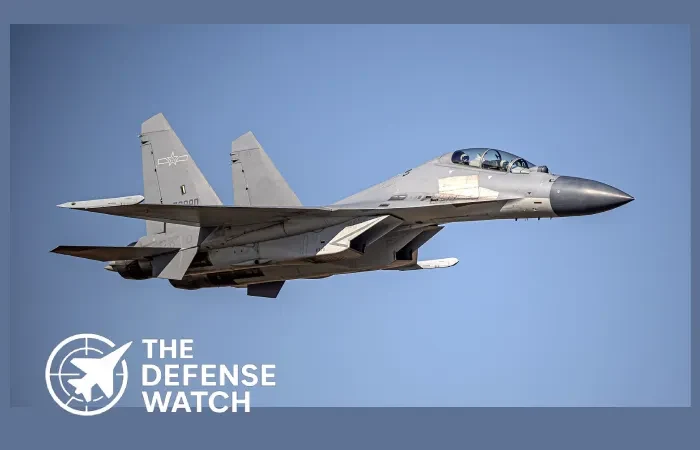
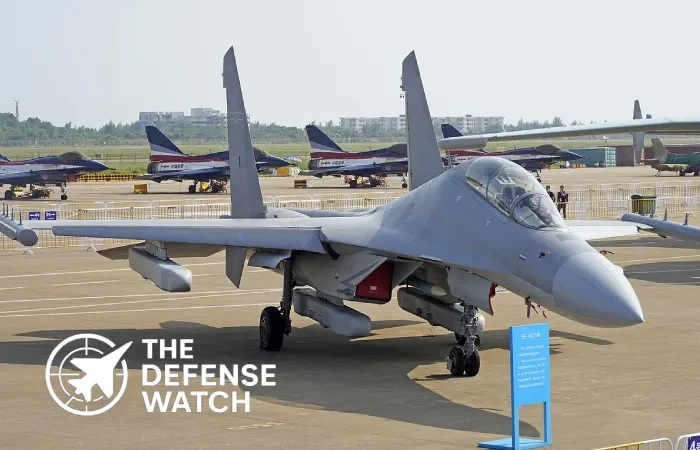
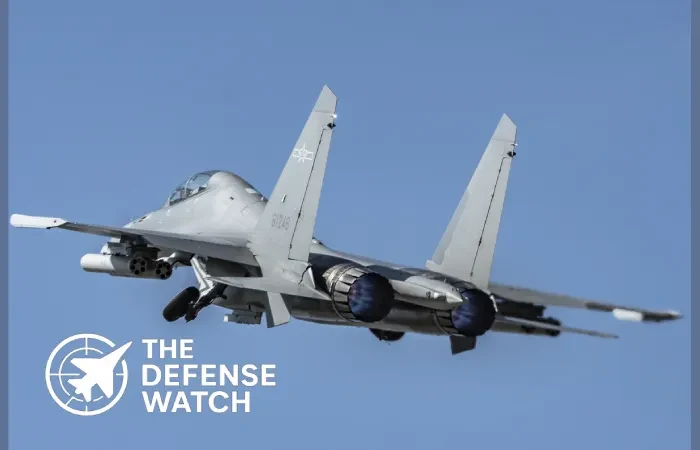
Shenyang J-16 Fighter Jet
Defense Systems Full Specifications
General Information
| Name | J‑16 |
| Manufacturer | Shenyang Aircraft Corporation |
| Country of Origin | China |
| Type / Role | Multirole fighter / strike aircraft |
| Generation | 4+ / 4.5 |
| Status | In service |
| First Flight | 2011–2012 |
| Introduction / In Service Since | 2015 |
| Number Built | 300+ (est.) |
| Operators | People’s Liberation Army Air Force (PLAAF) |
Dimensions & Structure
| Length | 21.9 m (~71 ft 10 in) |
| Wingspan | 14.7 m (~48 ft 3 in) |
| Height | 6.36 m (~20 ft 10 in) |
| Wing Area | ~62 m² (~670 ft²) |
| Empty Weight | ~17,700 kg (~39,000 lb) |
| Maximum Takeoff Weight (MTOW) | ~35,000 kg (~77,000 lb) |
| Internal Weapons Bay | None |
| External Hardpoints | 12 |
Performance
| Maximum Speed | Mach 2 (~2,120 km/h) |
| Range | ~3,000 km (~1,900 mi) |
| Combat Radius | ~1,500 km (est.) |
| Service Ceiling | ~17,300 m (~56,800 ft) |
| Rate of Climb | ~230 m/s (~45,000 ft/min) |
| Thrust-to-Weight Ratio | Classified / Approx. |
| G Limits | +9 g |
Powerplant
| Engine Type | Shenyang WS‑10B afterburning turbofan |
| No. of Engines | 2 |
| Thrust (each) | ~135 kN (~30,000 lbf) |
| Thrust Vectoring | No |
| Fuel Capacity | Classified |
Armament
| Gun | 1×30 mm GSh‑30‑1 (150 rounds) |
| Missiles (Air-to-Air) | PL‑10, PL‑9, PL‑12, PL‑15 |
| Missiles (Air-to-Ground) | KD‑88, LS‑500J, other LACMs |
| Bombs | Laser/GPS guided bombs |
| Hardpoints | 12 |
| Payload Capacity | ~9,700 kg |
Avionics & Systems
| Radar | AESA radar |
| Radar Range | Classified |
| Electronic Warfare (EW) System | J‑16D EW variant available |
| Targeting System | Sensor fusion, HMD |
| Helmet Display | Yes |
| Navigation | GPS/Inertial/BeiDou |
| Autopilot / AI Assistance | Partial AI/backseat support |
| Communication | Networked datalink |
Stealth & Technology
| Radar Cross Section (RCS) | Non-stealth, reduced via coatings |
| Stealth Features | Radar-absorbent paint, com |
| Infrared Signature Reduction | Radar-absorbent paint, com |
| Sensor Fusion | Yes |
| Networking Capabilities | Multi-aircraft datalink |
Variants
| Special Export Versions | - |
Operational History
| Major Conflicts / Deployments | Patrols, interceptions in South China Sea/Taiwan Strait |
| Notable Operators | PLAAF |
| Combat Proven? | Not publicly confirmed |
| Mission Types | Air superiority, strike, SEAD, anti-ship, EW |
Cost & Program
| Unit Cost | Classified |
| Development Cost | Classified |
| Program Name | J‑16 / Qianlong (‘Hidden Dragon’) |
| Funding Countries | China (domestic funding) |
Additional Information
| Upgrades Planned | Avionics, sensors, missile integration |
| Future Replacement | Next-gen Chinese fighters (TBD) |
| Export Restrictions | Primarily domestic use |
| Notable Achievements | Largest Flanker derivative fleet in China |
| Competitors | F-15E, Eurofighter Typhoon, Dassault Rafale |
PROS
- Multi‑role flexibility: capable of both air‑to‑air and air‑to‑surface missions.
- Modern sensor suite and AESA radar provides improved situational awareness.
- Long range and high payload capacity allow for extended reach and strike options.
- Domestic Chinese production reduces reliance on foreign systems and supports rapid fleet expansion.
- Dedicated electronic‑warfare variant (J‑16D) enhances suppression and network‑centric capabilities.
CONS
- While advanced, the J‑16 does not match true fifth‑generation stealth platforms in survivability.
- Reliability of domestic turbofans (WS‑10 series) has been questioned in open‑source analyses.
- Limited or no export availability may restrict broader interoperability or alliance support.
- Advanced missile and sensor integration may face maturity challenges compared to Western competitors.
- Operating in contested air‑defense environments still poses risk given the non‑stealth configuration and larger radar cross‑section.
Shenyang J-16 Fighter Jet
The J‑16 is China’s premier multirole fighter, blending advanced avionics, long-range strike capability, and air superiority performance. Developed by the Shenyang Aircraft Corporation (SAC), the J‑16 is an evolution of the Su-27/30 platform, incorporating modern Chinese technologies to serve as both a strike and air dominance aircraft.
Designed to operate in complex combat environments, the J‑16 excels in precision strike missions, air interdiction, and fleet defense. Its robust airframe supports high-speed maneuvers, with a top speed exceeding Mach 2.2, and a combat radius suitable for long-range missions over hostile airspace. The aircraft carries a diverse array of air-to-air and air-to-ground munitions, including guided missiles, bombs, and precision ordnance.
Equipped with modern avionics, the J‑16 features an advanced radar system, digital fly-by-wire controls, and an electronic warfare suite capable of countering radar-guided threats. The platform also supports precision targeting pods, advanced sensors, and datalink connectivity, allowing coordinated operations within China’s integrated air defense and strike networks.
Operationally, the J‑16 provides China with a versatile tool for power projection, maritime strike, and tactical support. Its twin-engine configuration ensures reliability and high thrust, while its payload capacity allows for flexible mission profiles. In recent years, the J‑16 has become a core component of the People’s Liberation Army Air Force (PLAAF), demonstrating its capability in large-scale exercises and rapid deployment scenarios.
With a combination of speed, firepower, and modern avionics, the J‑16 represents a significant step in China’s development of high-performance, multirole combat aircraft, catering to both defensive and offensive operational requirements.
Disclaimer Note
The information provided on TheDefenseWatch.com is for general informational purposes only. While we strive to ensure the accuracy, completeness, and timeliness of our content regarding defense and aerospace products, technologies, and specifications, we cannot guarantee that all information is 100% accurate or up-to-date due to the evolving nature of military technology and classified data.TheDefenseWatch.com does not warrant the reliability, suitability, or availability of the information for any specific purpose. Users are advised to consult official sources, such as manufacturers, government publications, or defense agencies, for precise and verified data before making decisions based on our content.We are not affiliated with any defense manufacturers, governments, or military organizations mentioned. Opinions, reviews, and ratings reflect expert analysis but are subjective and should not be considered endorsements. TheDefenseWatch.com is not responsible for any errors, omissions, or consequences arising from the use of this website’s content.External links are provided for convenience and do not imply endorsement. TheDefenseWatch.com reserves the right to update or modify content without prior notice. By using this website, you agree to our Privacy & Cookies Policy.


New Arrivals



Popular Comparisons
-
 Tejas vs Gripen: Key Differences and Capabilities
View Comparison →
-
Tejas vs MiG-21 Bison: How India Replaced Its Iconic Supersonic Fighter
View Comparison →
-
F-35 vs F-16: Stealth, Sensors and Combat Roles
View Comparison →
-
Tejas Fighter Jet vs F-16 Fighting Falcon: Capability Compared
View Comparison →
-
Rafale Fighter Jet vs F-16 Fighting Falcon : Which Fighter Has the Edge?
View Comparison →
-
Su-57 Fighter Jet vs J-20 Fighter Jet: Stealth and Air Combat Compared
View Comparison →
-
Mirage 2000 vs Tejas Mk1A: Legacy Combat Power vs Indigenous Modernization
View Comparison →
-
Rafale Fighter Jet vs F-22 Raptor: Which Air Dominance Fighter Has the Edge?
View Comparison →
-
Tejas Fighter Jet vs. Rafale Fighter Jet: India’s Indigenous Fighter Meets France’s Proven Multirole Combat Aircraft
View Comparison →
-
F-22 Raptor vs. F-35 Joint Strike Fighter: Which Fifth Generation Fighter Has the Edge?
View Comparison →


- USS Oregon Visits Norway as U.S. Navy Maintains High North Presence

- Lockheed Martin Unveils PAC-3 Edge Interceptor for U.S. Army
- Northrop Grumman Completes B-2 Spirit of Kitty Hawk Overhaul
- Army Report Finds Systemic Failures Behind Fatal 2025 Midair Collision
- Lockheed Martin to Supply Black Hawk Training Systems to Philippine Air Force
- US Air Force Expands B-21 Raider Production Capacity by 25%
- Boeing Wins $10.9 Million VC-25B Test Maintenance Contract Modification
- Raytheon Wins $6.34 Billion Contract for SM-3 Block IB Missile Production
- USS Abraham Lincoln CO Addresses Crew Welfare Concerns After 322-Day Deployment
- General Dynamics, Primordial Labs to Add Voice Control to Abrams and XM30




Fighter Jets
-
 MIG-31 Fighter Jet
-
J-10CE Fighter Jet
-
Chengdu J-10 Fighter Jet
-
Chengdu J-10C Fighter Jet
-
Gripen E Fighter Jet
-
Tejas Mk1A Fighter Jet
-
Tejas Mk‑2 Fighter Jet
-
F-16V Viper Block 70 Fighter Jet
-
F-15EX Eagle II Fighter
-
Boeing F/A-XX Fighter
-
F-15E Strike Eagle Fighter
-
F/A-18E/F Super Hornet Fighter Jet
-
Saab Gripen F Fighter Jet
-
JAS 39E/F Gripen Fighter Jet
-
JAS 39 Gripen Fighter Jet
-
F-35A Lightning II Fighter Jet
-
F/A-18F Super Hornet
-
J-50 Fighter Jet
-
Spanish EF-18 Hornet Fighter
-
F-47 Fighter Jet
-
F-35i Adir Fighter Jet
-
F-16 Fighting Falcon
-
AIDC T-5 Brave Eagle
-
F-CK-1 Ching-Kuo Fighter







Recent Compares
-
Tejas vs Gripen: Key Differences and Capabilities
View Comparison →
-
Tejas vs MiG-21 Bison: How India Replaced Its Iconic Supersonic Fighter
View Comparison →
-
F-35 vs F-16: Stealth, Sensors and Combat Roles
View Comparison →
-
Tejas Fighter Jet vs F-16 Fighting Falcon: Capability Compared
View Comparison →
-
Rafale Fighter Jet vs F-16 Fighting Falcon : Which Fighter Has the Edge?
View Comparison →
Latest Defense Systems
10 Compares Defense Systems
-
Tejas vs Gripen: Key Differences and Capabilities
View Comparison →
-
Tejas vs MiG-21 Bison: How India Replaced Its Iconic Supersonic Fighter
View Comparison →
-
F-35 vs F-16: Stealth, Sensors and Combat Roles
View Comparison →
-
Tejas Fighter Jet vs F-16 Fighting Falcon: Capability Compared
View Comparison →
-
Rafale Fighter Jet vs F-16 Fighting Falcon : Which Fighter Has the Edge?
View Comparison →
-
Su-57 Fighter Jet vs J-20 Fighter Jet: Stealth and Air Combat Compared
View Comparison →
-
Mirage 2000 vs Tejas Mk1A: Legacy Combat Power vs Indigenous Modernization
View Comparison →
-
Rafale Fighter Jet vs F-22 Raptor: Which Air Dominance Fighter Has the Edge?
View Comparison →
-
Tejas Fighter Jet vs. Rafale Fighter Jet: India’s Indigenous Fighter Meets France’s Proven Multirole Combat Aircraft
View Comparison →
-
F-22 Raptor vs. F-35 Joint Strike Fighter: Which Fifth Generation Fighter Has the Edge?
View Comparison →
- USS Oregon Visits Norway as U.S. Navy Maintains High North Presence
- Lockheed Martin Unveils PAC-3 Edge Interceptor for U.S. Army
- Northrop Grumman Completes B-2 Spirit of Kitty Hawk Overhaul
- Army Report Finds Systemic Failures Behind Fatal 2025 Midair Collision
- Lockheed Martin to Supply Black Hawk Training Systems to Philippine Air Force