
- Home
- Defense Systems
- Bombers & Strategic Aircraft
- Hawk T1 Jet Trainer
Hawk T1 Jet Trainer
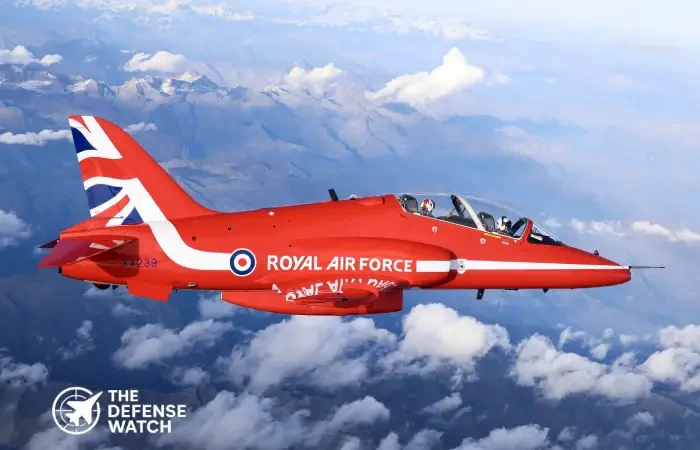
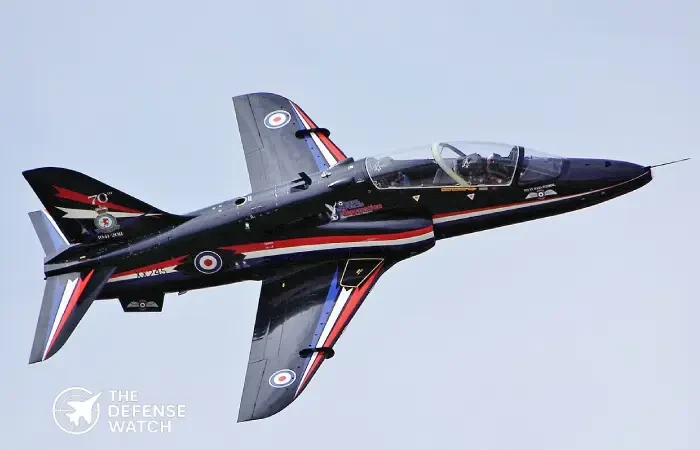
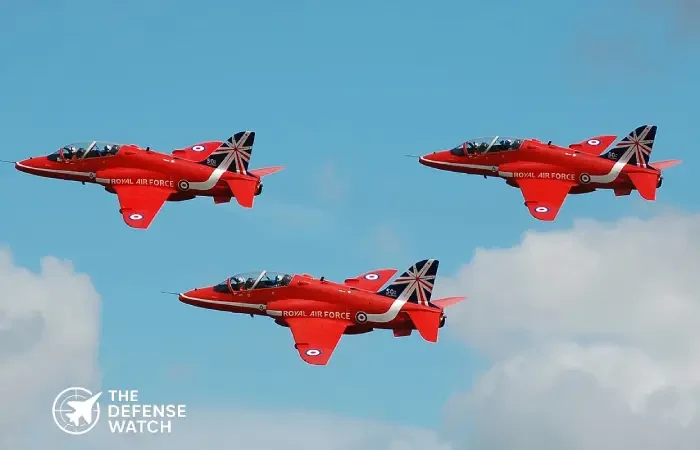
Defense Systems Full Specifications
1. General Information
| Name | Hawk T1 |
| Manufacturer | Hawker Siddeley / British Aerospace (BAE Systems) |
| Country of Origin | United Kingdom |
| Introduction / In Service Since | 1976 |
| Status | In service (limited/Red Arrows; T1 largely retired from frontline training) |
| Category | Advanced Jet Trainer / Light Attack |
| Crew | 2 |
| Unit Cost | ~£18 million (historical, adjusted equivalents higher) |
2. Dimensions & Structure
| Length | 11.9 m |
| Wingspan | 9.4–9.94 m |
| Height | ~3.98 m |
| Wing Area | 16.7 m² |
| Empty Weight | ~4,480 kg |
| Maximum Takeoff Weight (MTOW) | 9,100 kg |
3. Performance
| Maximum Speed | Mach 0.84 (1,028 km/h) |
| Range | 2,520 km |
| Combat Radius | Limited (training-focused) |
| Service Ceiling | ~13,565–14,630 m (44,500–48,000 ft) |
| Rate of Climb | ~9,300 ft/min |
4. Powerplant
| Engine Type | 1 × Rolls-Royce Adour Mk 151 turbofan |
| Thrust (per engine) | ~5,200–5,700 lbf |
| Total Thrust | ~5,200–5,700 lbf |
5. Payload & Armament
| Internal Payload Capacity | Limited |
| Weapons Bay | None |
| Compatible Weapons | 30 mm ADEN gun pod, practice bombs, rockets, AIM-9 Sidewinder (T1A) |
| Hardpoints | 5 (centerline + wing) |
6. Avionics & Systems
| Radar System | Basic (no advanced radar in standard T1) |
| Navigation | Standard instrument / inertial |
| Electronic Warfare (EW) | Limited / optional RWR in variants |
| Stealth Features | None |
7. Operational History
| Primary Operator | Royal Air Force (UK) |
| Conflict Usage | Primarily training; limited operational support |
| Notable Missions | Red Arrows aerobatic displays; pilot training pipeline |
8. Additional Information
| Variants | T1, T1A, export series (50/60/100/200) |
| Successor / Future Replacement | Hawk T2; future systems |
| Notable Features | Robust design, excellent visibility, aerobatic capability |
| Estimated Operational Life | Decades with sustainment (fatigue life managed) |
PROS
- Excellent handling and maneuverability ideal for advanced pilot training.
- Proven reliability with low maintenance demands and high availability.
- Cost-effective acquisition and operation compared to supersonic trainers.
- Versatile platform adaptable for light attack and aggressor roles.
- Strong export track record with over 1,000 aircraft produced.
CONS
- Subsonic performance limits direct replication of high-speed fighter characteristics.
- Basic avionics in early T1 models lack modern glass cockpit features found in newer trainers.
- Limited internal fuel and payload constrain long-range combat missions.
- Aging airframes in some fleets require ongoing sustainment investment.
- No inherent stealth or advanced sensor fusion for contested environments.
BAE Hawk T1 Advanced Jet Trainer: Proven RAF Workhorse
The Hawk T1 stands as one of the most successful advanced jet trainers ever produced, embodying British engineering excellence in military aviation. Designed in the early 1970s as a replacement for the Folland Gnat and Hawker Hunter in the Royal Air Force’s advanced training syllabus, this single-engine, tandem-seat subsonic jet has trained generations of fast-jet pilots while also serving in aerobatic display roles with the renowned Red Arrows. Its straightforward design, robust construction, and cost-effective operation have made it a staple for pilot conversion training and limited weapons instruction.
Manufacturer
Developed by Hawker Siddeley (later British Aerospace, now BAE Systems), the Hawk T1 originated in the United Kingdom. First flight occurred on August 21, 1974, with RAF service entry in 1976. Over 1,000 Hawks of various marks have been built, with significant export success.
Speed and Range
Powered by a Rolls-Royce Adour Mk 151 turbofan engine delivering approximately 5,200 lbf of thrust, the Hawk T1 achieves a maximum speed of around Mach 0.84 (1,028 km/h) at altitude, with a never-exceed speed of Mach 1.2 in a dive. Its ferry range reaches approximately 2,520 km, supporting extended training sorties, while typical operational ranges suit tactical training profiles. Service ceiling is about 48,000 ft, with a strong rate of climb.
Cost/Price
Unit costs for early Hawk T1 variants were significantly lower than frontline fighters. Historical estimates place new-build costs in the lower tens of millions (adjusted figures around $15–25 million range for comparable export models), emphasizing its affordability for advanced training. Operating costs remain competitive due to reliable systems and straightforward maintenance.
The aircraft’s aluminum alloy fuselage and conventional layout prioritize ease of production and maintenance. It features five hardpoints (including centerline) for practice ordnance, gun pods (such as 30 mm ADEN cannon), and limited air-to-air weapons like AIM-9 Sidewinders in armed configurations (T1A). Basic avionics support instrument flying and weapons simulation, though later variants added more advanced systems. The Hawk T1 has seen primary use with the RAF for advanced flying training, weapons training, and aerobatics, proving highly effective in preparing pilots for operational types.
Disclaimer Note
The information provided on TheDefenseWatch.com is for general informational purposes only. While we strive to ensure the accuracy, completeness, and timeliness of our content regarding defense and aerospace products, technologies, and specifications, we cannot guarantee that all information is 100% accurate or up-to-date due to the evolving nature of military technology and classified data.TheDefenseWatch.com does not warrant the reliability, suitability, or availability of the information for any specific purpose. Users are advised to consult official sources, such as manufacturers, government publications, or defense agencies, for precise and verified data before making decisions based on our content.We are not affiliated with any defense manufacturers, governments, or military organizations mentioned. Opinions, reviews, and ratings reflect expert analysis but are subjective and should not be considered endorsements. TheDefenseWatch.com is not responsible for any errors, omissions, or consequences arising from the use of this website’s content.External links are provided for convenience and do not imply endorsement. TheDefenseWatch.com reserves the right to update or modify content without prior notice. By using this website, you agree to our Privacy & Cookies Policy.



New Arrivals




Popular Comparisons
-
 Tejas vs Gripen: Key Differences and Capabilities
View Comparison →
-
Tejas vs MiG-21 Bison: How India Replaced Its Iconic Supersonic Fighter
View Comparison →
-
F-35 vs F-16: Stealth, Sensors and Combat Roles
View Comparison →
-
Tejas Fighter Jet vs F-16 Fighting Falcon: Capability Compared
View Comparison →
-
Rafale Fighter Jet vs F-16 Fighting Falcon : Which Fighter Has the Edge?
View Comparison →
-
Su-57 Fighter Jet vs J-20 Fighter Jet: Stealth and Air Combat Compared
View Comparison →
-
Mirage 2000 vs Tejas Mk1A: Legacy Combat Power vs Indigenous Modernization
View Comparison →
-
Rafale Fighter Jet vs F-22 Raptor: Which Air Dominance Fighter Has the Edge?
View Comparison →
-
Tejas Fighter Jet vs. Rafale Fighter Jet: India’s Indigenous Fighter Meets France’s Proven Multirole Combat Aircraft
View Comparison →
-
F-22 Raptor vs. F-35 Joint Strike Fighter: Which Fifth Generation Fighter Has the Edge?
View Comparison →


- USS Oregon Visits Norway as U.S. Navy Maintains High North Presence

- Lockheed Martin Unveils PAC-3 Edge Interceptor for U.S. Army
- Northrop Grumman Completes B-2 Spirit of Kitty Hawk Overhaul
- Army Report Finds Systemic Failures Behind Fatal 2025 Midair Collision
- Lockheed Martin to Supply Black Hawk Training Systems to Philippine Air Force
- US Air Force Expands B-21 Raider Production Capacity by 25%
- Boeing Wins $10.9 Million VC-25B Test Maintenance Contract Modification
- Raytheon Wins $6.34 Billion Contract for SM-3 Block IB Missile Production
- USS Abraham Lincoln CO Addresses Crew Welfare Concerns After 322-Day Deployment
- General Dynamics, Primordial Labs to Add Voice Control to Abrams and XM30






Fighter Jets
-
 MIG-31 Fighter Jet
-
J-10CE Fighter Jet
-
Chengdu J-10 Fighter Jet
-
Chengdu J-10C Fighter Jet
-
Gripen E Fighter Jet
-
Tejas Mk1A Fighter Jet
-
Tejas Mk‑2 Fighter Jet
-
F-16V Viper Block 70 Fighter Jet
-
F-15EX Eagle II Fighter
-
Boeing F/A-XX Fighter
-
F-15E Strike Eagle Fighter
-
F/A-18E/F Super Hornet Fighter Jet
-
Saab Gripen F Fighter Jet
-
JAS 39E/F Gripen Fighter Jet
-
JAS 39 Gripen Fighter Jet
-
F-35A Lightning II Fighter Jet
-
F/A-18F Super Hornet
-
J-50 Fighter Jet
-
Spanish EF-18 Hornet Fighter
-
F-47 Fighter Jet
-
F-35i Adir Fighter Jet
-
F-16 Fighting Falcon
-
AIDC T-5 Brave Eagle
-
F-CK-1 Ching-Kuo Fighter







Recent Compares
-
Tejas vs Gripen: Key Differences and Capabilities
View Comparison →
-
Tejas vs MiG-21 Bison: How India Replaced Its Iconic Supersonic Fighter
View Comparison →
-
F-35 vs F-16: Stealth, Sensors and Combat Roles
View Comparison →
-
Tejas Fighter Jet vs F-16 Fighting Falcon: Capability Compared
View Comparison →
-
Rafale Fighter Jet vs F-16 Fighting Falcon : Which Fighter Has the Edge?
View Comparison →
Latest Defense Systems
10 Compares Defense Systems
-
Tejas vs Gripen: Key Differences and Capabilities
View Comparison →
-
Tejas vs MiG-21 Bison: How India Replaced Its Iconic Supersonic Fighter
View Comparison →
-
F-35 vs F-16: Stealth, Sensors and Combat Roles
View Comparison →
-
Tejas Fighter Jet vs F-16 Fighting Falcon: Capability Compared
View Comparison →
-
Rafale Fighter Jet vs F-16 Fighting Falcon : Which Fighter Has the Edge?
View Comparison →
-
Su-57 Fighter Jet vs J-20 Fighter Jet: Stealth and Air Combat Compared
View Comparison →
-
Mirage 2000 vs Tejas Mk1A: Legacy Combat Power vs Indigenous Modernization
View Comparison →
-
Rafale Fighter Jet vs F-22 Raptor: Which Air Dominance Fighter Has the Edge?
View Comparison →
-
Tejas Fighter Jet vs. Rafale Fighter Jet: India’s Indigenous Fighter Meets France’s Proven Multirole Combat Aircraft
View Comparison →
-
F-22 Raptor vs. F-35 Joint Strike Fighter: Which Fifth Generation Fighter Has the Edge?
View Comparison →
- USS Oregon Visits Norway as U.S. Navy Maintains High North Presence
- Lockheed Martin Unveils PAC-3 Edge Interceptor for U.S. Army
- Northrop Grumman Completes B-2 Spirit of Kitty Hawk Overhaul
- Army Report Finds Systemic Failures Behind Fatal 2025 Midair Collision
- Lockheed Martin to Supply Black Hawk Training Systems to Philippine Air Force