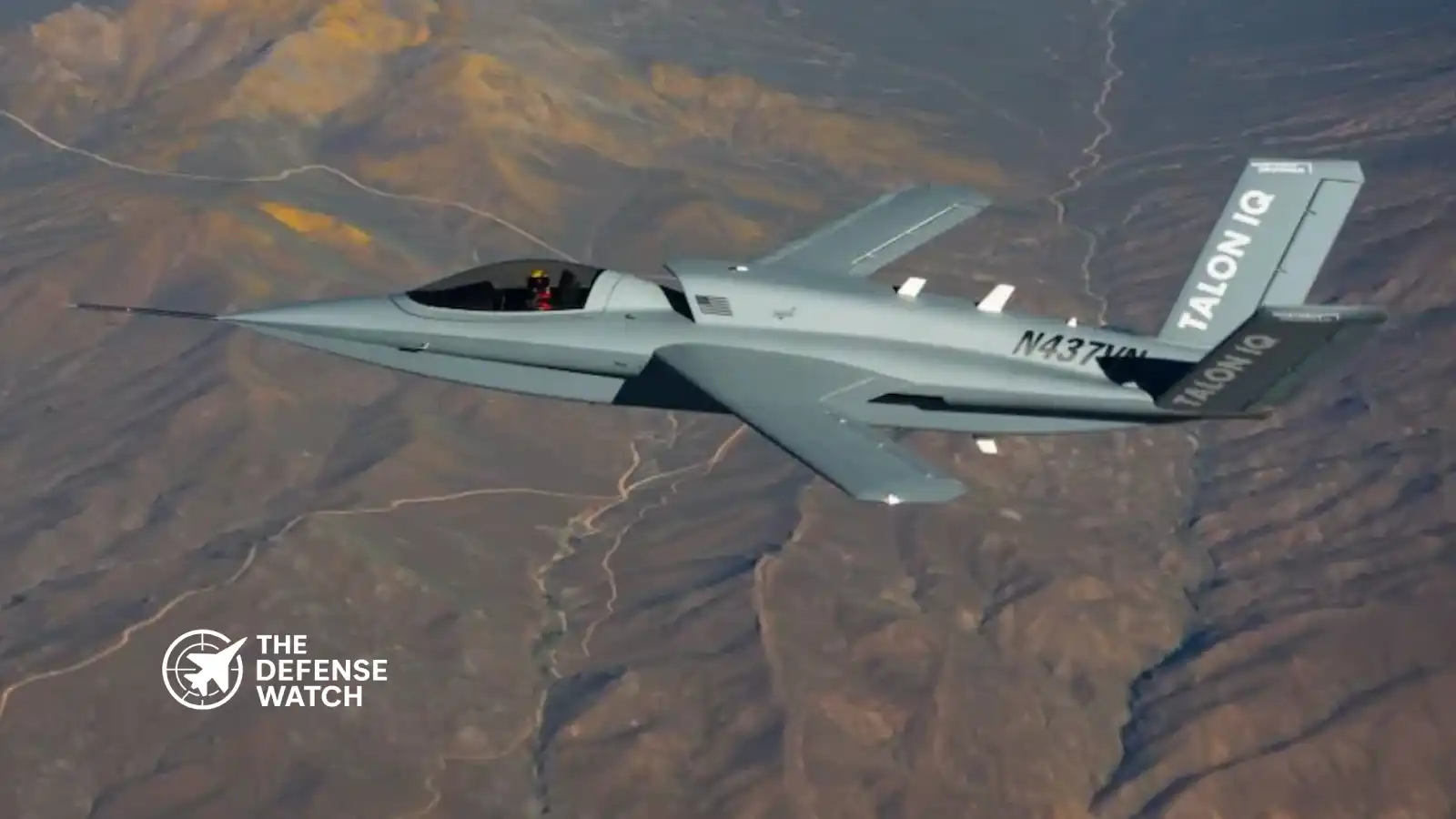
- Northrop Grumman successfully demonstrated mid-flight autonomy software swapping on its Talon IQ testbed aircraft.
- The test enables real-time updates to onboard autonomy systems without landing or interrupting missions.
- The capability supports modular open systems architecture for faster integration of new software and mission tools.
- Demonstration aligns with U.S. military efforts to accelerate AI-driven and autonomous combat capabilities.
- The Talon IQ platform serves as a flexible airborne testbed for next-generation autonomy technologies.
Northrop Grumman Autonomy Software Swap Demonstration Signals Shift in Air Combat Flexibility
The Northrop Grumman autonomy software swap demonstration marks a significant step toward real-time adaptability in military aviation, as the company successfully executed a mid-flight software update on its Talon IQ airborne test platform.
- Northrop Grumman Autonomy Software Swap Demonstration Signals Shift in Air Combat Flexibility
- Real-Time Software Updates Without Mission Disruption
- Modular Open Systems Architecture Gains Momentum
- Strategic Implications for Autonomous Warfare
- Talon IQ as a Testbed for Future Combat Systems
- Industry Context and Competitive Landscape
- Why This Matters Now
According to reporting from Northrop Grumman, the test proved that autonomy software can be modified and replaced during flight without interrupting operations. The demonstration was conducted on the Talon IQ, a platform designed to evaluate next-generation autonomous and AI-driven capabilities.
This milestone highlights a broader push across the U.S. defense sector to adopt modular, software-defined architectures that can evolve rapidly in response to emerging threats.
Real-Time Software Updates Without Mission Disruption
The core achievement of the test lies in its ability to perform a seamless software transition while airborne. Traditionally, updates to mission systems require aircraft to be grounded, tested, and redeployed. That process can take hours or even days.
By contrast, the demonstrated capability allows operators to swap autonomy algorithms mid-mission. This opens the door to dynamic mission adaptation, where aircraft can adjust behavior based on changing battlefield conditions.
From an operational standpoint, this could allow:
- Rapid updates to threat recognition algorithms
- Integration of new mission parameters during flight
- Real-time testing and validation of AI models
This approach reflects the growing importance of software dominance in modern warfare, where adaptability can outweigh raw hardware performance.
Modular Open Systems Architecture Gains Momentum
The Northrop Grumman autonomy software swap test aligns with the U.S. Department of Defense push for Modular Open Systems Architecture, often referred to as MOSA.
MOSA aims to decouple hardware and software development, allowing components to be upgraded independently. In practical terms, this reduces vendor lock-in and accelerates innovation cycles.
The Talon IQ testbed is built to support this concept. It acts as a flying laboratory where different autonomy stacks, sensors, and mission systems can be integrated and evaluated without redesigning the entire platform.
This modular approach is increasingly seen as essential for programs such as:
- Collaborative combat aircraft
- Loyal wingman drones
- AI-enabled ISR platforms
The ability to update systems mid-flight reinforces the viability of MOSA in real-world operations, not just controlled test environments.
Strategic Implications for Autonomous Warfare
The successful demonstration of a Northrop Grumman autonomy software swap has broader implications beyond a single test.
First, it supports the shift toward software-defined warfare. In this model, the effectiveness of a platform depends less on its physical configuration and more on its software capabilities.
Second, it enables faster iteration cycles. Military developers can deploy, test, and refine autonomy algorithms in operational conditions, shortening the feedback loop significantly.
Third, it enhances resilience. If a vulnerability or performance issue is identified, updates can be deployed immediately without waiting for the platform to return to base.
This capability becomes especially relevant in contested environments where communications and logistics may be degraded.3
Talon IQ as a Testbed for Future Combat Systems
The Talon IQ platform plays a central role in this development. Designed as a flexible and reconfigurable testbed, it allows engineers to experiment with advanced autonomy concepts in a real-world flight environment.
Unlike traditional test aircraft, Talon IQ emphasizes rapid integration and experimentation. This makes it well-suited for evaluating emerging technologies tied to artificial intelligence, machine learning, and autonomous decision-making.
The platform’s role is expected to expand as the U.S. military continues investing in next-generation air combat systems, including unmanned and optionally crewed aircraft.
Industry Context and Competitive Landscape
The Northrop Grumman autonomy software swap demonstration comes at a time when defense contractors are racing to define the future of autonomous airpower.
Companies across the U.S. and allied nations are developing systems capable of operating with increasing levels of independence. Programs such as collaborative combat aircraft and swarm-enabled drones rely heavily on adaptable software frameworks.
In this environment, the ability to update autonomy systems in flight could provide a competitive edge. It allows operators to maintain technological relevance even as threats evolve rapidly.
Moreover, it aligns with Pentagon priorities around agile development and continuous capability delivery.
Why This Matters Now
The timing of this demonstration is notable. As geopolitical tensions rise and air defense systems become more sophisticated, the demand for adaptable and resilient platforms is increasing.
Autonomous systems are expected to operate in highly contested environments where pre-programmed behavior may not be sufficient. Real-time updates offer a way to maintain effectiveness under these conditions.
The Northrop Grumman autonomy software swap capability directly addresses this need, providing a pathway toward more responsive and flexible air operations.