

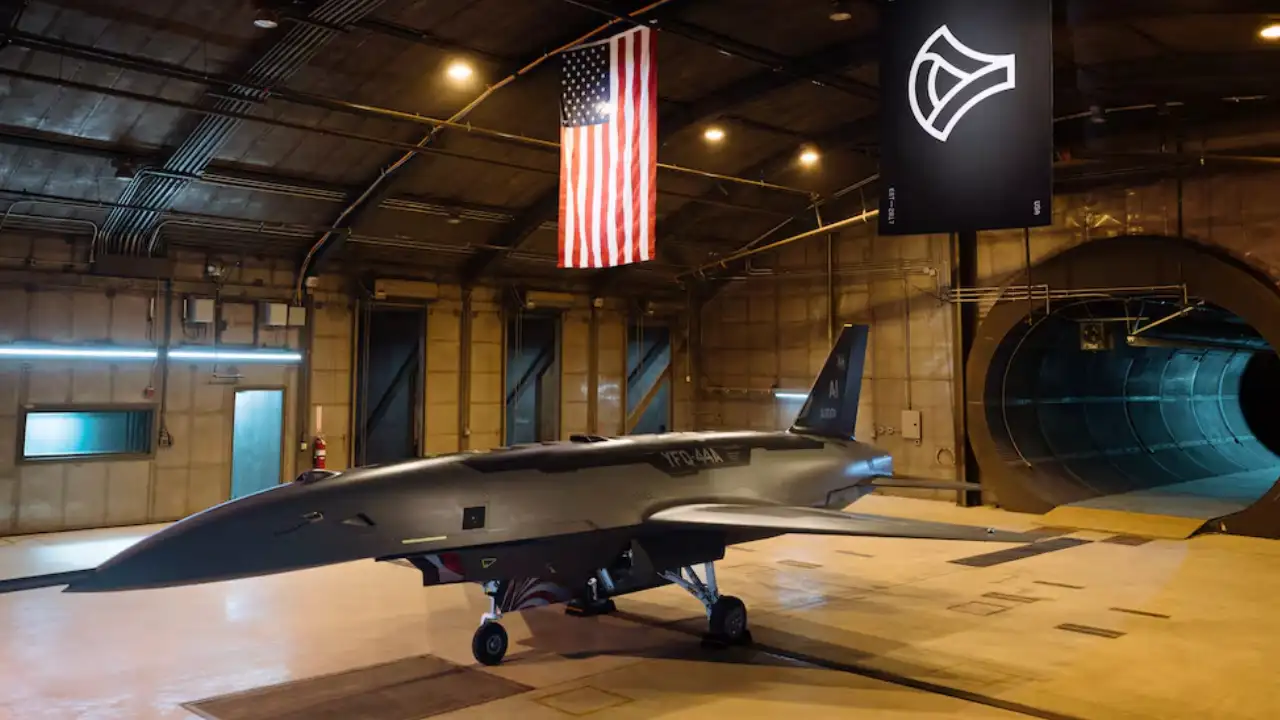
Anduril’s Drone Wingman Nears Historic First Flight
Anduril Industries is set to conduct the first flight of its YFQ-44A collaborative combat aircraft (CCA) in mid-October, marking a critical milestone in the U.S. Air Force’s push to field drone wingmen for crewed fighters. The flight, expected to take place in California, will test the aircraft’s ability to operate semiautonomously from takeoff to landing—without traditional remote piloting.
The YFQ-44A is one of two candidates for the Air Force’s CCA program, alongside General Atomics’ YFQ-42A, which successfully flew in August. Both firms were awarded initial contracts in 2024 to design and build prototypes under a program the service sees as pivotal to future air dominance.
Semiautonomy From the Start
Unlike its competitor, Anduril is skipping the remote-control stage. According to company executives, the YFQ-44A has been designed from the outset to execute flight profiles with autonomy software, including automated taxiing, takeoff, and landing at the push of a button.
“There is no stick and throttle,” said Diem Salmon, vice president for air dominance and strike at Anduril. “It will be able to execute the first flight profile, preplanned, using autonomy software on the vehicle.”
This approach, though slower to reach first flight, is intended to accelerate long-term testing and integration. By tackling autonomy challenges upfront, Anduril believes it can “leapfrog” the traditional development cycle.
Air Force’s Collaborative Combat Aircraft Vision
The U.S. Air Force envisions a fleet of at least 1,000 CCAs to accompany fifth- and sixth-generation fighters like the F-35 Lightning II and forthcoming F-47. These drones are expected to perform strike missions, reconnaissance, electronic warfare, and decoy operations.
In May, Air Force Chief of Staff Gen. David Allvin said CCAs would feature stealth comparable to the F-35, a combat radius of more than 700 nautical miles, and be operational later this decade. That range exceeds that of the F-35A and even the F-22, providing greater mission flexibility in the vast Indo-Pacific theater.
Competition and Diverging Paths
While General Atomics’ YFQ-42A is already flying under remote control, the company stresses its long experience with autonomy through platforms like the MQ-9 Reaper and Avenger. General Atomics argues that piloted test flights reduce risk and yield valuable data.
Anduril, by contrast, has invested heavily in a “clean-sheet” software design for semiautonomous flight. Jason Levin, senior vice president of engineering at Anduril, said the company avoided developing a ground control station in favor of solving autonomy from day one.
Analysis: What This Means for U.S. Defense
The Air Force’s CCA initiative represents a shift from expensive, pilot-centric platforms toward affordable mass and attritable assets. By pairing advanced fighters with lower-cost autonomous wingmen, the service aims to stretch budgets while complicating adversary planning.
For the U.S., this could mean greater ability to deter China in the Pacific, where large distances demand aircraft with long ranges and endurance. If successful, Anduril’s software-first approach may also influence future unmanned systems across the Pentagon, from naval drones to autonomous ground combat vehicles.
Globally, the race to integrate autonomy into combat aircraft is accelerating. China has showcased its own loyal wingman projects, while Australia’s MQ-28 Ghost Bat has already flown operational tests. The U.S. cannot afford delays if it hopes to maintain an edge.
Conclusion: A Turning Point in Air Combat Development
Anduril’s upcoming YFQ-44A flight is more than just a technical milestone—it could signal a turning point in how the Air Force develops and fields unmanned combat systems. By embedding autonomy from the beginning, Anduril is betting on a faster path to scalable, mission-ready CCAs.
If the program delivers, the Air Force may enter the 2030s with not only stealth fighters but also a loyal wingman fleet capable of reshaping air warfare.

10 comments
[…] China are investing heavily, with systems like Russia’s Avangard HGV, China’s DF-17, and the U.S. Air Force’s AGM-183 ARRW under […]
[…] sixth-generation stealth fighter. The objective: develop a multirole, stealth-optimized, networked combat aircraft capable of manned-unmanned teaming, advanced sensors, internal weapon bays and long-range global […]
[…] in “loyal wingman” or unmanned combat aircraft (UCA) is well established. Programs such as the Collaborative Combat Aircraft (CCA) initiative seek to pair unmanned platforms with crewed jets for distributed operations. The […]
[…] The JAS 39 Gripen, first introduced in the 1990s, was designed to give smaller air forces a capable, affordable alternative to heavy twin-engine fighters like the F-15 or Eurofighter Typhoon. Known for its short takeoff capability, advanced avionics, and low maintenance requirements, the Gripen has earned a reputation as one of the world’s most efficient fourth-generation combat aircraft. […]
[…] aircraft involved are workhorses of the carrier air wing. The MH-60R Sea Hawk is a multi-mission maritime helicopter tailored for anti-submarine and […]
[…] industry and the Air Force are laying the technical and doctrinal foundation for scalable Collaborative Combat Aircraft […]
[…] inherently carry risk, especially when combat aircraft perform demonstration flights. The Tejas crash underscores how even mature platforms can face performance issues or pilot error […]
[…] where uncrewed or autonomous partners operate alongside manned fighters. These concepts include collaborative combat aircraft, sometimes called drone wingmen, which could perform tasks such as air-to-air engagement or […]
[…] next round of diplomatic engagement is expected soon, even as military preparations continue in […]
[…] The award aligns with the Air Force push for collaborative combat aircraft and attritable […]