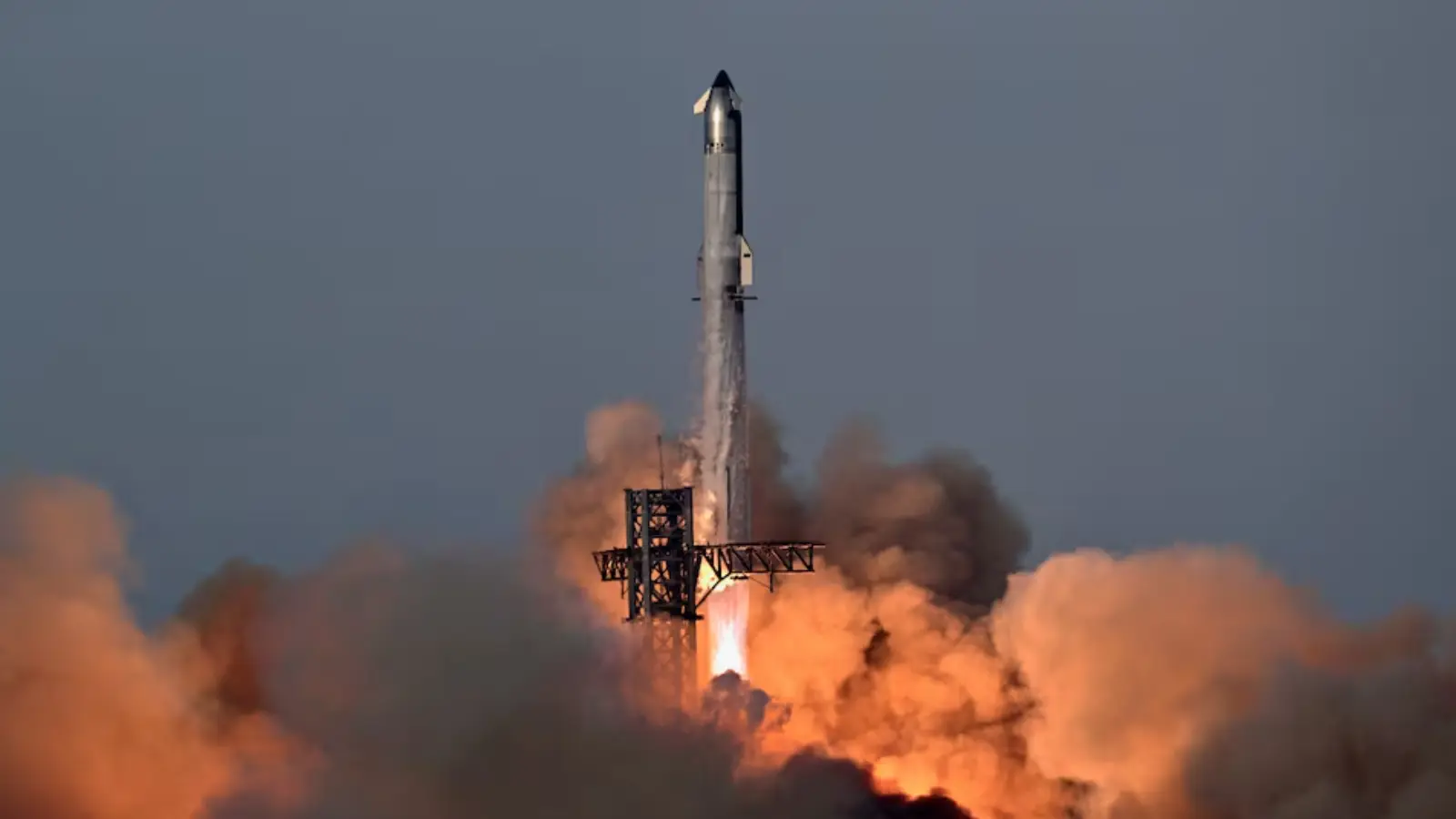
Executive Summary: SpaceX President Gwynne Shotwell has privately told FAA Administrator Bryan Bedford that the company is targeting 10,000 rocket launches per year within five years — a roughly 60-fold increase over its current pace. Bedford disclosed this figure publicly on May 21, 2026, while cautioning that regulatory approval at that scale will require dramatic improvements in launch reliability. The disclosure carries significant implications for U.S. national security space architecture, satellite communications, and American strategic superiority in the emerging space domain.
SpaceX Pushes For 10,000 Annual Launches As FAA Signals Reliability Must Come First
SpaceX has set an audacious target of 10,000 rocket launches per year within the next five years, a figure disclosed publicly by Federal Aviation Administration Administrator Bryan Bedford following a direct meeting with SpaceX President Gwynne Shotwell.
The FAA chief confirmed that Shotwell told him about the company’s five-year vision to reach 10,000 launches annually, but warned that government officials would need to see significantly improved reliability before any such expansion could be approved.
The revelation, made at a public forum in Arlington, Virginia, reframes the scale of America’s commercial space ambitions — and the regulatory infrastructure required to support them.
The Numbers Behind The Goal
SpaceX currently flies approximately 160 orbital missions per year, completing 154 launches in 2025 and reaching 50 by late April 2026. The entire world managed roughly 250 launches last year.
The 10,000-launch target represents a roughly 60-fold increase over SpaceX’s own current pace and a 40-fold increase over total global launch output. The FAA has currently approved SpaceX for a combined 195 launches per year across its four active sites, with the Starbase facility in Texas holding a 25-launch annual cap after the FAA raised it from five in May 2025.
Put plainly: SpaceX is proposing to do in one year what the entire global launch industry cannot do in 40.
The scale of this ambition is not purely commercial. For U.S. defense planners, a dramatically higher launch cadence translates directly into faster deployment of intelligence, surveillance, and reconnaissance (ISR) satellites, resilient communications constellations, and potential space-based missile defense architecture — capabilities that rival powers China and Russia are actively seeking to counter or replicate.
FAA Taps The Brakes — But Signals Openness
Bedford was candid about both the opportunity and the regulatory challenge.
He told reporters the FAA would need to see substantially greater reliability from SpaceX before approving a dramatic expansion. “We need to see a lot more reliability,” Bedford said. He added that the FAA was reviewing data from prior launches to better understand risks, and noted that safety protocols — including barring flights in certain airspace corridors at launch time — could become highly disruptive at extreme cadence.
Bedford also said the FAA was not currently the primary limiting factor for space launches, but warned: “I can see a future where we will be the limiting factor, because we are not putting enough funding into our space team.”
That statement has immediate policy implications. If the U.S. government views high-cadence commercial launches as strategically important — and the Pentagon’s growing reliance on commercial space assets suggests it does — then FAA staffing and funding will become a national security question, not merely a bureaucratic one.
Bedford noted that the purpose of his meeting with Shotwell was to work through constraints and plan ahead. “What can we do planning-wise now to put ourselves in a position to accommodate that type of a stretch goal,” he said.
Musk’s Vision And The Satellite Mega-Constellation
In a Forbes video interview that aired this week, SpaceX CEO Elon Musk confirmed the company already has 10,000 Starlink satellites in orbit and eventually wants to launch 10,000 communications satellites per year, though he did not specify a timeline. Separately, SpaceX announced in January that it intends to launch a constellation of 1 million satellites to orbit Earth and harness solar energy to power AI data centers.
The target also aligns with Musk’s March 31 post on X, in which he stated: “In 4 or 5 years, there will be a launch every hour” — which would equate to approximately 8,760 launches annually, slightly below the 10,000 figure Shotwell disclosed to Bedford.
The convergence of these statements suggests that the 10,000-launch figure is not an off-the-cuff projection but a coordinated internal target that SpaceX is now surfacing to regulators.
Strategic & Defense Implications
From a defense and national security standpoint, a SpaceX operating at 10,000 annual launches would fundamentally alter the geometry of space as a warfighting domain.
The U.S. Space Force and the National Reconnaissance Office have increasingly relied on commercial launch providers — SpaceX in particular — for rapid deployment of classified satellites. A launch cadence approaching dozens of missions per day would enable on-demand reconstitution of degraded satellite constellations, a key vulnerability that adversaries have identified and targeted in doctrine.
SpaceX conducted 170 launches in 2025 alone, deploying approximately 2,500 satellites in a single year. Scaling that by a factor of 60 would mean tens of thousands of new satellites entering orbit annually — potentially overwhelming any adversary’s ability to track, target, or neutralize American space assets.
President Donald Trump has stated his intent to return Americans to the moon before 2028, and Bedford connected that goal directly to the need for regulatory and industry partnership: “To do that, we are going to have to work with industry to unlock that innovation,” he said.
The lunar timeline and the 10,000-launch target are not unrelated. High-cadence Starship launches from Starbase would be central to any sustained lunar logistics architecture under NASA’s Artemis program.
The Reliability Hurdle
The FAA’s emphasis on reliability is not merely procedural. At extreme launch cadence, a single vehicle anomaly could cascade into prolonged airspace closures, satellite debris events, or mission failures with national security consequences.
Bedford acknowledged that launch-related airspace restrictions can already be “very disruptive” and indicated the agency is examining prior launch data to better model risk at scale.
SpaceX has not publicly responded to the 10,000-launch figure or the FAA’s reliability conditions. The company’s Falcon 9 booster reuse program has demonstrated strong consistency — the vehicle has now flown individual boosters more than 25 times — but Starship, the heavy-lift system central to any hyper-cadence scenario, remains in active development with an evolving flight record.
Conclusion: A Regulatory Race With Strategic Stakes
SpaceX’s five-year vision represents one of the most consequential proposals in the history of commercial spaceflight. Whether the company can technically execute — and whether the FAA can build the regulatory infrastructure to accommodate it — will shape not just the commercial launch market but American strategic posture in space for the next generation.
The FAA under Bedford appears to be approaching the challenge seriously rather than dismissively. That posture signals that Washington recognizes the strategic weight of what SpaceX is proposing. The next milestone to watch: whether future FAA licensing reviews begin to reflect the infrastructure, staffing, and policy frameworks needed to manage a launch rate of this magnitude.
For now, 10,000 annual launches remains a declared goal. Whether it becomes operational reality will depend on reliability, funding, and regulatory will — in equal measure.