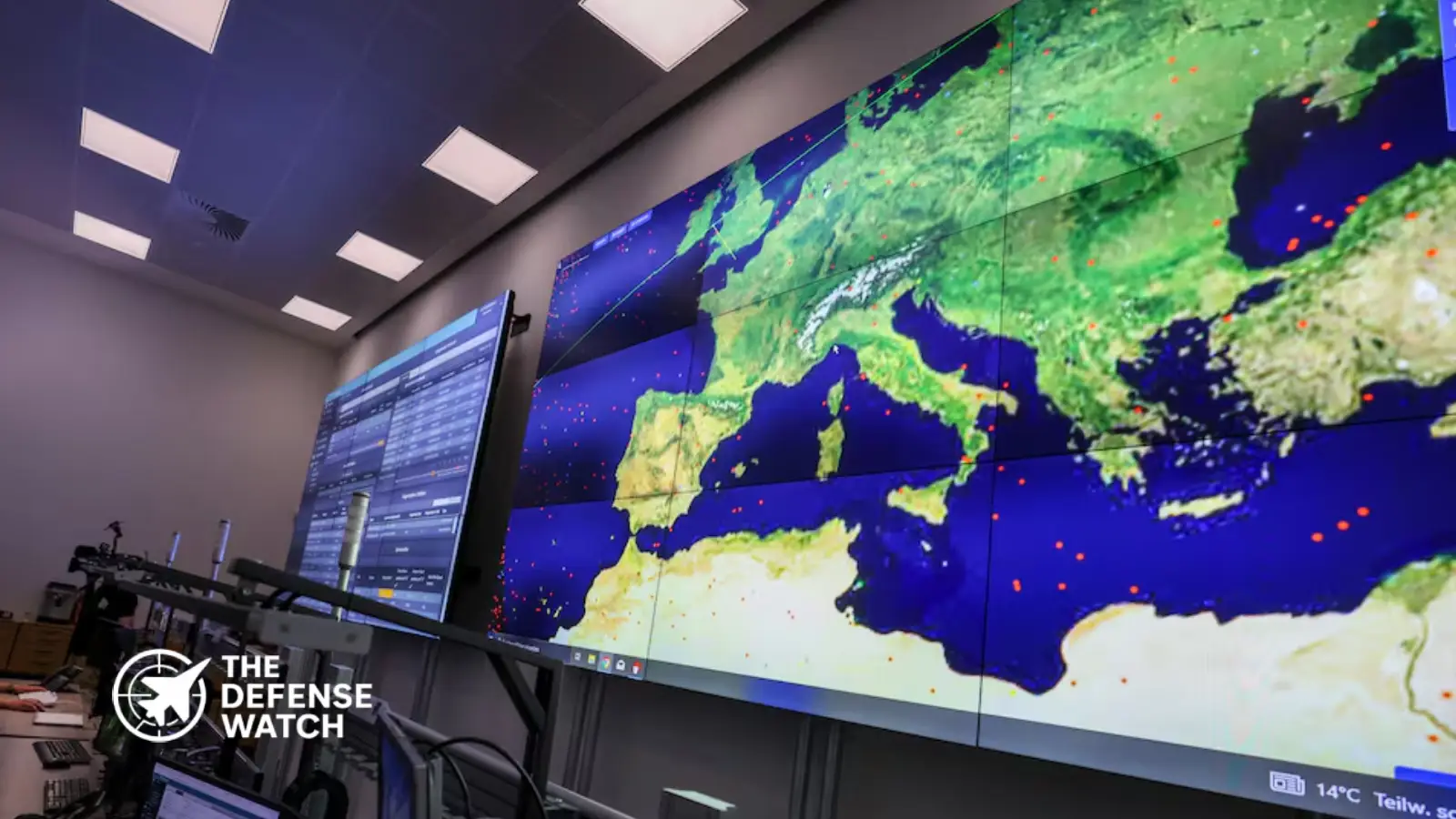
Executive Summary: Germany’s Defense Minister Boris Pistorius has unveiled plans for a European Space Component Command and a multilateral space training academy, inviting Austria, Switzerland, and Luxembourg to co-design — not just adopt — the initiative. The move is backed by Germany’s €35 billion ($40.7 billion) military space investment and reflects a broader European drive to reduce strategic dependence on U.S. space infrastructure.
Germany Unveils European Space Command Blueprint In Push For Strategic Autonomy
VIENNA — Germany is moving decisively to anchor a new European military space architecture, with Defense Minister Boris Pistorius using a rare quadrilateral summit of German-speaking defense chiefs in Berlin this week to formally introduce the concept of a European Space Component Command.
The initiative, paired with a proposed Weltraumakademie — a multilateral military space training academy — signals Berlin’s ambition to become the institutional center of gravity for European space defense, at a moment when the continent is accelerating efforts to reduce its reliance on U.S. technology providers.
The DACH+L Format: A New Defense Dialogue Takes Shape
The May 18 gathering, billed as the inaugural “DACH+L” ministerial, expanded the established German-Austrian-Swiss trilateral defense format to include Luxembourg for the first time. The symbolism was deliberate: a broader coalition of aligned, if sometimes constitutionally constrained, nations coordinating on the most strategically sensitive domain in modern warfare — space.
Pistorius made clear that partner nations would not be handed a finished construct. Austria, Switzerland, and Luxembourg, he said, will be “embedded in the design phase” — a significant concession that suggests Berlin is pursuing genuine multilateral buy-in rather than simply asking smaller nations to join a German-led framework.
€35 Billion Space Investment: What Germany Is Building
Germany’s military space ambitions are not rhetorical. The program, pledged last fall, encompasses:
- Encrypted low-earth-orbit (LEO) satellite constellations for secure military communications
- Military-grade domestic launch capacity
- Expansion of the Bundeswehr Space Command, headquartered in Uedem, Germany
The European Space Component Command being developed alongside these national investments would serve as the broader coalition layer — a shared command-and-control architecture integrating allied space assets across participating nations.
The €35 billion commitment, equivalent to roughly $40.7 billion, represents one of the most significant defense space investments in European history. Analysts note that the scale reflects both the capability gap Europe faces and the geopolitical pressure that has made closing it urgent.
Austria: Military Satellites on a Startup Budget
Austria’s Defense Minister Claudia Tanner used the Berlin summit to reaffirm a striking national ambition: placing three operationally designated military satellites and a test object into orbit as early as next year — developed in part with Austrian commercial startups.
The program centers on two distinct projects:
- LEO2VLEO — a joint initiative with the Netherlands focused on imaging and navigation in very low Earth orbit
- BEACONSAT — an Austrian military navigation satellite built for under €1 million ($1.16 million)
Tanner framed the satellites not as purely national assets but as capabilities to be shared with partners, emphasizing communications independence in a crisis scenario. The low unit cost of the BEACONSAT program underscores how smaller European nations are finding cost-effective pathways into the military space domain.
Austria’s participation carries a notable geopolitical dimension. Constitutionally neutral, Vienna has nonetheless deepened its defense integration with European partners significantly since Russia’s invasion of Ukraine. Austria’s 2023 accession to the German-led European Sky Shield Initiative, alongside Switzerland, marked a turning point in how both nations interpret their neutrality obligations in practice.
Luxembourg and Switzerland: Niche Capabilities, Shared Urgency
Luxembourg’s Defense Minister Yuriko Backes, attending a DACH-format meeting for the first time, pointed to her country’s established strengths in satellite communications and Earth observation — capabilities she described as ones Luxembourg is “very willing to make available to allies and partners.
Backes and Tanner both referenced a forthcoming bilateral cooperation agreement on satellite use, expected to be formalized in July, though neither elaborated on specific terms.
Swiss Federal Councilor Martin Pfister delivered perhaps the summit’s sharpest assessment: there is no domain, he said, where Europe faces a greater dependency on non-European technology providers than in space. “It is not possible for one country to solve this alone,” Pfister stated, while pointing to Swiss state-owned firm Beyond Gravity as a potential industrial contributor to a European solution.
Switzerland’s deepening engagement in European defense structures mirrors Austria’s trajectory. Both nations joined the European Sky Shield Initiative in 2023 in what was widely viewed as a significant recalibration of traditional neutrality doctrine under the pressure of a land war on the continent.
Locked Shields: Operational Cohesion Beyond Space
The Berlin summit produced at least one concrete deliverable. On the cyber front, the four DACH+L nations placed second at NATO’s Locked Shields exercise in April, competing under German leadership — a result that underscores the group’s growing operational coherence beyond the space domain.
The meeting’s overall output on space remains largely conceptual at this stage. What the summit produced in practical terms was political alignment: a reaffirmation of cooperation threads already underway, and a shared public commitment to the European Space Component Command framework going forward.
Why This Matters: The Transatlantic Dimension
The timing of Germany’s push is not coincidental. Across NATO capitals, the question of strategic dependence on U.S. space, communications, and intelligence infrastructure has moved from a theoretical concern to an operational priority. Europe’s ability to sustain military operations independently — whether in a contingency where U.S. support is limited, delayed, or conditional — increasingly turns on whether the continent possesses its own assured access to space-based services.
Germany’s €35 billion investment, the DACH+L command initiative, and Austria’s satellite program all represent concrete steps toward that autonomy. But observers note that the gap between political momentum and deployable capability remains substantial. Concepts like the European Space Component Command require agreed command structures, interoperability standards, funding commitments, and industrial delivery — each of which takes years to mature.
What Berlin has demonstrated this week is that it understands the urgency, and that it is working to build the coalition architecture required to close that gap.
Analysis: Germany’s Strategic Calculus
Germany’s hosting of the DACH+L forum reflects a broader strategic posture. Berlin is increasingly willing to serve as the anchor for European defense integration — not just financially, but institutionally. The design of the European Space Component Command as a collaborative architecture rather than a purely German-led structure is a deliberate signal: Berlin wants partners invested in the outcome, not merely compliant with it.
For the United States, the development is worth watching carefully. A Europe with genuinely independent military space capabilities is a more capable NATO partner — but also one with greater freedom of action. That dynamic is becoming central to transatlantic defense planning as both sides recalibrate their assumptions about allied interdependence in an era of strategic competition.