

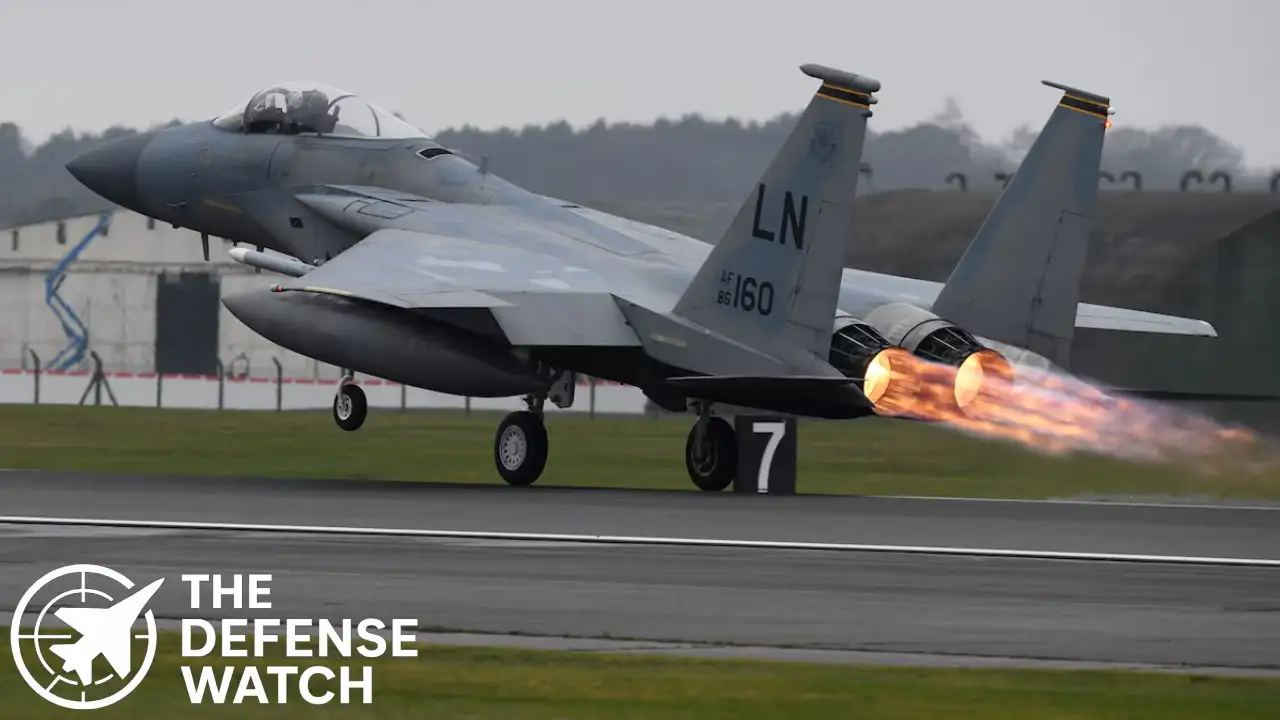
Why the F-15 Fighter Jet Still Matters
Few combat aircraft have achieved the reputation of the F-15 fighter jet, a platform that has defined U.S. and allied airpower since the mid-1970s. Developed by McDonnell Douglas (now Boeing), the F-15 was designed as a pure air superiority fighter to ensure the U.S. Air Force could defeat Soviet aircraft during the Cold War.
Half a century later, the aircraft is still in frontline service, upgraded and adapted for new missions ranging from strike to electronic warfare. Its latest variant, the F-15EX Eagle II, represents an effort to extend the aircraft’s relevance into the next generation, balancing payload and survivability against stealth-centric designs like the F-35.
Origins of the F-15 Fighter Jet
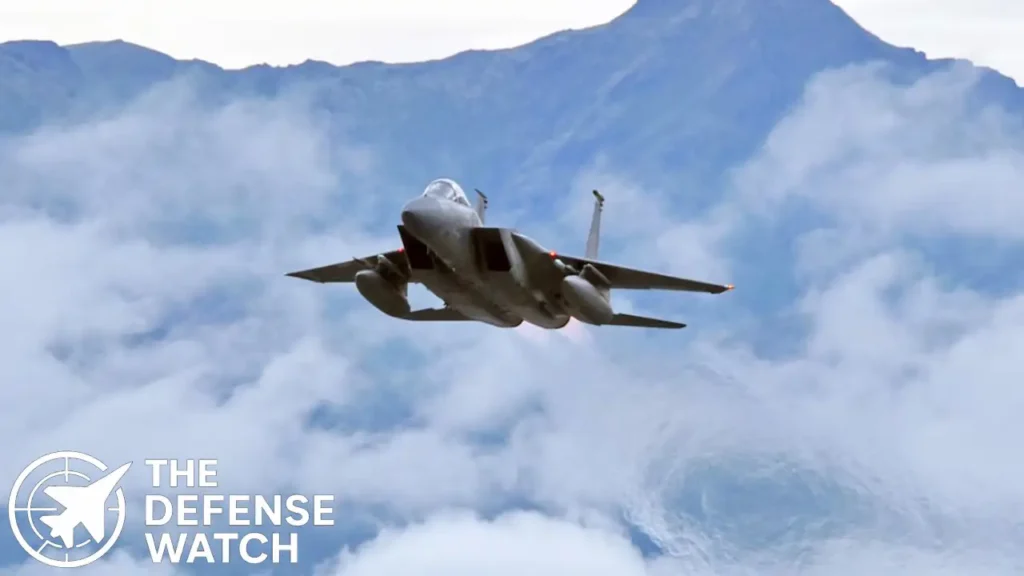
The program for the F-15 began in the late 1960s after the U.S. Air Force sought a dedicated air superiority fighter following lessons from Vietnam. McDonnell Douglas won the contract in 1969, and the first flight took place in 1972.
When it entered service in 1976, the F-15 Eagle was revolutionary: twin-engine reliability, a large radar aperture, and a thrust-to-weight ratio greater than 1:1, allowing it to accelerate while climbing vertically.
From the outset, the F-15’s motto was clear: “Not a pound for air-to-ground.” It was built to dominate the skies, a role in which it still boasts a remarkable combat record.
Combat Record and Legacy
The F-15 fighter jet has accumulated one of the most impressive records in aerial combat: over 100 air-to-air kills with zero losses in air-to-air engagements, largely credited to Israeli, Saudi, and U.S. Air Force operations.
- Israel first used the F-15 in combat in 1979, scoring dozens of kills over Syrian aircraft in Lebanon.
- Saudi F-15s achieved kills during the Iran–Iraq War and later in Desert Storm.
- The U.S. Air Force relied heavily on the F-15C for air dominance during Operation Desert Storm (1991), where it achieved the majority of coalition air-to-air kills.
This legacy gave the F-15 a reputation as one of the most successful fighter designs ever fielded.
Evolution of the F-15 Variants
Over time, the F-15 family expanded to meet changing requirements:
- F-15A/B (1970s) – Original single- and two-seat versions for air superiority.
- F-15C/D (1980s) – Improved avionics, conformal fuel tanks, and extended range.
- F-15E Strike Eagle (1988 onward) – A dual-role fighter capable of precision strike and deep interdiction, with two-seat cockpit for pilot and weapons officer.
- F-15SA / F-15QA – Advanced export variants with digital flight controls, modern avionics, and expanded payloads for Saudi Arabia and Qatar.
- F-15EX Eagle II (2020s) – The newest U.S. variant with advanced electronic warfare systems, modern cockpit displays, fly-by-wire controls, and hypersonic weapon compatibility.
The F-15EX: Future of the Eagle
The U.S. Air Force ordered its first F-15EX Eagle II aircraft in 2020 to replace aging F-15C/D fleets.
Key features include:
- Payload capacity: up to 29,500 lbs, the heaviest among U.S. fighters.
- Weapons carriage: 12 AMRAAM-class missiles or a mix of bombs, missiles, and hypersonics.
- EPAWSS electronic warfare suite for survivability in contested airspace.
- Digital backbone enabling faster software updates and integration with unmanned systems.
- Two-seat design adaptable for collaborative combat with drones.
Unlike stealth aircraft, the F-15EX is designed to carry heavy payloads and serve as a “weapons truck,” complementing stealth fighters in large-scale operations.
Global Operators of the F-15 Fighter Jet
The F-15 remains in use across several air forces:
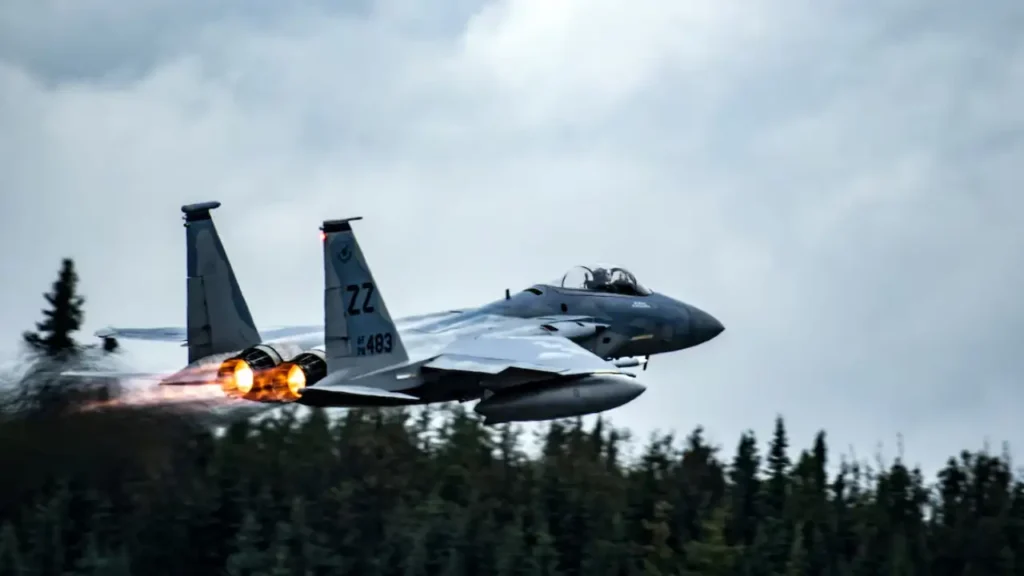
- United States – Operates F-15C/D, F-15E Strike Eagle, and now F-15EX.
- Israel – One of the earliest and most effective operators.
- Saudi Arabia – Fields one of the largest F-15 fleets, including advanced F-15SA.
- Japan – Locally produced under license; now upgrading to F-15JSI standard.
- Qatar – Fields the latest F-15QA variant.
- South Korea & Singapore – Both operate the Strike Eagle variant.
These nations highlight the F-15’s continued relevance, with several investing in modernization programs rather than retiring the type.
Analysis: The F-15’s Place in the Modern Era
Despite its legacy, the F-15 fighter jet competes in an era dominated by stealth, network-centric warfare, and emerging sixth-generation projects. Critics argue that in heavily defended airspace, its non-stealth profile limits survivability.
Yet, the F-15 offers advantages:
- unmatched payload capacity,
- proven range and reliability,
- ability to integrate future weapons like hypersonics.
For the U.S. and allies, the F-15EX provides a cost-effective bridge between legacy fourth-generation aircraft and future sixth-generation systems like NGAD (Next Generation Air Dominance). Its role as a complement — not competitor — to stealth platforms gives air forces flexibility in planning strike packages.
FAQs
Its combination of speed, power, and payload has made it one of the most successful fighters in history, with an undefeated air-to-air record.
The F-15EX Eagle II, now entering U.S. Air Force service.
The F-15 can reach speeds of Mach 2.5 (around 1,650 mph).
At least eight countries, including the U.S., Israel, Japan, Saudi Arabia, South Korea, Qatar, and Singapore.
Yes. With upgrades and new variants like the F-15EX, the fighter is expected to remain operational well into the 2040s.

2 comments
[…] under the Lightweight Fighter (LWF) program, which sought a cost-effective, highly maneuverable jet to complement heavier fighters like the F-15 Eagle. General Dynamics (later acquired by Lockheed Martin) won the competition with a design that […]
[…] the past 24 hours, 12 F-15 fighter jets arrived in Jordan, with more air assets heading to the region, while strategic airlift has landed […]