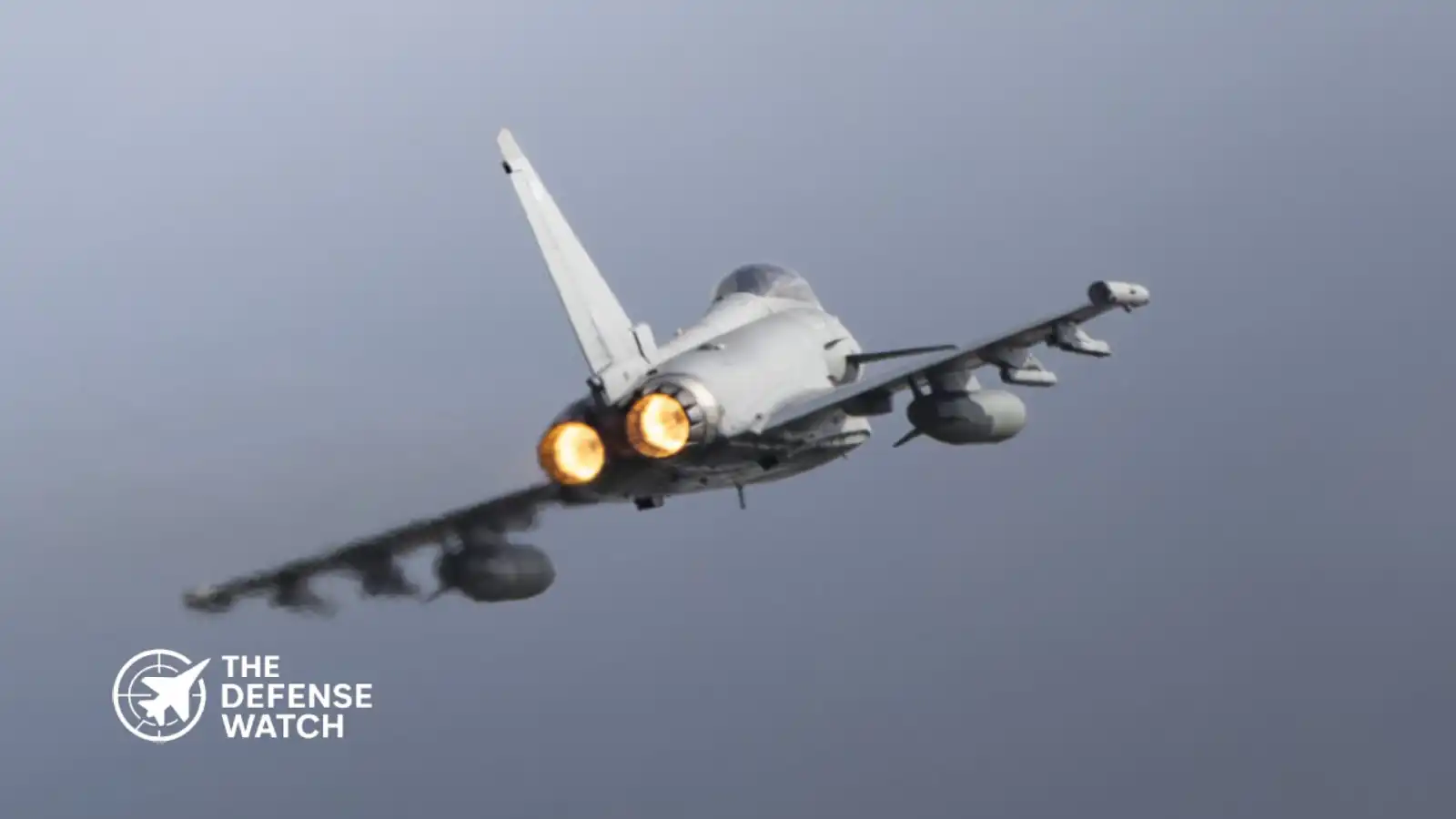
Executive Summary:
The Royal Air Force has deployed Eurofighter Typhoon jets to patrol NATO’s eastern flank, reinforcing alliance air defense. The missions aim to deter potential airspace violations and reassure member states amid ongoing regional tensions. The deployment reflects NATO’s continued emphasis on rapid response and collective security.
RAF Typhoons Strengthen NATO Air Policing Mission
The Royal Air Force has intensified its contribution to NATO air policing operations by deploying Eurofighter Typhoon fighters to the alliance’s eastern flank. These missions are part of NATO’s standing effort to secure allied airspace and deter unauthorized or hostile aircraft activity near its borders.
Operating from forward bases in Eastern Europe, RAF Typhoons conduct quick reaction alert sorties, intercept missions, and joint training exercises with allied air forces. The deployment comes amid sustained geopolitical tensions, particularly involving Russian military aviation activity near NATO airspace.
Operational Role and Mission Profile
The Typhoon is a cornerstone of NATO’s air defense architecture due to its speed, agility, and advanced sensor suite. RAF crews are tasked with:
- Intercepting unidentified aircraft approaching NATO-controlled airspace
- Conducting air-to-air patrols to maintain persistent presence
- Participating in joint exercises to enhance interoperability
- Supporting quick reaction alert (QRA) readiness at all times
These missions are coordinated through NATO’s integrated air and missile defense system, ensuring seamless communication and rapid response across multiple member states.
Eurofighter Typhoon vs Legacy Air Policing Platforms
Platform Range Payload Status Key Technology Eurofighter Typhoon ~2,900 km ~7,500 kg Active AESA radar, supercruise, advanced EW suite Panavia Tornado F3 ~1,850 km ~6,000 kg Retired Pulse-Doppler radar, legacy avionics F-16 Fighting Falcon ~2,200 km ~7,700 kg Active (NATO) Multirole radar, proven combat record Technical Advantages of the Typhoon Platform
- Supercruise capability, allowing sustained supersonic flight without afterburners
- Advanced Captor radar systems, improving detection and tracking range
- Integrated electronic warfare suite for survivability in contested environments
- High thrust-to-weight ratio, enhancing maneuverability in interception scenarios
- Compatibility with NATO data links, enabling real-time information sharing
Strategic Context: NATO’s Eastern Flank and Deterrence Posture
NATO’s eastern flank has become a focal point of alliance defense planning since the Annexation of Crimea and subsequent tensions between Russia and Western nations. Increased Russian air activity near Baltic and Black Sea regions has prompted NATO to expand its air policing rotations.
The RAF deployment serves several strategic purposes:
- Deterrence: Demonstrates NATO’s readiness to defend its airspace
- Reassurance: Signals commitment to Eastern European allies
- Interoperability: Strengthens coordination among multinational forces
The presence of advanced fighters like the Typhoon complicates any potential adversary’s operational planning, raising the cost of airspace incursions.
Broader Implications for European Air Security
The continued use of Typhoon jets in NATO missions underscores a shift toward high-readiness, technologically advanced air forces capable of rapid deployment. As NATO adapts to evolving threats, including hybrid warfare and advanced aerial platforms, air policing missions are becoming more complex and strategically significant.
The RAF’s role highlights the UK’s ongoing commitment to collective defense, even as broader geopolitical dynamics continue to evolve across Europe.