Takeaways
Key facts from the F-15 Eagle Crest contract
1. $131.23 Billion Contract Ceiling
The Air Force awarded Boeing an indefinite-delivery/indefinite-quantity contract with a maximum ceiling of $131.23 billion for F-15-related work.
2. No Aircraft Were Ordered at Award
The contract establishes a framework for future orders. The award notice did not include an order for a specific number of F-15 aircraft.
3. Work Extends Through 2037
The contract covers production, modernization, upgrades, retrofits, sustainment and organic depot maintenance capabilities through August 2037.
4. Seven Foreign Customers Are Listed
The contract involves Foreign Military Sales cases involving Japan, Israel, Saudi Arabia, South Korea, Singapore, Indonesia and Poland.
The U.S. Air Force has awarded Boeing a $131.23 billion ceiling indefinite-delivery/indefinite-quantity contract covering production, modernization, upgrades, retrofits and sustainment of the F-15 fighter family. The contract also establishes organic depot maintenance capabilities and supports both U.S. and foreign customers.
According to the U.S. Department of War contract announcement dated Aug. 24, 2026, the award was made to Boeing through a sole-source acquisition for the F-15 Eagle Crest program. The work will be performed in St. Louis, Missouri, and is expected to continue through August 2037.
The size of the contract ceiling is significant, but it should not be interpreted as $131.23 billion already committed to Boeing. The IDIQ structure provides the government with a framework under which future orders can be placed over time. Only $343,740 in fiscal 2026 research, development, test and evaluation funding was obligated when the contract was awarded.
What the Contract Covers
The F-15 Eagle Crest contract brings several categories of F-15 work under one acquisition framework.
The official notice lists:
- Aircraft production
- Systems integration
- Modernization
- Upgrades
- Retrofits
- Sustainment
- Establishment of organic depot maintenance capabilities
The work supports the Air Force, Air National Guard and other Department of War customers. The contract also incorporates Foreign Military Sales requirements for seven countries.
The ordering period is expected to run through Aug. 24, 2031, with an option allowing the period to be extended to Aug. 24, 2036. The overall contract is expected to be completed by August 2037.
Importantly, the Aug. 24 award did not include an order for a specific number of F-15 aircraft. Future production or modernization requirements can therefore be placed through subsequent orders under the contract.
Technical and Operational Context
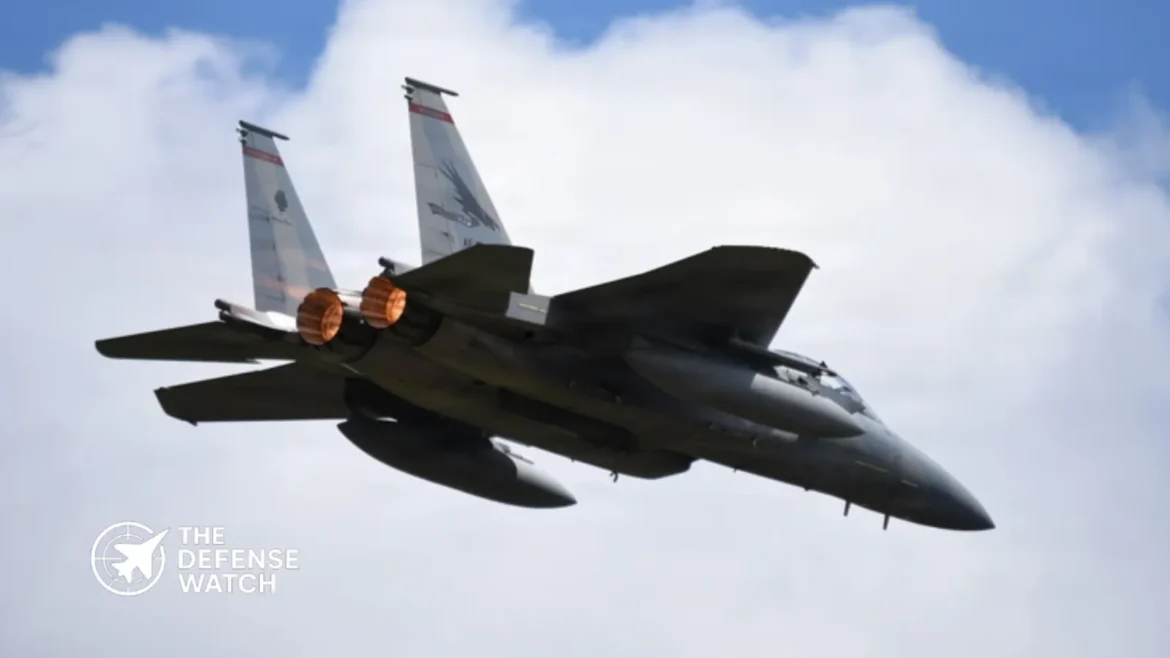
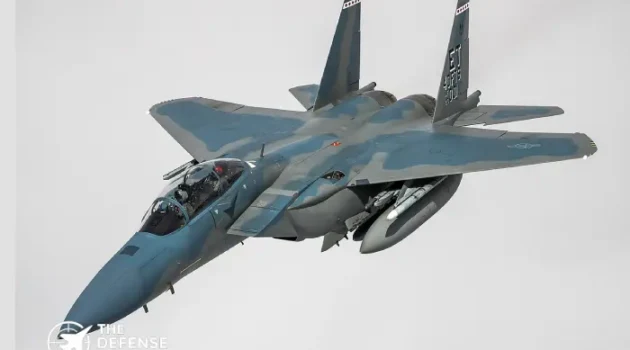
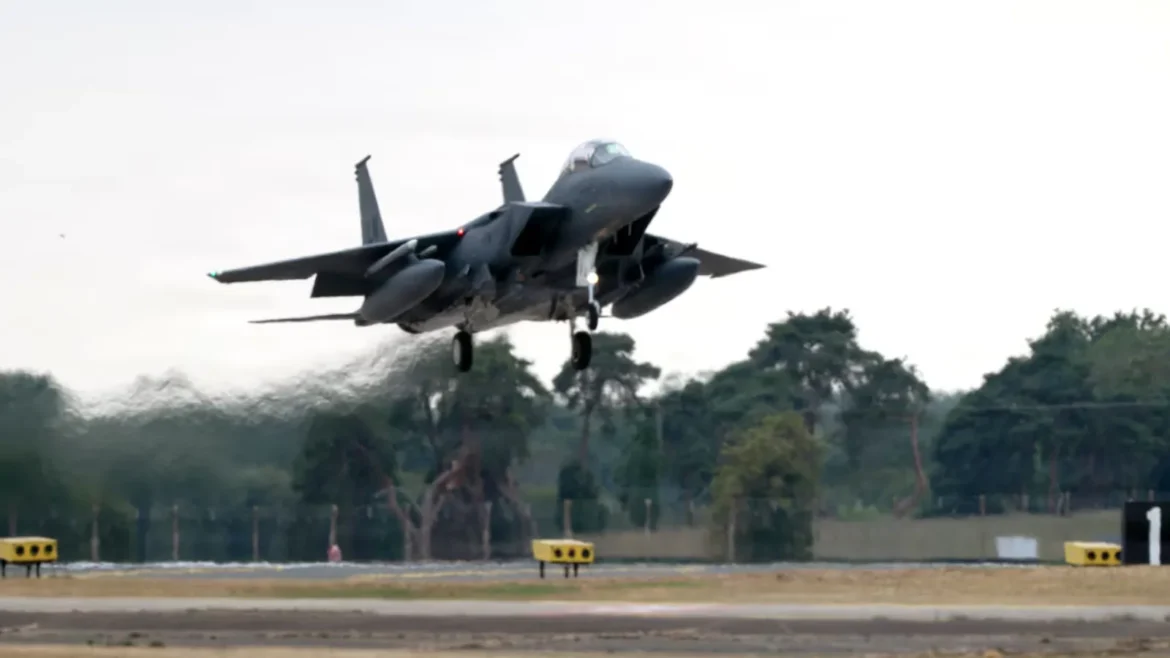
The F-15 family remains an important part of U.S. tactical aviation, while the F-15EX Eagle II represents the current production version being acquired by the Air Force.
Air Force budget documents describe the F-15EX as a multirole fighter based on the two-seat F-15QA configuration and equipped with U.S.-specific capabilities. The aircraft incorporates systems including the Eagle Passive Active Warning Survivability System, or EPAWSS, and an open mission systems architecture.
The Air Force’s fiscal 2027 procurement documentation lists F-15EX missions including defensive and offensive counter-air operations, homeland defense and operations in highly contested environments. The documents also indicate that F-15EX procurement and modernization activities extend into the early 2030s.
The new Eagle Crest framework is broader than simply buying new F-15EX aircraft. Its inclusion of modernization, retrofit and sustainment work allows the government to address different requirements across the aircraft’s lifecycle.
Why the Award Matters
One important feature of the contract is its support for organic depot maintenance.
Under this approach, Air Force depots will gain the capability to conduct heavy maintenance and overhaul work on F-15 aircraft rather than depending exclusively on the original equipment manufacturer. Boeing will perform the contracted work in St. Louis, while the Air Force Life Cycle Management Center at Wright-Patterson Air Force Base, Ohio, serves as the contracting activity.
From an acquisition perspective, consolidating production, modernization, sustainment and depot-support activities into a long-term framework can give the service greater flexibility when requirements change. However, the contract ceiling itself does not establish how much of that potential value will ultimately be ordered.
The F-15EX program is also moving into a period of expanded procurement. Air Force fiscal 2027 budget documents show that the program’s overall procurement quantity can reach 268 aircraft when additional reconciliation-funded aircraft are included.
The aircraft is also being prepared for expanded operational use. In June 2026, F-15EX aircraft from the 85th Test and Evaluation Squadron deployed to Kadena Air Base, Japan, for integration and familiarization activities ahead of the aircraft’s longer-term role there.
Contract Breakdown
Contract Value
The maximum contract ceiling is $131.23 billion.
That figure represents the potential value of orders that can be placed under the IDIQ contract. It is not an immediate $131.23 billion expenditure or obligation.
Only $343,740 in fiscal 2026 RDT&E funding was obligated at the time of award.
Contractor
Boeing Co., St. Louis, Missouri, received the award through a sole-source acquisition.
Contract Type
The award is an indefinite-delivery/indefinite-quantity contract, commonly known as an IDIQ.
An IDIQ contract establishes the framework for future government orders without requiring the government to purchase the entire potential contract value when the framework is established.
Work Locations
The official contract notice identifies St. Louis, Missouri, as the work location.
Performance Period
The contract is expected to be completed by August 2037.
The ordering period is expected to end Aug. 24, 2031, with an option to extend the ordering period through Aug. 24, 2036.
Funding
The initial obligation consists of $343,740 in fiscal 2026 RDT&E funding.
The announcement did not identify a corresponding aircraft production order at the time of award.
Options or Follow-On Work
The contract allows orders to be placed through Aug. 24, 2031, with an option to extend the ordering period to Aug. 24, 2036.
Future aircraft production, upgrades, modernization, sustainment and other work would be ordered under the contract as requirements are established and funded.
Industry and Acquisition Implications
The award gives the Air Force a long-term contracting mechanism for maintaining and developing the F-15 fleet while supporting continued production of the F-15EX.
The foreign military sales component is also notable. The contract identifies Japan, Israel, Saudi Arabia, South Korea, Singapore, Indonesia and Poland as participating foreign customers.
Several of these countries already operate F-15 aircraft, while Indonesia and Poland are not current F-15 operators. The contract notice does not specify the individual quantities or configurations associated with each country’s FMS requirements.
Israel is already purchasing new F-15 aircraft from Boeing’s St. Louis production line. The fiscal 2027 F-15EX Selected Acquisition Report cited by Defense News identified a December 2025 agreement covering 25 F-15IA aircraft, with an option for another 25.
The broader production environment also remains relevant to the U.S. program. Air Force documentation reported that a 2025 strike at Boeing’s St. Louis facility interrupted F-15EX production, while subsequent Air Force reporting described efforts to resume deliveries and recover from the disruption.
What Happens Next
The next steps will come through individual orders placed against the Eagle Crest contract.
The Aug. 24 contract announcement does not specify the number of new aircraft to be purchased under the award, nor does it provide a detailed schedule for future production or modernization orders. Those details will become clearer as the Air Force places funded orders against the contract.
The long-term framework is expected to support F-15 production and sustainment through 2037, while the ordering authority can remain available until 2031 or, if exercised, 2036.
For the F-15EX program specifically, Air Force procurement documents show continued aircraft acquisition and modernization funding into the early 2030s, while operational units are preparing for the aircraft’s expanded role, including at Kadena in Japan.