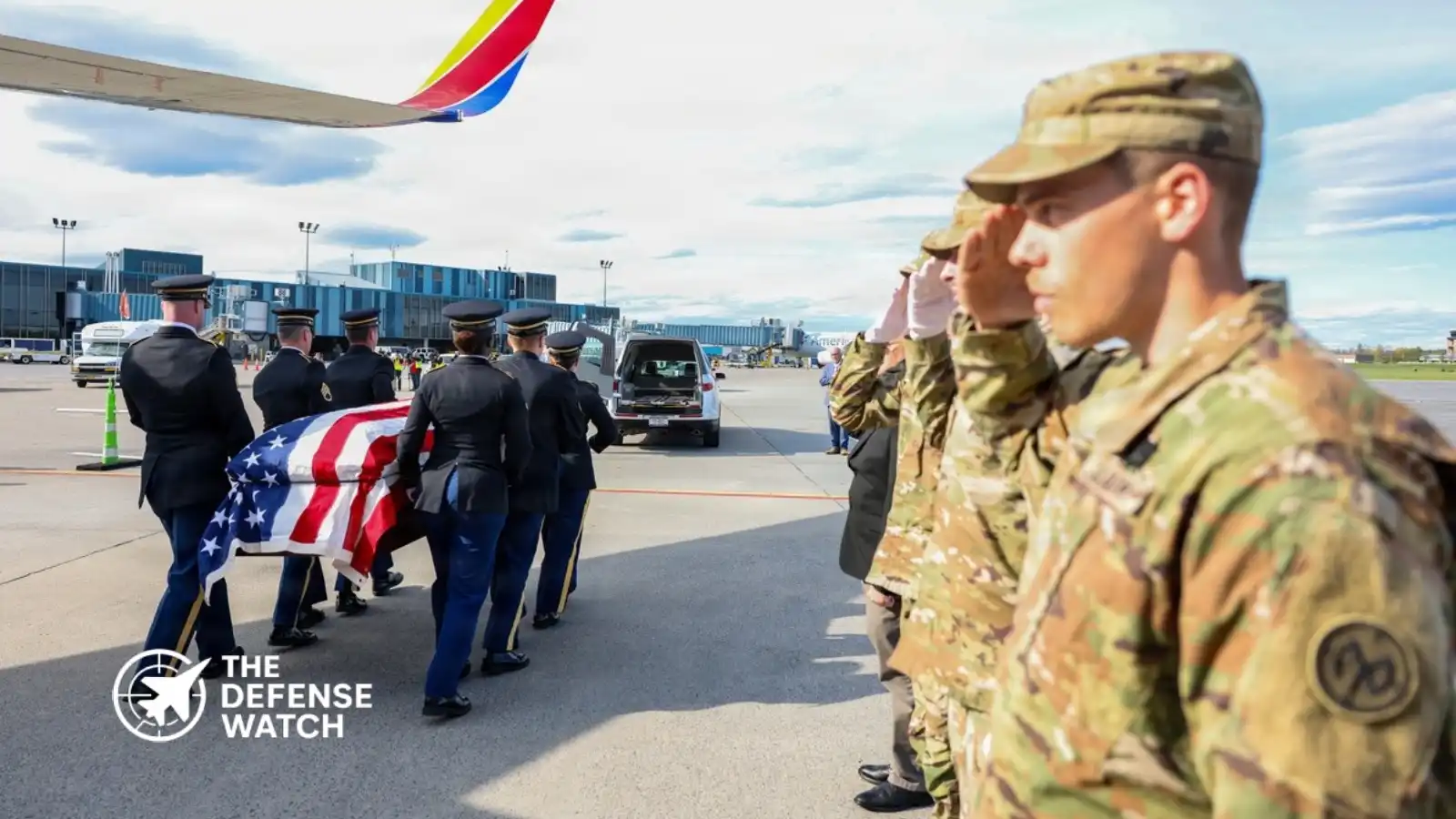
Executive Summary: Army Air Corps 2nd Lt. Joseph Leroy “Roy” Burke, a World War II prisoner of war killed in 1945, was returned to his family in Troy, New York on May 1, 2026 — 84 years after his capture in the Philippines. The Defense POW/MIA Accounting Agency identified his remains in 2025 using DNA provided by his nephew. The New York Army National Guard Honor Guard conducted a dignified transfer at Albany International Airport, with full military funeral honors to follow.
New York National Guard Receives WWII Airman’s Remains After 84-Year Journey
The remains of a World War II Army Air Corps officer came home to New York on May 1, 2026, closing an 84-year chapter of absence, uncertainty, and loss for one American family — and marking another quiet victory for the U.S. military’s long-running effort to recover and identify its missing.
Army Air Corps 2nd Lt. Joseph Leroy “Roy” Burke arrived at Albany International Airport in Latham, New York, greeted by members of the New York Army National Guard Honor Guard who rendered full dignified transfer honors.
The moment, decades in the making, reflects both the enduring commitment of the U.S. military to its fallen and the increasingly sophisticated forensic tools that are finally making these returns possible.
Captured, Killed, and Lost — The Story of 2nd Lt. Joseph Burke
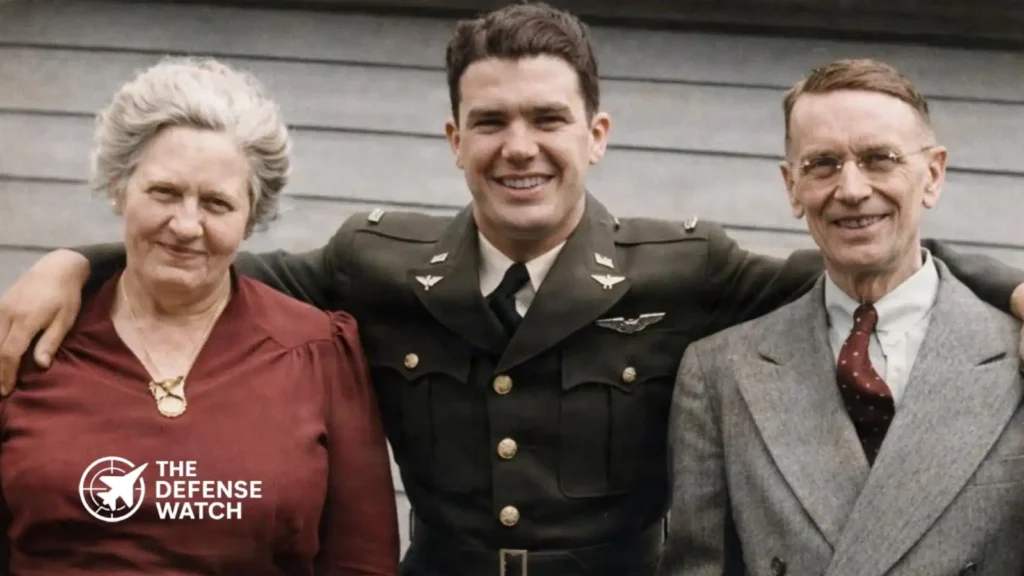
Burke was captured by Japanese forces in May 1942 in the Philippines and held as a prisoner of war for more than two years. He was killed in January 1945 when U.S. aircraft inadvertently struck the unmarked prison ship transporting him to Japan.
His death — caused by friendly fire without his captors or countrymen knowing his fate — was one of thousands of tragic incidents that left American service members unaccounted for across the Pacific theater.
Burke’s remains were interred with 431 other unknowns at the National Military Cemetery of the Pacific in Hawaii, commonly known as the “Punchbowl.” For decades, he remained one of the more than 72,000 Americans still unaccounted for from World War II — a number that the Defense POW/MIA Accounting Agency (DPAA) continues to work to reduce year by year.
DNA Science Delivers What Decades Could Not
The breakthrough came in 2025. The Defense POW/MIA Accounting Agency used DNA donated by the son of Burke’s sister to confirm the identity of the remains — a process that has become central to DPAA’s modern identification effort.
The DPAA conducts roughly 200 identifications per year, drawing on advances in mitochondrial DNA analysis, forensic anthropology, and historical records research. Burke’s identification is a direct result of that sustained federal investment in accounting for the missing.
Burke’s family elected to bring him home to Troy, New York, where he had grown up, attended college, and first learned to fly. The decision to repatriate — rather than maintain burial at the Punchbowl — reflects the personal weight of this process for the families involved, many of whom are now grandchildren and great-grandchildren of those who knew the fallen directly.
The Dignified Transfer: Precision, Protocol, and Respect
The homecoming at Albany International Airport was brief by design — but it was no small undertaking.
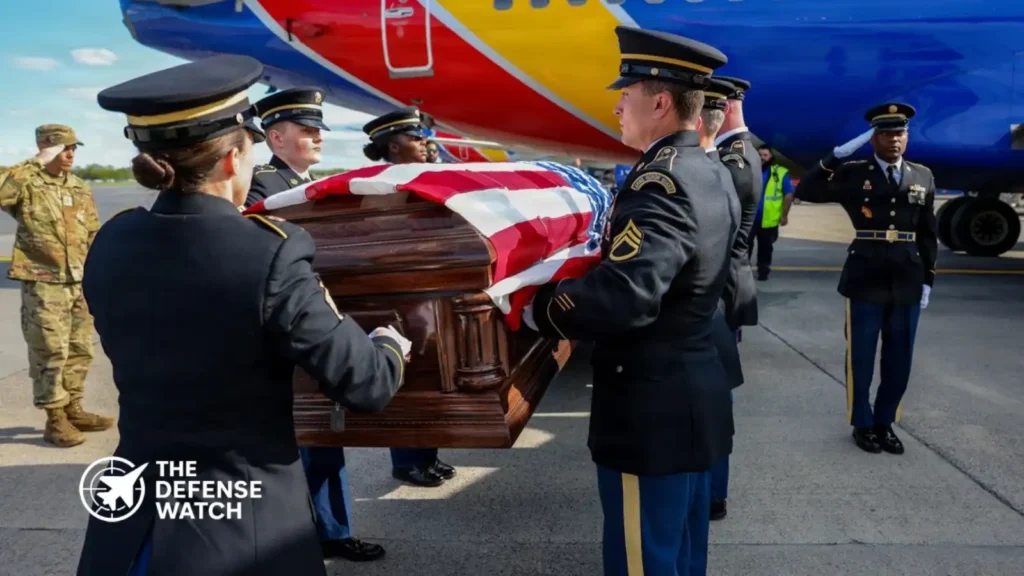
Ten members of the New York Army National Guard Honor Guard were present for the dignified transfer, moving Burke’s casket from a Southwest Airlines flight to a waiting hearse as television cameras filmed and family members, escorted by casualty assistance officer Lt. Col. Michael Squires, stood nearby.
Staff Sgt. Ryan Gosse, the Non-Commissioned Officer in Charge of the state Honor Guard, noted that while the transfer itself takes about one minute, it required a full week of coordination — including scheduling ten soldiers, securing tarmac access, and working with airline baggage staff.
Three soldiers in Army combat uniforms with white gloves entered the cargo hold first. Their responsibilities included removing the shipping carton, verifying that Burke’s dog tags were properly displayed on the casket, and confirming the American flag was secured.
A seven-member honor guard in dress blue uniforms then moved forward in formation, lifted the casket, and transported the remains to the hearse.
For Burke’s nephew John, who served as the family spokesman, the sight was overwhelming.
“To see the coffin come off, the honor guard go out, his dog tags hanging from the front — it’s just, it’s a lot,” John Burke said.
Full Military Honors at Saratoga National Cemetery
On May 7, 2026, following a memorial service at Siena University — where Burke attended college — he will be interred at the Gerald B. Solomon Saratoga National Cemetery, located near the historic Revolutionary War battlefield at Saratoga.
As a soldier killed in action, Burke is entitled to the highest honors: a firing party, the playing of “Taps,” and a six-man flag fold — what Staff Sgt. Gosse described as among the highest honors the Guard can bestow.
Lt. Col. Squires, who coordinated the logistics of Burke’s return as casualty assistance officer, framed the mission in deeply human terms.
“His parents weren’t able to have that closure; his brother and sisters weren’t,” Squires said. “But now, knowing his brothers and sister and parents see from up above what we’re doing to honor Roy in this time.”
Why This Matters: The Broader Mission of DPAA
Burke’s identification and repatriation is not an isolated event. The Defense POW/MIA Accounting Agency currently lists more than 81,500 Americans as missing from conflicts dating back to World War II. Approximately 72,000 of those are from the Second World War alone — many in the Pacific, where the chaotic nature of island combat, maritime losses, and wartime POW conditions created enormous identification challenges.
The DPAA’s work combines archival research, field recoveries, and cutting-edge forensic science. In recent years, advances in next-generation sequencing (NGS) DNA technology have dramatically increased the agency’s identification rate, making cases like Burke’s — once considered permanently unresolvable — now achievable.
Each identification carries layered significance: it resolves a casualty status, fulfills a federal commitment made to service members and their families, and provides generations of relatives with the knowledge of where their family member rests.
For the Burke family, that knowledge arrived 84 years late — but it arrived.
Analysis: The Military’s Commitment to Accounting for the Fallen
The handling of 2nd Lt. Burke’s return illustrates the institutional depth behind the phrase “no one left behind.” From DPAA’s laboratory work to the Honor Guard’s tarmac precision to the casualty assistance officer’s week of coordination, the return of a single service member from 1945 requires the seamless operation of multiple military branches and specialized units.
It also demonstrates the growing role of DNA science in national defense — not on the battlefield, but in the quiet, painstaking work of forensic accounting. As identification technology improves, more families who have waited decades may yet receive the same call the Burke family received in 2025.