
XQ-67A Drone
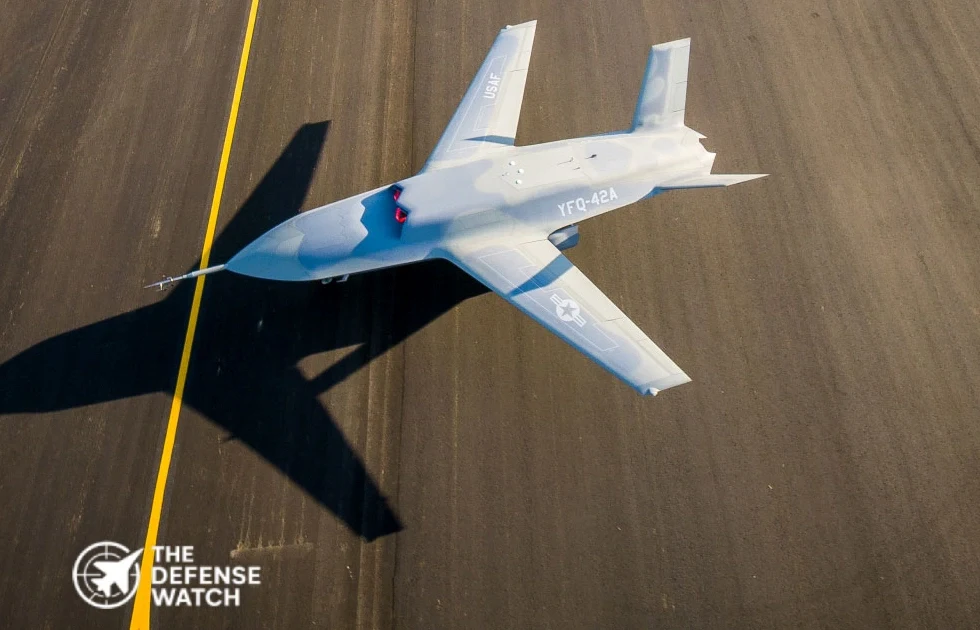

Defense Systems Full Specifications
1. General Information
| Name | XQ-67A Off-Board Sensing Station |
| Manufacturer | General Atomics Aeronautical Systems |
| Country of Origin | United States |
| Type / Role | Experimental autonomous uncrewed aircraft |
| First Flight / Introduced | February 28, 2024 |
| Status | Development and flight testing |
| Unit Cost | Not publicly disclosed |
2. Performance
| Maximum Speed | Not disclosed |
3. Dimensions
4. Payload & Armament
| Payload Capacity | Not publicly disclosed |
5. Propulsion
| Engine Type | Not publicly disclosed |
| Engine Power | Not publicly disclosed |
| Propeller Type | Not publicly disclosed |
6. Communication & Control
| Control Type | Remote piloting with autonomous flight capability |
| Data Link Range | Not disclosed |
| Navigation | Detailed configuration not publicly disclosed |
| Ground Control Station | Specific configuration not publicly disclosed |
7. Operational Use
| Primary Users | U.S. Air Force Research Laboratory |
| Combat Proven | No publicly confirmed operational combat use |
| Notable Operations | First flight at Gray Butte Flight Operations Facility, California, in 2024 |
PROS
- Tests autonomous flight for future military missions.
- Uses a common chassis design approach to support related aircraft variants.
- May reduce development time and manufacturing costs.
- Supports research into distributed combat operations.
- Could provide a foundation for future sensing and other mission configurations.
CONS
- Public performance specifications remain limited.
- Unit procurement cost has not been established.
- Operational weapons integration is unconfirmed.
- Endurance and range cannot be independently assessed from published figures.
- Operational readiness and combat effectiveness have not been established.
XQ-67A Drone: U.S. Autonomous Stealth UAV
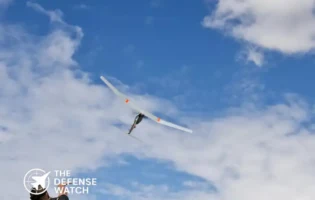
The XQ-67A is an experimental uncrewed aircraft developed to explore a new approach to affordable military aviation. Designed for the U.S. Air Force Research Laboratory (AFRL), the aircraft supports research into autonomous operations and the development of lower-cost unmanned platforms for future combat missions. Its design reflects the Air Force’s interest in aircraft that can operate alongside crewed fighters and support distributed combat operations.
Unlike operational armed drones designed primarily for surveillance or strike missions, the XQ-67A is a technology demonstrator. Its purpose is to evaluate aircraft design, autonomous flight, mission systems, and potential approaches to producing multiple related uncrewed aircraft from a common platform architecture. Publicly confirmed information does not establish an operational weapons loadout.
Manufacturer and Development
The XQ-67A was developed by General Atomics Aeronautical Systems in the United States under an AFRL program. It is associated with the Off-Board Sensing Station (OBSS) initiative, which explores autonomous aircraft capable of supporting sensing and other distributed mission functions.
The program also reflects the concept of a common aircraft chassis that can support different mission-specific configurations. This approach could help reduce development time and production costs for future unmanned aircraft, although its broader operational benefits remain to be demonstrated.
Speed and Range
The XQ-67A’s maximum speed, endurance, operational range, service ceiling, and payload capacity have not been reliably disclosed in available public specifications. These figures should not be inferred from other General Atomics aircraft.
Its flight testing is intended to evaluate the aircraft and its systems, including capabilities relevant to autonomous operations. Publicly available information also does not confirm a production-standard radar cross-section, operational data-link range, or weapons integration.
Cost and Price
No verified unit price has been publicly established for the XQ-67A. As an experimental aircraft, its development and testing costs should not be confused with the eventual procurement price of a production system. Future costs would depend on production volume, mission equipment, software, and the degree of commonality with related aircraft.
The XQ-67A remains significant as a research platform for affordable autonomous aviation, rather than a confirmed operational combat drone.
Disclaimer Note
The information provided on TheDefenseWatch.com is for general informational purposes only. While we strive to ensure the accuracy, completeness, and timeliness of our content regarding defense and aerospace products, technologies, and specifications, we cannot guarantee that all information is 100% accurate or up-to-date due to the evolving nature of military technology and classified data.TheDefenseWatch.com does not warrant the reliability, suitability, or availability of the information for any specific purpose. Users are advised to consult official sources, such as manufacturers, government publications, or defense agencies, for precise and verified data before making decisions based on our content.We are not affiliated with any defense manufacturers, governments, or military organizations mentioned. Opinions, reviews, and ratings reflect expert analysis but are subjective and should not be considered endorsements. TheDefenseWatch.com is not responsible for any errors, omissions, or consequences arising from the use of this website’s content.External links are provided for convenience and do not imply endorsement. TheDefenseWatch.com reserves the right to update or modify content without prior notice. By using this website, you agree to our Privacy & Cookies Policy.


New Arrivals












Popular Comparisons
-
 J-10C vs JF-17 Thunder: Which Fighter Is More Capable?
View Comparison →
-
Tejas vs Gripen: Key Differences and Capabilities
View Comparison →
-
Tejas vs MiG-21 Bison: How India Replaced Its Iconic Supersonic Fighter
View Comparison →
-
F-35 vs F-16: Stealth, Sensors and Combat Roles
View Comparison →
-
Tejas Fighter Jet vs F-16 Fighting Falcon: Capability Compared
View Comparison →
-
Rafale Fighter Jet vs F-16 Fighting Falcon : Which Fighter Has the Edge?
View Comparison →
-
Su-57 Fighter Jet vs J-20 Fighter Jet: Stealth and Air Combat Compared
View Comparison →
-
Mirage 2000 vs Tejas Mk1A: Legacy Combat Power vs Indigenous Modernization
View Comparison →
-
Rafale Fighter Jet vs F-22 Raptor: Which Air Dominance Fighter Has the Edge?
View Comparison →
-
Tejas Fighter Jet vs. Rafale Fighter Jet: India’s Indigenous Fighter Meets France’s Proven Multirole Combat Aircraft
View Comparison →


- Destinus Produces 1,750 Ruta B1 Cruise Missiles as European Output Expands

- Boeing Wins $11.1 Million Contract Modification for Kuwait F/A-18 Training Support
- U.S. Navy Awards $23.1 Million Contract for Cybersecurity of Shipboard Power Systems
- Lockheed Martin Wins $43.7 Million F-35 Reprogramming Lab Upgrade Contract
- USS Colorado Arrives in Australia for AUKUS Submarine Maintenance
- U.S. Marines and Japanese Forces Train in Explosive Ordnance Disposal During Keen Sword 2027
- Lockheed Martin Tests In-Flight Retargeting of GMLRS Rocket
- Saab and GA-ASI Test LoyalEye Airborne Early Warning on MQ-9B
- Trump’s Russian Diesel Deal Could Benefit Moscow More Than US Consumers
- China Reports Fielding 40mm Cased Telescoped Ammunition





Fighter Jets
-
 F-100 Super Sabre
-
North American F-86 Sabre
-
Northrop YF-23 Fighter
-
Rafale F5 Fighter
-
SU-57 Felon Stealth Fighter
-
Boeing F/A-XX Fighter
-
JF-17 Thunder Fighter Jet
-
F-47 Fighter Jet
-
MIG-31 Fighter Jet
-
J-10CE Fighter Jet
-
Chengdu J-10 Fighter Jet
-
Chengdu J-10C Fighter Jet
-
Gripen E Fighter Jet
-
Tejas Mk1A Fighter Jet
-
Tejas Mk‑2 Fighter Jet
-
F-16V Viper Block 70 Fighter Jet
-
F-15EX Eagle II Fighter
-
F-15E Strike Eagle Fighter
-
F/A-18E/F Super Hornet Fighter Jet
-
Saab Gripen F Fighter Jet
-
JAS 39E/F Gripen Fighter Jet
-
JAS 39 Gripen Fighter Jet
-
F-35A Lightning II Fighter Jet
-
F/A-18F Super Hornet







Recent Compares
-
J-10C vs JF-17 Thunder: Which Fighter Is More Capable?
View Comparison →
-
Tejas vs Gripen: Key Differences and Capabilities
View Comparison →
-
Tejas vs MiG-21 Bison: How India Replaced Its Iconic Supersonic Fighter
View Comparison →
-
F-35 vs F-16: Stealth, Sensors and Combat Roles
View Comparison →
-
Tejas Fighter Jet vs F-16 Fighting Falcon: Capability Compared
View Comparison →
Latest Defense Systems
10 Compares Defense Systems
-
J-10C vs JF-17 Thunder: Which Fighter Is More Capable?
View Comparison →
-
Tejas vs Gripen: Key Differences and Capabilities
View Comparison →
-
Tejas vs MiG-21 Bison: How India Replaced Its Iconic Supersonic Fighter
View Comparison →
-
F-35 vs F-16: Stealth, Sensors and Combat Roles
View Comparison →
-
Tejas Fighter Jet vs F-16 Fighting Falcon: Capability Compared
View Comparison →
-
Rafale Fighter Jet vs F-16 Fighting Falcon : Which Fighter Has the Edge?
View Comparison →
-
Su-57 Fighter Jet vs J-20 Fighter Jet: Stealth and Air Combat Compared
View Comparison →
-
Mirage 2000 vs Tejas Mk1A: Legacy Combat Power vs Indigenous Modernization
View Comparison →
-
Rafale Fighter Jet vs F-22 Raptor: Which Air Dominance Fighter Has the Edge?
View Comparison →
-
Tejas Fighter Jet vs. Rafale Fighter Jet: India’s Indigenous Fighter Meets France’s Proven Multirole Combat Aircraft
View Comparison →
- Destinus Produces 1,750 Ruta B1 Cruise Missiles as European Output Expands
- Boeing Wins $11.1 Million Contract Modification for Kuwait F/A-18 Training Support
- U.S. Navy Awards $23.1 Million Contract for Cybersecurity of Shipboard Power Systems
- Lockheed Martin Wins $43.7 Million F-35 Reprogramming Lab Upgrade Contract
- USS Colorado Arrives in Australia for AUKUS Submarine Maintenance