
- Home
- Defense Systems
- Bombs & Aerial Munitions
- GBU-57 Bomb
GBU-57 Bomb
Defense Systems Full Specifications
1. General Information
| Name / Designation | GBU-57 Massive Ordnance Penetrator |
| Type | Precision Guided Bomb |
| Manufacturer | United States |
| Country of Origin | Around 2010 |
| Year Introduced | In active U.S. service |
2. Physical Characteristics
| Weight | Approx. 30,000 lb |
| Length | Approx. 20.5 ft |
| Diameter | Approx. 31.5 in |
| Casing Type | Hardened steel penetrator |
3. Performance
| Yield | Conventional high explosive |
| Guidance | GPS aided |
| Accuracy (CEP) | Estimated within a few meters |
| Delivery Platforms | B-2 Spirit, B-52 Stratofortress |
| Penetration Capability | Designed for deep reinforced concrete and rock |
4. Warhead / Explosive Details
| Warhead Type | High Explosive Penetrator |
| Fuzing Options | Delayed detonation for underground burst |
| Explosive Composition | Not publicly disclosed |
5. Operational Use
| Primary Mission | Destruction of hardened underground facilities |
| Operators | United States Air Force |
| Notable Deployments / History | Developed for potential use against fortified WMD sites |
6. Variants
| Variants | GBU-57A, GBU-57E updated guidance versions |
PROS
- Deep penetration capability against hardened bunkers
- Non nuclear option for strategic underground targets
- GPS guided precision strike
- Compatible with U.S. long range bombers
- High deterrence value
CONS
- Limited to specific heavy bomber platforms
- High production and integration cost
- Requires air superiority for delivery
- Limited publicly confirmed combat use
- Very large logistical footprint
GBU-57 Massive Ordnance Penetrator Bomb
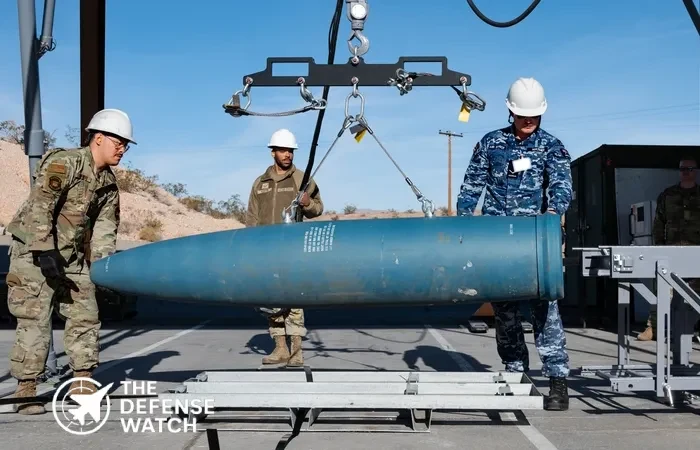
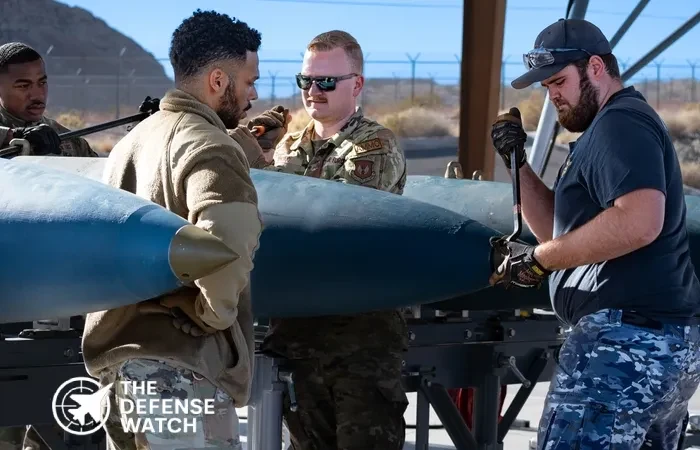
The GBU-57 Massive Ordnance Penetrator, known as the MOP, is the most powerful conventional bunker-busting bomb in the U.S. arsenal. Designed to defeat deeply buried and heavily reinforced underground facilities, it gives the United States a unique capability to hold hardened strategic targets at risk without using nuclear weapons.
Developed in the mid 2000s, the weapon was created to address emerging threats posed by fortified command centers and suspected weapons facilities built deep underground.
Manufacturer and Origin
The GBU-57 was developed by Boeing for the United States Air Force. It is produced in the United States and integrated primarily on long range strategic bombers.
Speed, Range, and Capability
The GBU-57 is a precision guided gravity bomb equipped with GPS guidance. It is released from high altitude bombers, including the B-2 Spirit and, following upgrades, the B-52 Stratofortress.
Once released, it follows a ballistic trajectory toward its target. The weapon does not have its own propulsion system. Its range depends on release altitude and aircraft speed, typically allowing stand off employment from high altitude.
Weighing roughly 30,000 pounds, the bomb uses a hardened steel casing designed to penetrate deep into reinforced concrete or rock before detonation. Its warhead is a high explosive penetrator optimized for underground targets.
Cost
Exact unit cost figures are not publicly confirmed, but estimates suggest several million dollars per weapon, reflecting its size, specialized casing, and guidance system.
FAQs
What is the primary role of the GBU-57?
It is designed to destroy deeply buried and hardened underground facilities using conventional explosives.
Is the GBU-57 a nuclear weapon?
No. It is a conventional high explosive penetrator bomb.
Which aircraft can carry the GBU-57?
It is primarily carried by the B-2 Spirit and, after modification, the B-52 Stratofortress.
How heavy is the GBU-57?
The weapon weighs approximately 30,000 pounds, making it one of the heaviest conventional bombs in U.S. service.
Why is the GBU-57 significant for U.S. strategy?
It provides a non nuclear option to strike hardened strategic targets that are beyond the reach of smaller bunker buster munitions.
Disclaimer Note
The information provided on TheDefenseWatch.com is for general informational purposes only. While we strive to ensure the accuracy, completeness, and timeliness of our content regarding defense and aerospace products, technologies, and specifications, we cannot guarantee that all information is 100% accurate or up-to-date due to the evolving nature of military technology and classified data.TheDefenseWatch.com does not warrant the reliability, suitability, or availability of the information for any specific purpose. Users are advised to consult official sources, such as manufacturers, government publications, or defense agencies, for precise and verified data before making decisions based on our content.We are not affiliated with any defense manufacturers, governments, or military organizations mentioned. Opinions, reviews, and ratings reflect expert analysis but are subjective and should not be considered endorsements. TheDefenseWatch.com is not responsible for any errors, omissions, or consequences arising from the use of this website’s content.External links are provided for convenience and do not imply endorsement. TheDefenseWatch.com reserves the right to update or modify content without prior notice. By using this website, you agree to our Privacy & Cookies Policy.

New Arrivals






Popular Comparisons
-
 J-10C vs JF-17 Thunder: Which Fighter Is More Capable?
View Comparison →
-
Tejas vs Gripen: Key Differences and Capabilities
View Comparison →
-
Tejas vs MiG-21 Bison: How India Replaced Its Iconic Supersonic Fighter
View Comparison →
-
F-35 vs F-16: Stealth, Sensors and Combat Roles
View Comparison →
-
Tejas Fighter Jet vs F-16 Fighting Falcon: Capability Compared
View Comparison →
-
Rafale Fighter Jet vs F-16 Fighting Falcon : Which Fighter Has the Edge?
View Comparison →
-
Su-57 Fighter Jet vs J-20 Fighter Jet: Stealth and Air Combat Compared
View Comparison →
-
Mirage 2000 vs Tejas Mk1A: Legacy Combat Power vs Indigenous Modernization
View Comparison →
-
Rafale Fighter Jet vs F-22 Raptor: Which Air Dominance Fighter Has the Edge?
View Comparison →
-
Tejas Fighter Jet vs. Rafale Fighter Jet: India’s Indigenous Fighter Meets France’s Proven Multirole Combat Aircraft
View Comparison →


- China Reports Fielding 40mm Cased Telescoped Ammunition

- Saab Launches Ocean Barrier Underwater Surveillance System
- Saab Names Canadian Partners for Gripen E Fighter Production
- U.S. Air Force Tests XQ-67A Drone Systems for Dispersed Combat Operations
- Lockheed Martin Wins $9.76 Million Contract for Canadian CH-148 Cyclone Electronic Warfare Software
- Lockheed Martin Wins $13.3 Million F-35 Engine Upgrade Contract Modification
- Army Trains Patriot Crews for Nighttime Missile Reloads
- Hegseth Reinstates Air Force Brigadier General Forced to Retire Over COVID-19 Vaccine Mandate
- Pentagon Reports Strong Interest in Competition for Next Great American Base
- DIA 2026 Space Report Warns China May Field Orbital Directed-Energy Weapons by Late 2020s




Fighter Jets
-
 F-100 Super Sabre
-
North American F-86 Sabre
-
Northrop YF-23 Fighter
-
Rafale F5 Fighter
-
SU-57 Felon Stealth Fighter
-
Boeing F/A-XX Fighter
-
JF-17 Thunder Fighter Jet
-
F-47 Fighter Jet
-
MIG-31 Fighter Jet
-
J-10CE Fighter Jet
-
Chengdu J-10 Fighter Jet
-
Chengdu J-10C Fighter Jet
-
Gripen E Fighter Jet
-
Tejas Mk1A Fighter Jet
-
Tejas Mk‑2 Fighter Jet
-
F-16V Viper Block 70 Fighter Jet
-
F-15EX Eagle II Fighter
-
F-15E Strike Eagle Fighter
-
F/A-18E/F Super Hornet Fighter Jet
-
Saab Gripen F Fighter Jet
-
JAS 39E/F Gripen Fighter Jet
-
JAS 39 Gripen Fighter Jet
-
F-35A Lightning II Fighter Jet
-
F/A-18F Super Hornet







Recent Compares
-
J-10C vs JF-17 Thunder: Which Fighter Is More Capable?
View Comparison →
-
Tejas vs Gripen: Key Differences and Capabilities
View Comparison →
-
Tejas vs MiG-21 Bison: How India Replaced Its Iconic Supersonic Fighter
View Comparison →
-
F-35 vs F-16: Stealth, Sensors and Combat Roles
View Comparison →
-
Tejas Fighter Jet vs F-16 Fighting Falcon: Capability Compared
View Comparison →
Latest Defense Systems
10 Compares Defense Systems
-
J-10C vs JF-17 Thunder: Which Fighter Is More Capable?
View Comparison →
-
Tejas vs Gripen: Key Differences and Capabilities
View Comparison →
-
Tejas vs MiG-21 Bison: How India Replaced Its Iconic Supersonic Fighter
View Comparison →
-
F-35 vs F-16: Stealth, Sensors and Combat Roles
View Comparison →
-
Tejas Fighter Jet vs F-16 Fighting Falcon: Capability Compared
View Comparison →
-
Rafale Fighter Jet vs F-16 Fighting Falcon : Which Fighter Has the Edge?
View Comparison →
-
Su-57 Fighter Jet vs J-20 Fighter Jet: Stealth and Air Combat Compared
View Comparison →
-
Mirage 2000 vs Tejas Mk1A: Legacy Combat Power vs Indigenous Modernization
View Comparison →
-
Rafale Fighter Jet vs F-22 Raptor: Which Air Dominance Fighter Has the Edge?
View Comparison →
-
Tejas Fighter Jet vs. Rafale Fighter Jet: India’s Indigenous Fighter Meets France’s Proven Multirole Combat Aircraft
View Comparison →
- China Reports Fielding 40mm Cased Telescoped Ammunition
- Saab Launches Ocean Barrier Underwater Surveillance System
- Saab Names Canadian Partners for Gripen E Fighter Production
- U.S. Air Force Tests XQ-67A Drone Systems for Dispersed Combat Operations
- Lockheed Martin Wins $9.76 Million Contract for Canadian CH-148 Cyclone Electronic Warfare Software