
- Home
- Defense Systems
- Bombers & Strategic Aircraft
- KC-135 Air Refueling Tanker
KC-135 Air Refueling Tanker
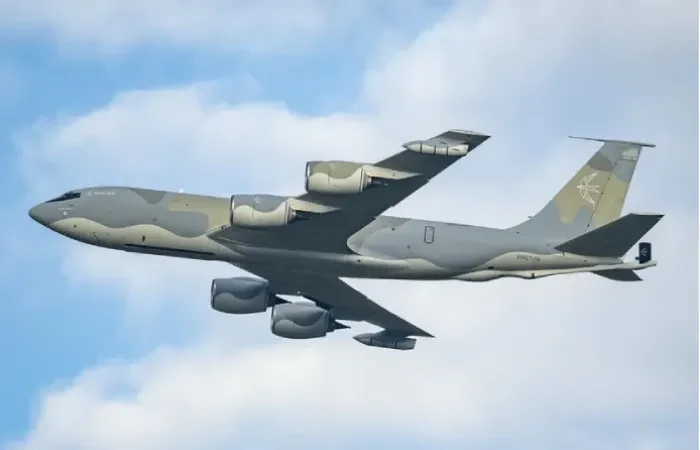
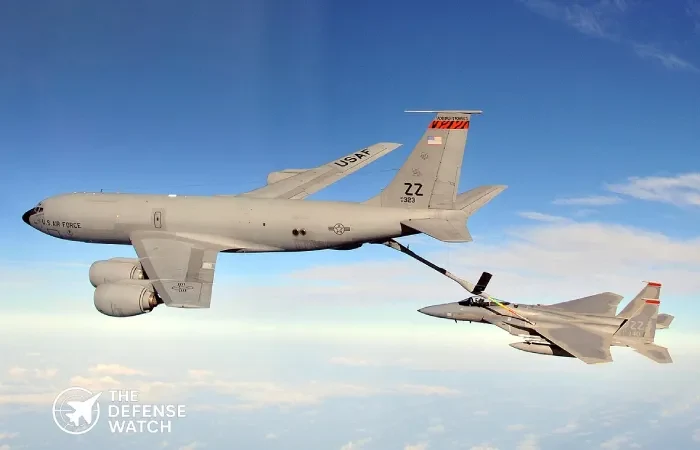

Defense Systems Full Specifications
1. General Information
| Name | KC-135 Stratotanker |
| Manufacturer | Boeing |
| Country of Origin | United States |
| Introduction / In Service Since | 1957 |
| Status | Active |
| Category | Aerial Refueling Aircraft |
| Crew | 3 to 4 |
| Unit Cost | Approx 45 million USD original |
2. Dimensions & Structure
| Length | 136 ft |
| Wingspan | 130 ft |
| Height | 41 ft |
| Wing Area | 2433 sq ft |
| Empty Weight | 104000 lb |
| Maximum Takeoff Weight (MTOW) | 322500 lb |
3. Performance
| Maximum Speed | 530 mph |
| Range | 1500 miles |
| Combat Radius | Mission dependent |
| Service Ceiling | 50000 ft |
| Rate of Climb | 6000 ft per minute |
4. Powerplant
| Engine Type | 4 turbofan engines |
| Thrust (per engine) | 21500 lbf |
| Total Thrust | 86000 lbf |
5. Payload & Armament
| Internal Payload Capacity | Fuel only |
| Weapons Bay | None |
| Compatible Weapons | Not applicable |
| Hardpoints | None |
6. Avionics & Systems
| Radar System | Weather and navigation radar |
| Navigation | GPS INS |
| Electronic Warfare (EW) | Limited countermeasures |
| Stealth Features | None |
7. Operational History
| Primary Operator | United States Air Force |
| Conflict Usage | Vietnam to present |
| Notable Missions | Global strike support |
8. Additional Information
| Variants | KC-135R KC-135T |
| Successor / Future Replacement | KC-46 Pegasus |
| Notable Features | Flying boom refueling |
| Estimated Operational Life | Mid 2030s |
PROS
- Proven and reliable airframe
- Large fuel offload capacity
- Wide aircraft compatibility
- Extensive global operating history
- Lower operating cost than newer tankers
CONS
- Aging structure and fatigue issues
- Limited defensive systems
- No stealth features
- Requires significant maintenance
- Gradual replacement underway
KC-135 Stratotanker Air Refueling Aircraft
The KC-135 Stratotanker is one of the most important force multipliers in U.S. air power. First introduced during the Cold War, this aircraft gave the U.S. Air Force the ability to project air combat power across continents without relying on forward bases. Even today, it remains a backbone of global air refueling operations.
Manufacturer and Origin
The KC-135 Air Refueling Tanker was developed by Boeing in the United States and is based on the company’s early jet transport designs. It entered service in 1957 and became the first jet powered aerial refueling tanker in the U.S. inventory. More than eight hundred aircraft were built, with many still flying after major upgrades.
Role and Capabilities
The primary mission of the KC-135 is air to air refueling using a flying boom system. It can refuel fighters, bombers, reconnaissance aircraft, and allied platforms. Some variants are also equipped with probe and drogue pods, expanding compatibility with NATO and partner aircraft.
Performance and Technology
Powered by modernized turbofan engines, the KC-135 cruises at high subsonic speed and offers intercontinental range. It can offload over ninety thousand pounds of fuel on long range missions. Avionics upgrades have added digital flight decks, GPS navigation, and improved communication systems. While not armed, the aircraft relies on escort fighters and mission planning for protection.
Operational Use
The KC-135 Air Refueling Tanker has supported every major U.S. military operation since Vietnam, including Desert Storm, Enduring Freedom, and current global deterrence patrols. Despite its age, continued upgrades have kept it operationally relevant as the KC-46 gradually enters service.
Disclaimer Note
The information provided on TheDefenseWatch.com is for general informational purposes only. While we strive to ensure the accuracy, completeness, and timeliness of our content regarding defense and aerospace products, technologies, and specifications, we cannot guarantee that all information is 100% accurate or up-to-date due to the evolving nature of military technology and classified data.TheDefenseWatch.com does not warrant the reliability, suitability, or availability of the information for any specific purpose. Users are advised to consult official sources, such as manufacturers, government publications, or defense agencies, for precise and verified data before making decisions based on our content.We are not affiliated with any defense manufacturers, governments, or military organizations mentioned. Opinions, reviews, and ratings reflect expert analysis but are subjective and should not be considered endorsements. TheDefenseWatch.com is not responsible for any errors, omissions, or consequences arising from the use of this website’s content.External links are provided for convenience and do not imply endorsement. TheDefenseWatch.com reserves the right to update or modify content without prior notice. By using this website, you agree to our Privacy & Cookies Policy.

New Arrivals



Popular Comparisons
-
 J-10C vs JF-17 Thunder: Which Fighter Is More Capable?
View Comparison →
-
Tejas vs Gripen: Key Differences and Capabilities
View Comparison →
-
Tejas vs MiG-21 Bison: How India Replaced Its Iconic Supersonic Fighter
View Comparison →
-
F-35 vs F-16: Stealth, Sensors and Combat Roles
View Comparison →
-
Tejas Fighter Jet vs F-16 Fighting Falcon: Capability Compared
View Comparison →
-
Rafale Fighter Jet vs F-16 Fighting Falcon : Which Fighter Has the Edge?
View Comparison →
-
Su-57 Fighter Jet vs J-20 Fighter Jet: Stealth and Air Combat Compared
View Comparison →
-
Mirage 2000 vs Tejas Mk1A: Legacy Combat Power vs Indigenous Modernization
View Comparison →
-
Rafale Fighter Jet vs F-22 Raptor: Which Air Dominance Fighter Has the Edge?
View Comparison →
-
Tejas Fighter Jet vs. Rafale Fighter Jet: India’s Indigenous Fighter Meets France’s Proven Multirole Combat Aircraft
View Comparison →


- Department of War and Lockheed Martin Sign 10-Year F-35 Agreement With $7 Billion Investment Commitment

- Pentagon Approves Active Denial System for Potential U.S. Southern Border Use
- U.S. Air Force Plans Larger F-35 Role in 1,509-Aircraft Fighter Fleet
- Raytheon Wins Two-Year Extension for AN/TPY-2 Radar Support
- Space Force Selects Northrop Grumman, True Anomaly for New Orbital Reconnaissance Satellites
- Hegseth and Guyana’s President Establish Enhanced Military Partnership
- Ukrainian F-16 vs. Russian Su-35: What Happened, How the Engagement Unfolded and Why It Matters
- Canada’s Fighter Jet Fleet Faces a Critical Transition as F-35 Review Continues
- New Zealand Signs Deal for Five MH-60R Seahawk Helicopters
- U.S. Air Force Test Pilot School Adds Water Landings to Training




Fighter Jets
-
 SU-57 Felon Stealth Fighter
-
Boeing F/A-XX Fighter
-
JF-17 Thunder Fighter Jet
-
F-47 Fighter Jet
-
MIG-31 Fighter Jet
-
J-10CE Fighter Jet
-
Chengdu J-10 Fighter Jet
-
Chengdu J-10C Fighter Jet
-
Gripen E Fighter Jet
-
Tejas Mk1A Fighter Jet
-
Tejas Mk‑2 Fighter Jet
-
F-16V Viper Block 70 Fighter Jet
-
F-15EX Eagle II Fighter
-
F-15E Strike Eagle Fighter
-
F/A-18E/F Super Hornet Fighter Jet
-
Saab Gripen F Fighter Jet
-
JAS 39E/F Gripen Fighter Jet
-
JAS 39 Gripen Fighter Jet
-
F-35A Lightning II Fighter Jet
-
F/A-18F Super Hornet
-
J-50 Fighter Jet
-
Spanish EF-18 Hornet Fighter
-
F-35i Adir Fighter Jet
-
F-16 Fighting Falcon






Recent Compares
-
J-10C vs JF-17 Thunder: Which Fighter Is More Capable?
View Comparison →
-
Tejas vs Gripen: Key Differences and Capabilities
View Comparison →
-
Tejas vs MiG-21 Bison: How India Replaced Its Iconic Supersonic Fighter
View Comparison →
-
F-35 vs F-16: Stealth, Sensors and Combat Roles
View Comparison →
-
Tejas Fighter Jet vs F-16 Fighting Falcon: Capability Compared
View Comparison →
Latest Defense Systems
10 Compares Defense Systems
-
J-10C vs JF-17 Thunder: Which Fighter Is More Capable?
View Comparison →
-
Tejas vs Gripen: Key Differences and Capabilities
View Comparison →
-
Tejas vs MiG-21 Bison: How India Replaced Its Iconic Supersonic Fighter
View Comparison →
-
F-35 vs F-16: Stealth, Sensors and Combat Roles
View Comparison →
-
Tejas Fighter Jet vs F-16 Fighting Falcon: Capability Compared
View Comparison →
-
Rafale Fighter Jet vs F-16 Fighting Falcon : Which Fighter Has the Edge?
View Comparison →
-
Su-57 Fighter Jet vs J-20 Fighter Jet: Stealth and Air Combat Compared
View Comparison →
-
Mirage 2000 vs Tejas Mk1A: Legacy Combat Power vs Indigenous Modernization
View Comparison →
-
Rafale Fighter Jet vs F-22 Raptor: Which Air Dominance Fighter Has the Edge?
View Comparison →
-
Tejas Fighter Jet vs. Rafale Fighter Jet: India’s Indigenous Fighter Meets France’s Proven Multirole Combat Aircraft
View Comparison →
- Department of War and Lockheed Martin Sign 10-Year F-35 Agreement With $7 Billion Investment Commitment
- Pentagon Approves Active Denial System for Potential U.S. Southern Border Use
- U.S. Air Force Plans Larger F-35 Role in 1,509-Aircraft Fighter Fleet
- Raytheon Wins Two-Year Extension for AN/TPY-2 Radar Support
- Space Force Selects Northrop Grumman, True Anomaly for New Orbital Reconnaissance Satellites