Executive Summary:
The Spanish Navy has completed maritime combat network testing involving the H135 helicopter, Flexrotor UAV, and A900 drone during operations at sea. The effort highlights Spain’s push to integrate manned and unmanned systems for surveillance, targeting, and naval situational awareness in contested maritime environments.
Spain Navy Tests Maritime Drone Combat Network At Sea
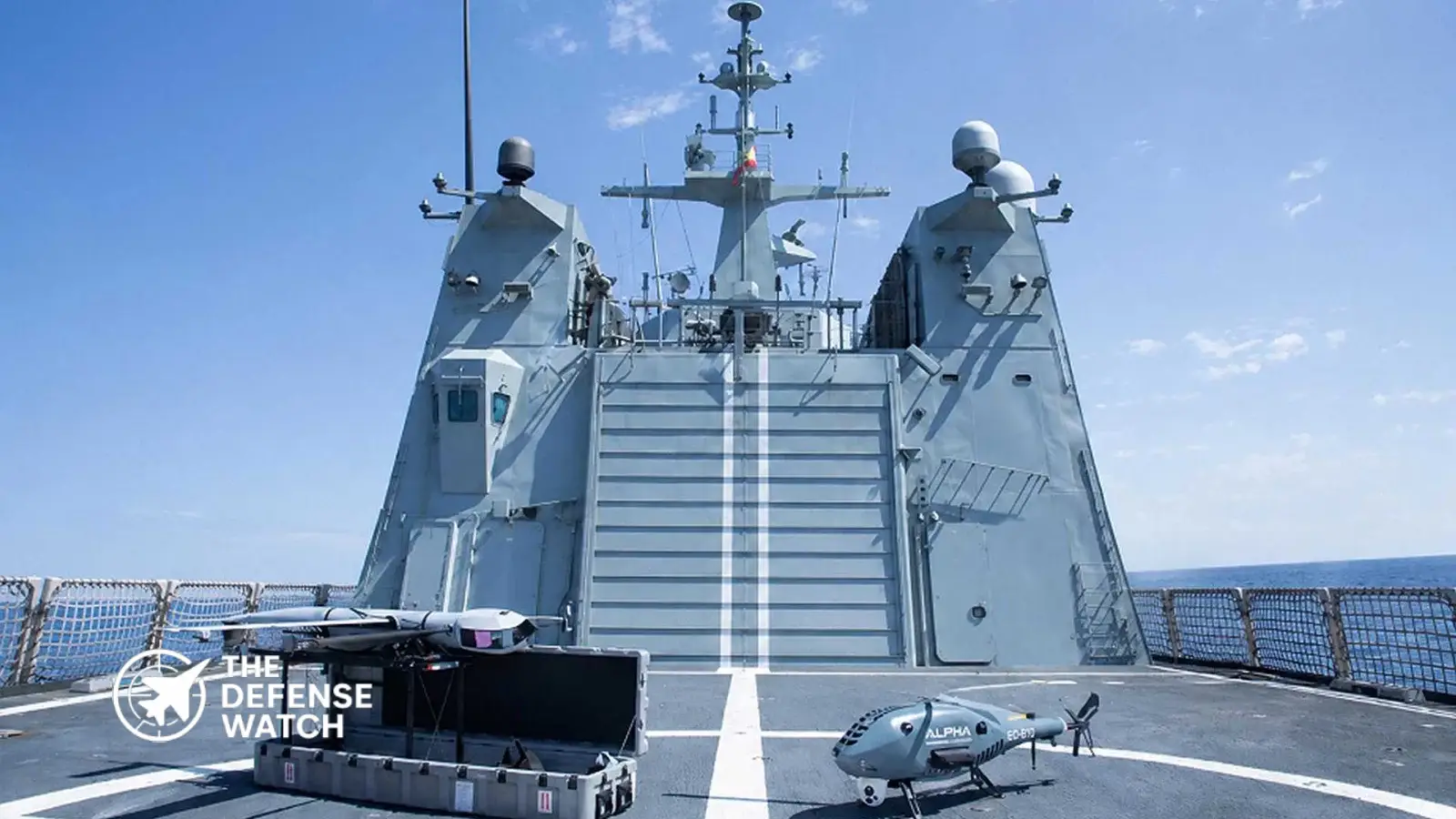
The Spanish Navy has conducted a new series of maritime combat network trials involving the H135 helicopter, Flexrotor unmanned aerial vehicle, and A900 drone platform, marking another step in Spain’s effort to modernize naval surveillance and operational coordination capabilities.
The tests evaluated how multiple airborne platforms could operate together within a shared maritime combat network during naval operations at sea.
The exercise focused on real-time information sharing between crewed and uncrewed systems. The objective was to improve maritime situational awareness, target detection, reconnaissance coverage, and operational coordination for future naval missions.
Multi-Platform Integration Reflects Broader Naval Modernization
The Spain Navy drone network effort reflects a wider trend among NATO naval forces toward distributed maritime sensing and unmanned integration.
The H135 helicopter, produced by Airbus, served as a manned aviation component within the exercise. The aircraft is increasingly used in military training, reconnaissance, and maritime support missions because of its compact size and multi-role flexibility.
Alongside the H135, Spain tested the Flexrotor unmanned aircraft developed by Airbus U.S. Space & Defense. The vertical takeoff and landing UAV is designed for long-endurance intelligence, surveillance, and reconnaissance missions. Its ability to launch without traditional runway infrastructure makes it suitable for naval operations aboard smaller ships.
The A900 drone added another surveillance layer during the exercise. The platform is designed for maritime reconnaissance and persistent monitoring, helping naval commanders extend operational visibility beyond the range of conventional shipboard sensors.
Spanish defense planners appear focused on creating a networked operational environment where helicopters, drones, ships, and command systems exchange targeting and surveillance data in near real time.
Maritime Surveillance Becoming A Core Naval Priority
The Spain Navy drone network tests come as European naval forces place greater emphasis on maritime domain awareness amid rising regional security concerns.
Navies operating in the Mediterranean and Atlantic increasingly face challenges linked to submarine tracking, illegal trafficking routes, infrastructure protection, and gray-zone maritime activity. Unmanned systems offer a relatively lower-cost method for expanding surveillance coverage without deploying larger crewed aircraft continuously.
By integrating platforms like the Flexrotor and A900 into naval combat networks, Spain is seeking to improve persistent intelligence collection while reducing operational strain on traditional aviation assets.
The use of multiple connected aerial systems also supports distributed maritime operations, where sensor and targeting information can be shared rapidly across naval formations.
This capability is becoming increasingly important as NATO members adapt to evolving electronic warfare environments and long-range precision threats.
H135 And Flexrotor Expand Operational Flexibility
The H135 maritime drone testing demonstrated how rotary-wing aircraft and UAVs can complement one another during naval operations.
Crewed helicopters remain valuable for search-and-rescue operations, personnel transport, medical evacuation, and direct visual reconnaissance. However, unmanned systems can stay airborne longer and operate in higher-risk environments without exposing crews to danger.
The Flexrotor platform is particularly suited for naval deployment because of its compact footprint and autonomous operational capability. Its vertical launch system allows deployment from confined deck spaces aboard patrol vessels and support ships.
Meanwhile, the A900 maritime surveillance drone provides additional sensor coverage that can support surface tracking and coastal monitoring operations.
The integration of these systems into a unified combat network could eventually support targeting, anti-surface warfare coordination, and wider intelligence-sharing operations across Spanish naval forces.
European Navies Accelerate Drone Integration
Spain’s maritime testing aligns with broader European efforts to expand unmanned naval aviation capabilities.
Several NATO members are increasing investment in shipborne drones, autonomous surveillance systems, and artificial intelligence-enabled command networks to improve fleet survivability and operational responsiveness.
The Spanish Navy’s testing campaign demonstrates how medium-sized naval forces are adapting to modern maritime requirements through scalable unmanned systems integration rather than relying solely on large traditional platforms.
As naval operations become increasingly data-driven, networked aerial systems are expected to play a larger role in reconnaissance, targeting support, and distributed fleet coordination.