Executive Summary:
Navantia UK has unveiled a new autonomous warship concept aimed at future maritime operations for the Royal Navy and allied fleets. The concept reflects increasing demand for AI-enabled naval systems, reduced-crewed operations, and distributed maritime warfare capabilities amid evolving global naval threats.
Navantia UK Autonomous Warship Signals Shift Toward AI-Driven Naval Operations
The new Navantia UK autonomous warship concept highlights how major naval shipbuilders are adapting to the rapid evolution of maritime warfare. Revealed during Combined Naval Event 2026 in the United Kingdom, the design focuses on autonomous operations, modular payload integration, and lower personnel requirements for future naval missions.
The concept is intended to support a broad range of missions, including intelligence gathering, anti-submarine warfare support, surveillance, logistics, and potentially electronic warfare operations.
The unveiling comes as NATO members and Indo-Pacific naval powers accelerate investments in unmanned and autonomous maritime technologies. Rising concerns over contested sea lanes, underwater threats, and distributed naval combat have increased pressure on Western fleets to field more flexible and survivable maritime systems.
Autonomous Naval Systems Becoming Central To Future Fleet Design
The Navantia UK autonomous warship concept reflects a wider transformation occurring across global naval forces. Traditional surface combatants remain essential, but navies are increasingly integrating autonomous vessels into operational planning.
Military planners view autonomous surface vessels as a way to expand fleet presence without significantly increasing personnel demands or long-term operational costs. Reduced-crewed or unmanned platforms can operate in higher-risk environments while supporting manned warships with sensor coverage, electronic warfare support, or decoy operations.
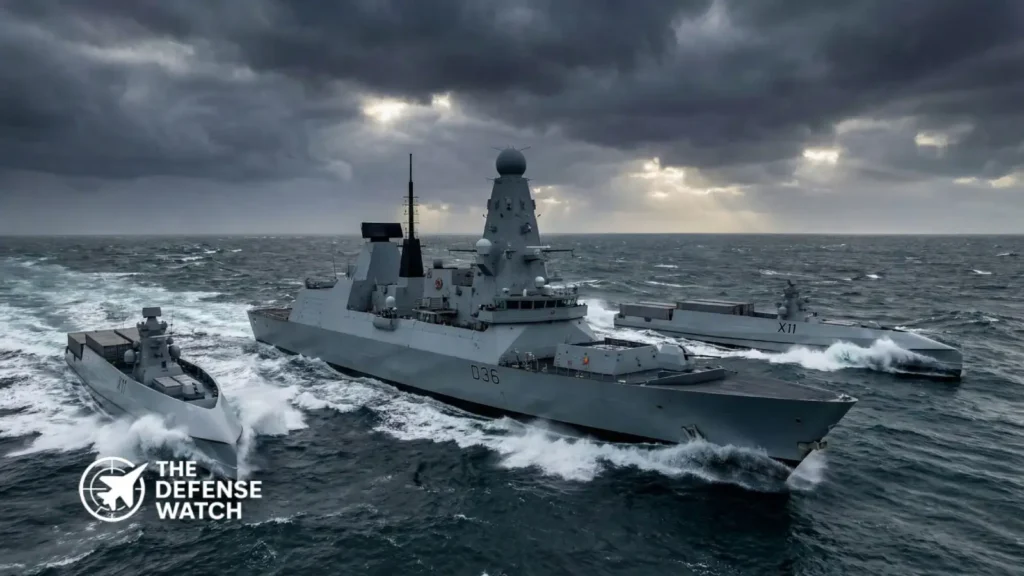
The concept unveiled by Navantia UK appears designed around that evolving operational model.
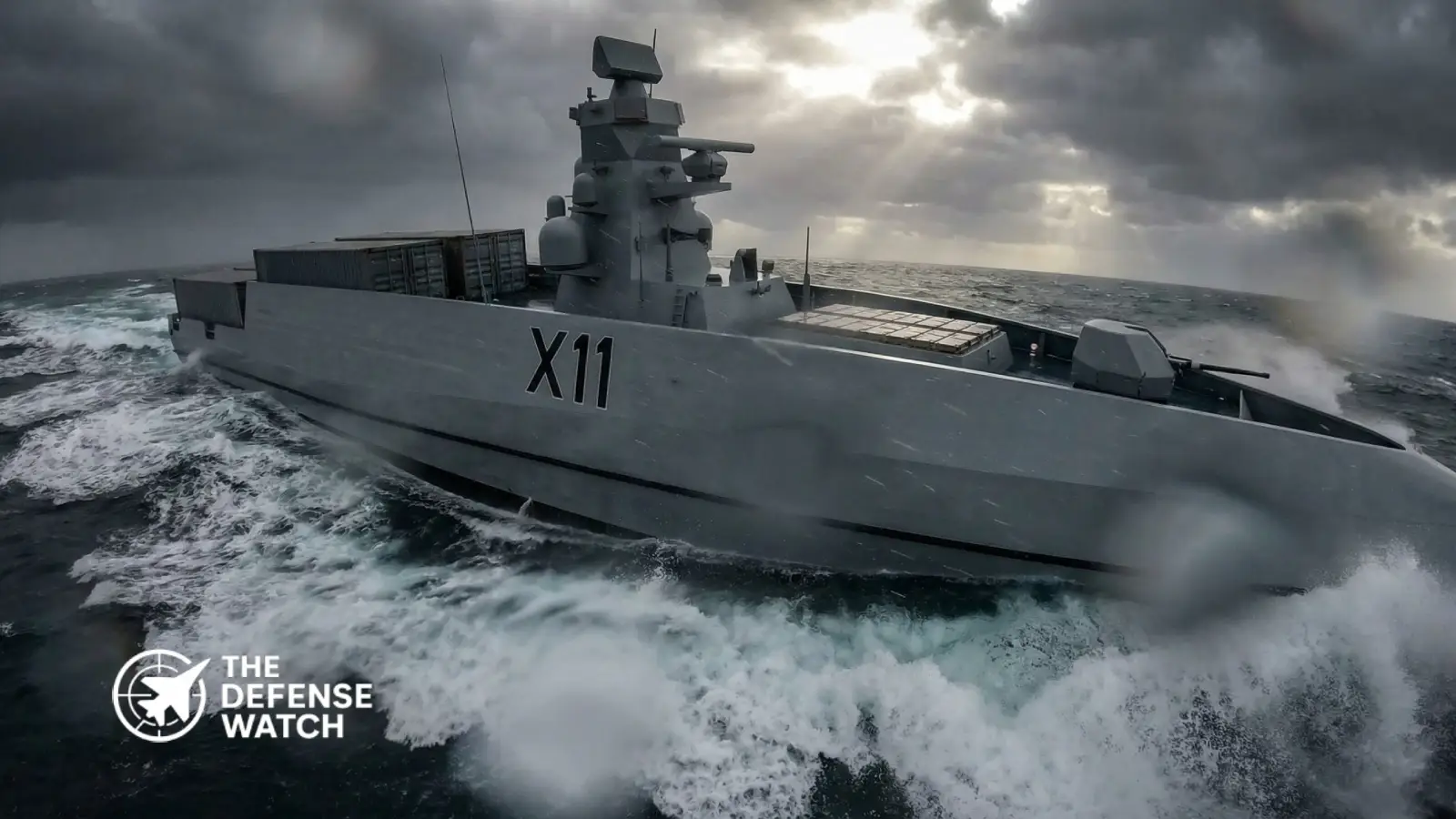
Images released during the event show a sleek, low-profile vessel featuring a large mission deck and modular architecture. Such configurations typically allow rapid integration of mission-specific payloads, including unmanned aerial systems, sonar packages, communications nodes, or strike systems.
While Navantia UK has not disclosed detailed specifications, the vessel’s layout suggests emphasis on adaptability and distributed maritime operations rather than traditional standalone combat roles.
Royal Navy And NATO Increasing Focus On Maritime Autonomy
The Royal Navy has steadily expanded experimentation with autonomous maritime platforms over the past several years. Programs involving unmanned mine-hunting systems, autonomous patrol vessels, and AI-supported command systems have become increasingly prominent within British naval modernization efforts.
The United Kingdom’s broader naval strategy aligns closely with NATO efforts to improve maritime situational awareness and survivability in contested environments.
Autonomous vessels are viewed as particularly valuable in areas where persistent surveillance is required, including the North Atlantic, Arctic approaches, and critical maritime chokepoints.
The new Navantia UK autonomous warship concept also aligns with growing international competition in unmanned naval technology. The United States Navy, China’s People’s Liberation Army Navy, and several European defense firms are actively pursuing similar systems aimed at expanding operational reach while reducing exposure of crewed assets.
In recent years, autonomous maritime systems have demonstrated increasing operational utility during exercises involving ISR missions, logistics support, and coordinated drone operations.
Modular Design Reflects Evolving Naval Warfare Requirements
One of the most significant aspects of the Navantia UK autonomous warship concept is its apparent modularity.
Modern naval procurement increasingly favors adaptable platforms capable of evolving alongside rapidly changing operational requirements. Fixed-role vessels risk becoming obsolete more quickly as new sensors, AI systems, and electronic warfare technologies emerge.
A modular autonomous platform allows operators to tailor systems for specific missions without requiring entirely new ship classes.
This approach mirrors broader trends seen across NATO naval modernization programs, where flexibility, interoperability, and scalable force structures are becoming central procurement priorities.
Naval analysts also note that autonomous systems could help address ongoing recruitment and retention challenges affecting several Western navies. Reduced-crewed vessels lower manpower demands while enabling expanded operational coverage.
However, autonomous naval warfare also introduces significant challenges. Secure communications, cyber resilience, command authority, and rules of engagement remain critical concerns for military planners integrating AI-enabled systems into operational fleets.
Strategic Implications For Future Maritime Competition
The unveiling of the Navantia UK autonomous warship concept illustrates how maritime competition is increasingly shifting toward networked and autonomous operations.
Future naval conflicts are expected to involve large numbers of interconnected manned and unmanned platforms operating simultaneously across wide maritime areas. Autonomous vessels may function as forward sensors, communications relays, electronic warfare nodes, or logistical support platforms for larger fleets.
For NATO navies, autonomous systems offer a potential force multiplier at a time when defense budgets face competing modernization demands across air, land, cyber, and space domains.
The concept also reinforces Europe’s broader push to strengthen indigenous defense industrial capabilities amid rising geopolitical uncertainty and growing emphasis on strategic autonomy.
As maritime threats evolve, autonomous platforms are likely to become increasingly integrated into both peacetime deterrence operations and future high-intensity naval warfare planning.