

Executive Summary:
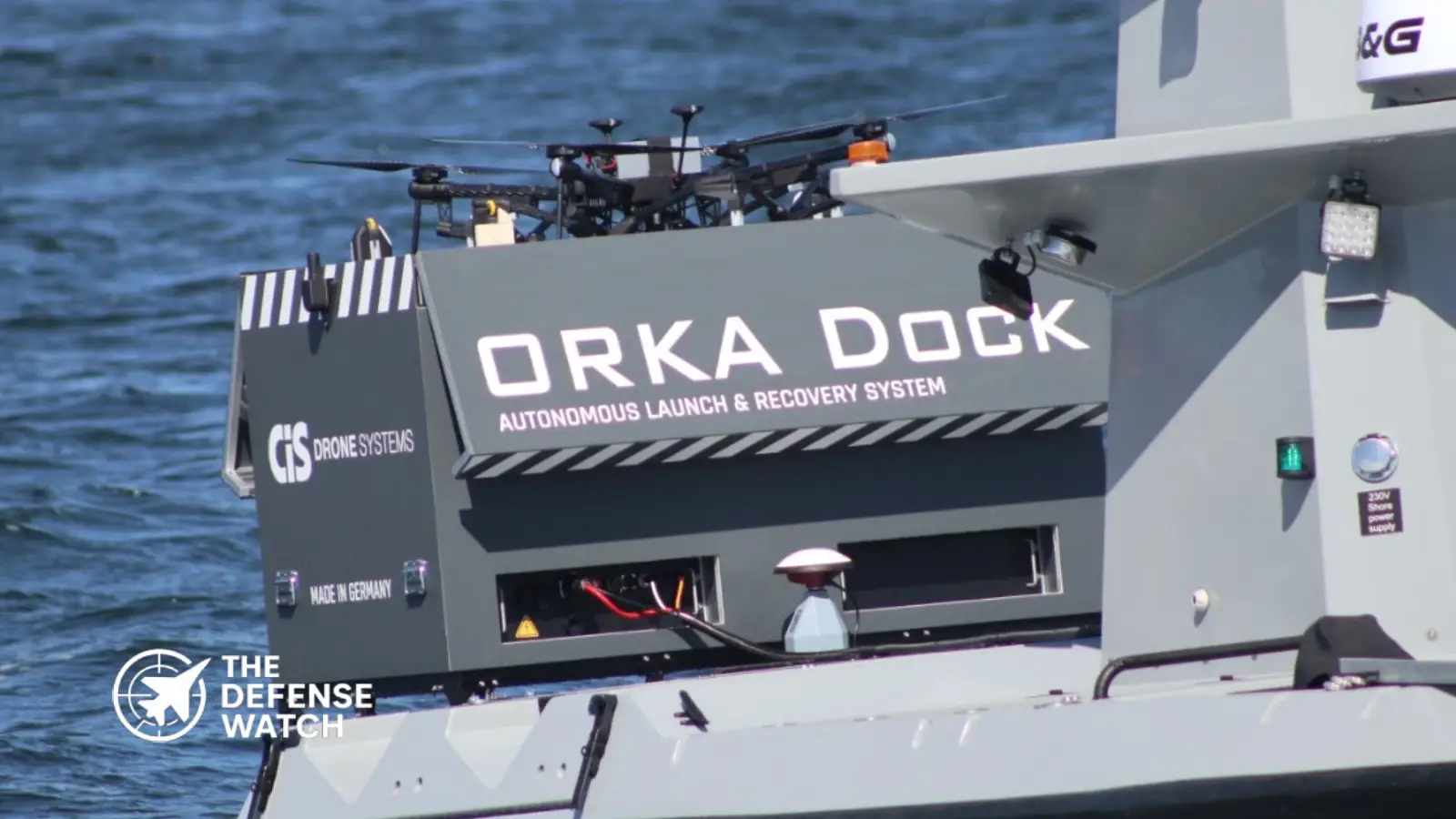
Canadian company CIS has unveiled an autonomous drone docking system designed for deployment aboard moving ships. The technology aims to improve naval UAV launch, recovery, charging, and storage operations while reducing crew workload and enabling persistent maritime surveillance capabilities.
The autonomous drone dock unveiled by CIS represents another step in the growing push toward persistent unmanned maritime operations. Designed for use aboard moving vessels, the system enables drones to autonomously land, recharge, and relaunch without direct operator intervention.
The announcement reflects increasing global naval interest in integrating unmanned systems into day-to-day fleet operations, particularly for intelligence gathering, surveillance, reconnaissance, and force protection missions.
The docking system is intended to function in demanding maritime conditions where vessel motion and environmental factors complicate UAV recovery procedures.
Autonomous Drone Dock Designed For Maritime Operations
CIS said the system combines autonomous landing guidance, charging capability, and secured storage within a compact maritime-ready platform. The drone dock is engineered to compensate for ship movement during launch and recovery operations, one of the key technical barriers for naval UAV deployment.
Modern naval forces increasingly rely on drones for over-the-horizon surveillance, maritime domain awareness, search and rescue support, and targeting assistance. However, sustaining UAV operations at sea remains operationally complex, especially on smaller vessels with limited flight deck space.
The autonomous drone dock seeks to address that challenge by reducing the need for dedicated personnel during UAV handling. Automated launch and recovery also potentially lower operational risk in rough sea states or adverse weather conditions.
CIS stated that the platform can support continuous drone operations by automatically recharging aircraft between missions. That capability could extend surveillance coverage windows while minimizing interruptions caused by manual maintenance cycles.
Growing Demand For Naval UAV Integration
Interest in shipborne unmanned systems has accelerated across NATO and Indo-Pacific navies as maritime competition intensifies in contested regions.
The U.S. Navy, Royal Navy, and several European naval forces are investing heavily in autonomous systems intended to improve fleet survivability and expand intelligence collection capacity.
Autonomous drone docking systems are becoming increasingly important because conventional UAV recovery methods aboard ships can require specialized crews, arresting equipment, or larger flight decks. Smaller autonomous docks could allow patrol vessels, offshore support ships, and even unmanned surface vessels to operate aerial drones more consistently.
The maritime drone sector has seen rapid development in recent years. Companies and defense agencies are pursuing systems capable of autonomous launch and recovery to support persistent ISR missions and distributed naval operations.
Analysts increasingly view unmanned systems as essential force multipliers, particularly in regions where naval forces must monitor large maritime areas with limited manned assets.
Operational Advantages At Sea
The CIS autonomous drone dock appears aimed at solving several operational limitations associated with maritime UAV deployment.
First, automated recovery reduces dependence on highly trained flight deck crews. That can improve operational efficiency aboard smaller vessels where manpower is limited.
Second, autonomous charging and mission cycling may enable near-continuous ISR coverage. Persistent drone presence has become increasingly valuable for tracking surface contacts, monitoring shipping lanes, and supporting maritime security operations.
Third, the compact nature of such systems may broaden UAV access beyond major warships. Offshore patrol vessels, coast guard platforms, logistics ships, and autonomous surface vessels could all potentially integrate similar capabilities.
The move aligns with broader naval modernization trends emphasizing distributed operations, autonomous systems, and lower-risk force projection methods.
Challenges Remain For Maritime Autonomy
Despite advances in autonomous docking technology, maritime UAV operations remain technically demanding.
Sea conditions, wind, vessel maneuvering, and electronic interference can complicate automated recovery operations. Reliability is especially critical during high sea states where deck motion becomes unpredictable.
Cybersecurity also remains a concern for autonomous naval systems. As unmanned platforms become more networked, navies will likely place greater emphasis on secure communications and electronic warfare resilience.
Regulatory and operational integration challenges also persist. Many navies continue developing doctrine governing unmanned operations alongside crewed vessels.
Still, the growing pace of investment suggests autonomous maritime aviation systems will continue expanding across both military and commercial sectors.
Strategic Significance
The unveiling of the autonomous drone dock comes as defense planners increasingly prioritize maritime surveillance and autonomous operations in contested waters.
Naval forces are under pressure to monitor wider operational areas while managing rising personnel and operational costs. Autonomous drone infrastructure may help address both challenges simultaneously.
For smaller navies and coast guards, compact autonomous systems could offer lower-cost access to advanced ISR capabilities without requiring large aviation-capable warships.
The technology also reflects the broader shift toward human-machine teaming in naval operations, where autonomous systems support crewed platforms rather than replace them outright.
As unmanned systems mature, autonomous docking and sustainment technologies are likely to become a foundational component of future naval operations.
