atOptions = { ‘key’ : ‘3d48d603f906e3fe9f205be3c4433835’, ‘format’ : ‘iframe’, ‘height’ : 250, ‘width’ : 300, ‘params’ : {} };Executive Summary:
EuroTrophy has unveiled an enhanced configuration of its Trophy Active Protection System (APS) integrated on the Leopard 2 A-RC 3.0 main battle tank, introducing new capabilities aimed at countering drones and other aerial threats. Displayed during Eurosatory 2026, the upgrade reflects the growing importance of layered protection against unmanned systems that have become a defining feature of modern combat operations. The development highlights the continuing evolution of active protection technologies beyond traditional anti-tank missile defense.
EuroTrophy Demonstrates Trophy APS Drone Defense Upgrade On Leopard 2 A-RC 3.0
EuroTrophy has presented a new configuration of its Trophy Active Protection System featuring drone defense enhancements on the Leopard 2 A-RC 3.0 main battle tank during the Eurosatory 2026 defense exhibition in Paris. The system was showcased on an updated version of KNDS Deutschland’s next-generation armored vehicle concept, emphasizing the industry’s response to lessons emerging from contemporary conflicts where drones increasingly threaten armored formations.
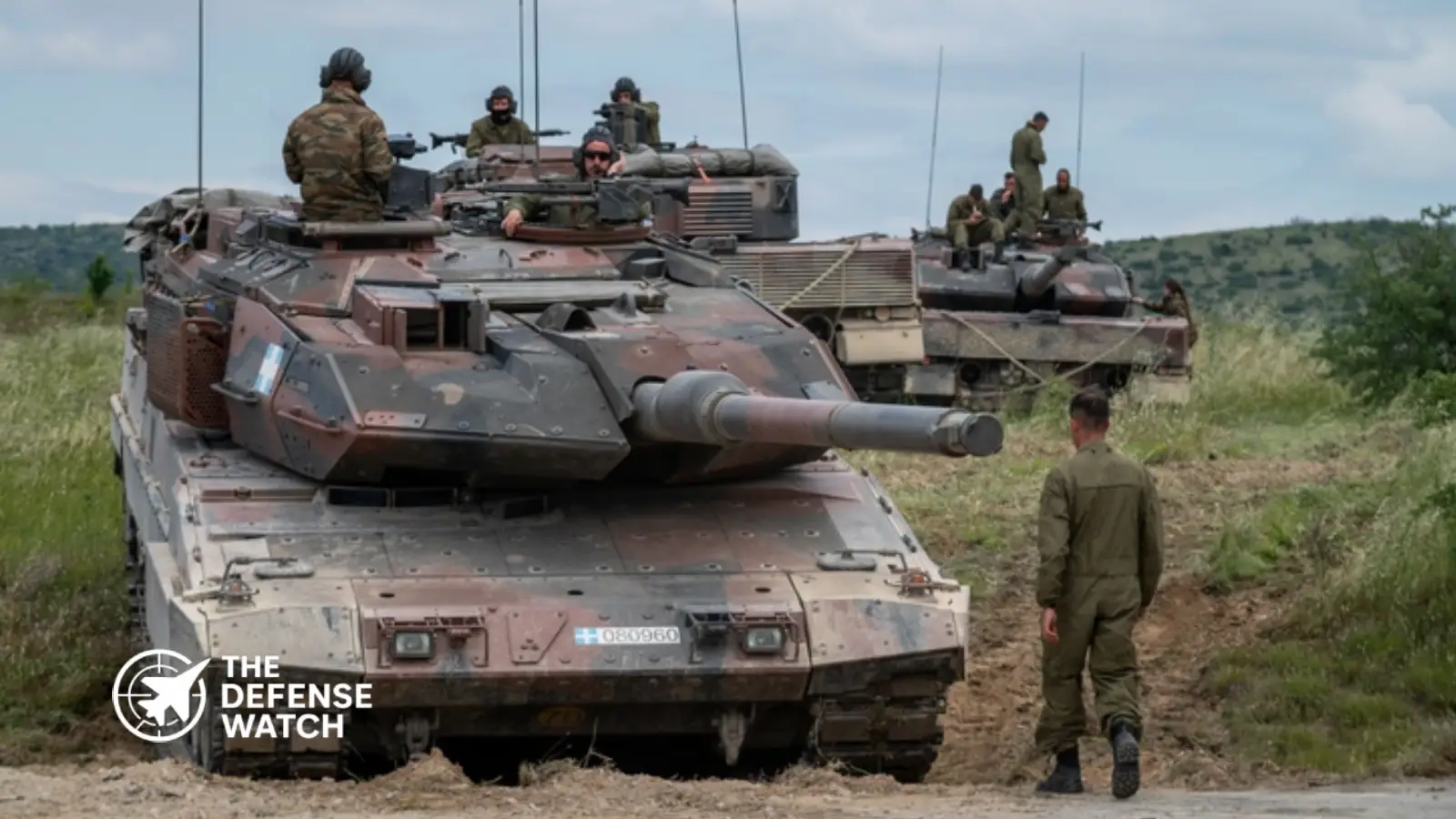
The upgraded configuration represents a significant evolution of the combat-proven Trophy APS, which is already deployed on multiple Western armored platforms, including the Leopard 2, M1 Abrams, and Merkava IV. Recent adoption across several European Leopard 2A8 programs has further strengthened Trophy’s position as one of NATO’s most widely fielded active protection systems.
New Protection Features Target Emerging Drone Threats
According to reports from Eurosatory 2026, the latest Trophy configuration incorporates new radar panels with expanded coverage and improved detection performance against unmanned aerial systems. The upgraded sensors are designed to identify small, low-flying drones that have become increasingly prevalent on modern battlefields.
The enhanced Leopard 2 A-RC 3.0 prototype also incorporates a 30 mm remote weapon station capable of engaging aerial and ground targets. The system reportedly features dual-feed ammunition capability, allowing crews to rapidly switch between different ammunition types depending on the threat environment.
This combination of advanced sensors and dedicated weapon systems reflects a broader shift in armored vehicle protection philosophy. Traditional active protection systems were primarily optimized to defeat anti-tank guided missiles, rocket-propelled grenades, and kinetic threats. The emergence of FPV drones, loitering munitions, and top-attack systems has forced manufacturers to expand protection architectures beyond conventional anti-armor threats.
Leopard 2 A-RC 3.0 Designed For Future Battlefield Requirements
The Leopard 2 A-RC 3.0 serves as KNDS Deutschland’s vision for the future evolution of the Leopard family while Europe continues development of the Main Ground Combat System (MGCS). The platform introduces an unmanned turret design, with all three crew members located within the hull for improved survivability.
Key reported characteristics of the Leopard 2 A-RC 3.0 include:
Capability Details Crew Configuration Three personnel housed in armored hull Turret Type Unmanned remote-controlled turret Main Armament 120 mm smoothbore gun, upgradeable to 140 mm Secondary Armament 30 mm remote weapon station Active Protection Trophy APS Weight Under 60 tons Engine Power 1,500 hp Maximum Speed Approximately 65 km/h Specifications based on publicly released prototype information.
The vehicle’s reduced profile and reconfigured crew compartment are intended to improve survivability while supporting future automation and sensor integration requirements.
(adsbygoogle = window.adsbygoogle || []).push({});Why Counter-Drone Protection Is Becoming Essential For Tanks
The addition of drone defense features to Trophy APS reflects one of the most significant trends in armored warfare since the end of the Cold War.
Recent conflicts have demonstrated that relatively inexpensive drones can threaten even heavily armored vehicles. First-person-view drones, loitering munitions, and reconnaissance UAVs are increasingly used to locate, track, and attack armored formations. In many cases, these systems approach from angles that traditional armor packages were not originally designed to withstand.
As a result, military planners are shifting toward layered protection concepts that combine:
- Passive armor
- Active protection systems
- Electronic warfare measures
- Optical detection systems
- Dedicated counter-drone weapons
- Networked battlefield sensors
The Trophy upgrade displayed by EuroTrophy appears aligned with this broader trend, seeking to provide armored units with greater protection against both conventional anti-tank weapons and emerging aerial threats.
(adsbygoogle = window.adsbygoogle || []).push({});Implications For NATO Armored Modernization
The unveiling carries broader implications for NATO land forces. Several European countries are currently acquiring Leopard 2A8 tanks equipped with Trophy APS as a standard feature, including Lithuania, the Netherlands, the Czech Republic, Croatia, Germany, and Norway.
If counter-drone enhancements mature into operational capabilities, future Leopard fleets could gain significantly improved protection against one of the fastest-growing threats facing armored formations.
The development also highlights the increasing convergence between active protection systems, sensor fusion technologies, and counter-unmanned aircraft capabilities. Rather than treating these functions as separate subsystems, manufacturers are moving toward integrated survivability architectures capable of detecting, tracking, and defeating multiple threat types simultaneously.
For NATO forces preparing for high-intensity operations, such integrated protection solutions may become as important as traditional armor thickness or main gun performance.
atOptions = { ‘key’ : ‘e7d18db8b7513fb2a224cf4c3f18bbf0’, ‘format’ : ‘iframe’, ‘height’ : 90, ‘width’ : 728, ‘params’ : {} };Outlook
EuroTrophy’s latest Trophy APS configuration demonstrates how active protection systems are evolving in response to rapidly changing battlefield conditions. While Trophy established its reputation by defeating anti-tank missiles and rocket attacks, the addition of drone defense features signals a new phase in armored vehicle survivability.
As unmanned systems continue to proliferate across modern battlefields, future tank protection will likely depend on the ability to detect and counter threats arriving from all directions, including the air. The Leopard 2 A-RC 3.0 demonstrator provides an early indication of how Western armored forces may address that challenge in the years ahead.