
- Home
- Defense Systems
- Bombs & Aerial Munitions
- GBU-32 JDAM
GBU-32 JDAM
Defense Systems Full Specifications
1. General Information
| Name / Designation | GBU-32 (V)1/B or (V)2/B |
| Type | Precision-Guided Bomb |
| Manufacturer | Boeing Defense, Space & Security |
| Country of Origin | United States |
| Year Introduced | Late 1990s (IOC ~1999) |
| Operational Status | Active |
2. Physical Characteristics
| Weight | ~1,013 pounds (460.5 kg) |
| Length | 119.5 inches (303.5 cm) |
| Diameter | ~14 inches (35.6 cm) |
| Casing Type | Mk 83 general purpose or BLU-110 |
3. Performance
| Yield | N/A (conventional high explosive) |
| Guidance | GPS/INS |
| Accuracy (CEP) | ~16 feet (5 m) with GPS |
| Delivery Platforms | Multiple U.S. fighters and bombers |
| Penetration Capability | Moderate (enhanced with BLU-110 variant) |
4. Warhead / Explosive Details
| Warhead Type | High Explosive (HE) / Penetrator |
| Fuzing Options | Impact, proximity (varies by configuration) |
| Explosive Composition | Standard HE fill (specifics classified) |
5. Operational Use
| Primary Mission | Precision strike against fixed/mobile targets |
| Operators | U.S. Air Force, U.S. Navy, select allies |
| Notable Deployments / History | Extensive use in Iraq, Afghanistan, and other operations since 1999 |
6. Variants
| Variants | GBU-32(V)1/B (USAF), GBU-32(V)2/B (USN); BLU-110 penetrator options |
PROS
- Exceptional all-weather precision guidance with GPS/INS integration.
- Cost-effective conversion of existing unguided bombs.
- Compatible with multiple U.S. fighters and bombers, including stealth platforms like the F-22.
- Reduced collateral damage through high accuracy.
- Reliable standoff capability up to 15 miles.
CONS
- Range limited compared to powered standoff weapons like cruise missiles.
- Susceptible to advanced GPS jamming in contested environments.
- Requires compatible aircraft interfaces for full functionality.
- Fixed warhead options limit flexibility against deeply hardened targets versus specialized penetrators.
- Dependent on weather and release parameters for maximum range.
GBU-32 JDAM: Precision 1,000-lb Guided Bomb Kit
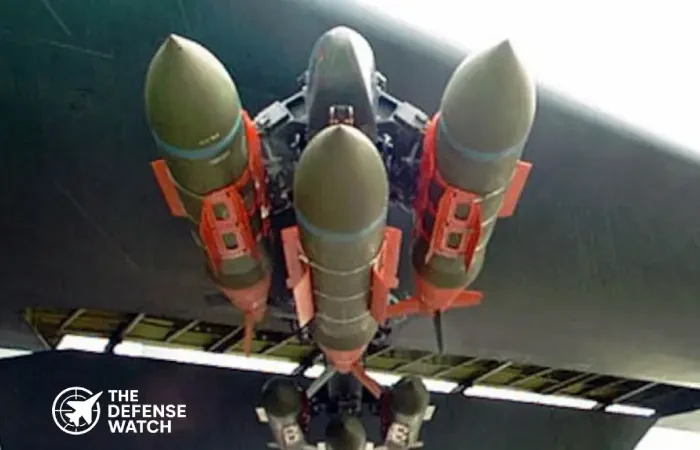
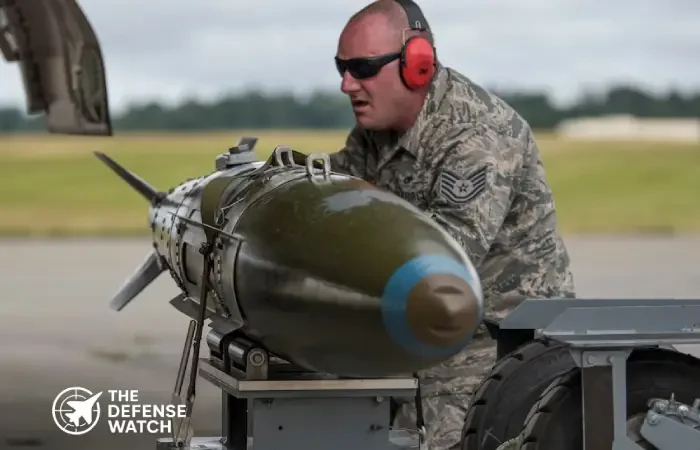
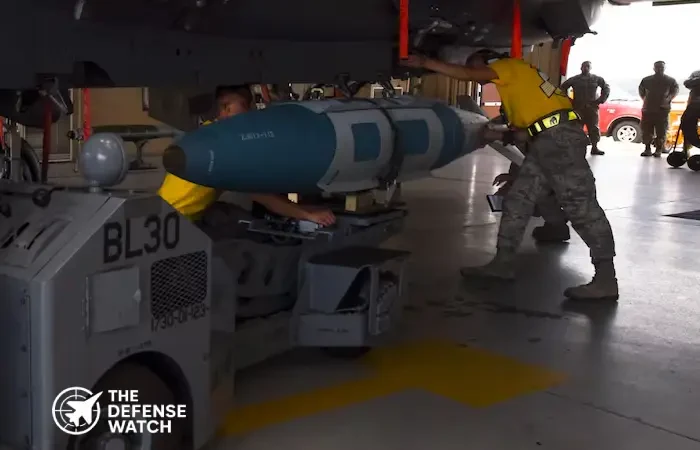
The GBU-32 represents a cornerstone of American precision strike capability within the Joint Direct Attack Munition (JDAM) family. This guided bomb transforms unguided 1,000-pound general-purpose bombs into accurate, all-weather smart munitions through the addition of a GPS-aided inertial navigation system (INS) tail kit. Developed to meet the demands of post-Cold War conflicts requiring reduced collateral damage and high first-pass accuracy, the GBU-32 enables U.S. forces to engage fixed and mobile targets effectively from medium to high altitudes.
Manufacturer
Boeing Defense, Space & Security serves as the primary contractor for the JDAM program, building on initial development work by McDonnell Douglas. The GBU-32 integrates with Mk 83 or BLU-110 warheads, with production supporting U.S. Air Force and Navy requirements.
Speed and Range
Released from aircraft at high altitudes, the GBU-32 achieves standoff ranges of up to 15 miles (24 km), depending on release altitude and speed. It supports delivery from platforms operating above 45,000 feet. While not a powered munition with sustained supersonic speed, it maintains high subsonic velocities during glide, prioritizing precision over raw velocity.
Cost/Price
The unit cost for a JDAM tail kit, including the GBU-32 configuration, is approximately $22,000–$25,000 (adjusted for various fiscal years), making it a cost-effective precision upgrade compared to legacy guided weapons. Full munition costs vary with the warhead.
The GBU-32 has seen extensive operational use since its introduction in the late 1990s, proving its value in operations such as those in Iraq and Afghanistan. Its GPS/INS guidance provides a Circular Error Probable (CEP) of about 16 feet under GPS conditions, offering exceptional reliability even in GPS-denied environments via INS backup. This combination of accuracy, affordability, and compatibility with a wide range of U.S. combat aircraft—including the F-15E, F-16, F-22, and bombers—ensures it remains a staple in the U.S. inventory for close air support, interdiction, and strategic strikes.
Disclaimer Note
The information provided on TheDefenseWatch.com is for general informational purposes only. While we strive to ensure the accuracy, completeness, and timeliness of our content regarding defense and aerospace products, technologies, and specifications, we cannot guarantee that all information is 100% accurate or up-to-date due to the evolving nature of military technology and classified data.TheDefenseWatch.com does not warrant the reliability, suitability, or availability of the information for any specific purpose. Users are advised to consult official sources, such as manufacturers, government publications, or defense agencies, for precise and verified data before making decisions based on our content.We are not affiliated with any defense manufacturers, governments, or military organizations mentioned. Opinions, reviews, and ratings reflect expert analysis but are subjective and should not be considered endorsements. TheDefenseWatch.com is not responsible for any errors, omissions, or consequences arising from the use of this website’s content.External links are provided for convenience and do not imply endorsement. TheDefenseWatch.com reserves the right to update or modify content without prior notice. By using this website, you agree to our Privacy & Cookies Policy.

New Arrivals



Popular Comparisons
-
 Tejas vs Gripen: Key Differences and Capabilities
View Comparison →
-
Tejas vs MiG-21 Bison: How India Replaced Its Iconic Supersonic Fighter
View Comparison →
-
F-35 vs F-16: Stealth, Sensors and Combat Roles
View Comparison →
-
Tejas Fighter Jet vs F-16 Fighting Falcon: Capability Compared
View Comparison →
-
Rafale Fighter Jet vs F-16 Fighting Falcon : Which Fighter Has the Edge?
View Comparison →
-
Su-57 Fighter Jet vs J-20 Fighter Jet: Stealth and Air Combat Compared
View Comparison →
-
Mirage 2000 vs Tejas Mk1A: Legacy Combat Power vs Indigenous Modernization
View Comparison →
-
Rafale Fighter Jet vs F-22 Raptor: Which Air Dominance Fighter Has the Edge?
View Comparison →
-
Tejas Fighter Jet vs. Rafale Fighter Jet: India’s Indigenous Fighter Meets France’s Proven Multirole Combat Aircraft
View Comparison →
-
F-22 Raptor vs. F-35 Joint Strike Fighter: Which Fifth Generation Fighter Has the Edge?
View Comparison →


- US Military Weighs MOAB for Potential Future Strikes on Iran, CNN Reports

- Saab Wins $120 Million Order for New Gripen Flight Control Computer
- L3Harris Delivers First VAMPIRE Counter-Drone Systems to U.S. Army
- Lockheed Martin Invests $300 Million in Texas Munitions Expansion, Plans 6,000 U.S. Jobs
- Lockheed Martin Taps Avio for ER GMLRS and PrSM Rocket Motor Production
- Lockheed Martin Wins $16.1 Million Contract Modification for F-35 Processor Support
- Lockheed Martin Wins $74.3 Million Contract Modification for AN/SLQ-32(V)6 Electronic Warfare Systems
- Hegseth Says Autonomous Warfare Has Long Been the Pentagon’s End Goal
- US Rejects Automatic Body Camera Activation for ICE Officers
- Iron Dome Architect Develops New Counter-Swarm Drone Defense System






Fighter Jets
-
 MIG-31 Fighter Jet
-
J-10CE Fighter Jet
-
Chengdu J-10 Fighter Jet
-
Chengdu J-10C Fighter Jet
-
Gripen E Fighter Jet
-
Tejas Mk1A Fighter Jet
-
Tejas Mk‑2 Fighter Jet
-
F-16V Viper Block 70 Fighter Jet
-
F-15EX Eagle II Fighter
-
Boeing F/A-XX Fighter
-
F-15E Strike Eagle Fighter
-
F/A-18E/F Super Hornet Fighter Jet
-
Saab Gripen F Fighter Jet
-
JAS 39E/F Gripen Fighter Jet
-
JAS 39 Gripen Fighter Jet
-
F-35A Lightning II Fighter Jet
-
F/A-18F Super Hornet
-
J-50 Fighter Jet
-
Spanish EF-18 Hornet Fighter
-
F-47 Fighter Jet
-
F-35i Adir Fighter Jet
-
F-16 Fighting Falcon
-
AIDC T-5 Brave Eagle
-
F-CK-1 Ching-Kuo Fighter







Recent Compares
-
Tejas vs Gripen: Key Differences and Capabilities
View Comparison →
-
Tejas vs MiG-21 Bison: How India Replaced Its Iconic Supersonic Fighter
View Comparison →
-
F-35 vs F-16: Stealth, Sensors and Combat Roles
View Comparison →
-
Tejas Fighter Jet vs F-16 Fighting Falcon: Capability Compared
View Comparison →
-
Rafale Fighter Jet vs F-16 Fighting Falcon : Which Fighter Has the Edge?
View Comparison →
Latest Defense Systems
10 Compares Defense Systems
-
Tejas vs Gripen: Key Differences and Capabilities
View Comparison →
-
Tejas vs MiG-21 Bison: How India Replaced Its Iconic Supersonic Fighter
View Comparison →
-
F-35 vs F-16: Stealth, Sensors and Combat Roles
View Comparison →
-
Tejas Fighter Jet vs F-16 Fighting Falcon: Capability Compared
View Comparison →
-
Rafale Fighter Jet vs F-16 Fighting Falcon : Which Fighter Has the Edge?
View Comparison →
-
Su-57 Fighter Jet vs J-20 Fighter Jet: Stealth and Air Combat Compared
View Comparison →
-
Mirage 2000 vs Tejas Mk1A: Legacy Combat Power vs Indigenous Modernization
View Comparison →
-
Rafale Fighter Jet vs F-22 Raptor: Which Air Dominance Fighter Has the Edge?
View Comparison →
-
Tejas Fighter Jet vs. Rafale Fighter Jet: India’s Indigenous Fighter Meets France’s Proven Multirole Combat Aircraft
View Comparison →
-
F-22 Raptor vs. F-35 Joint Strike Fighter: Which Fifth Generation Fighter Has the Edge?
View Comparison →
- US Military Weighs MOAB for Potential Future Strikes on Iran, CNN Reports
- Saab Wins $120 Million Order for New Gripen Flight Control Computer
- L3Harris Delivers First VAMPIRE Counter-Drone Systems to U.S. Army
- Lockheed Martin Invests $300 Million in Texas Munitions Expansion, Plans 6,000 U.S. Jobs
- Lockheed Martin Taps Avio for ER GMLRS and PrSM Rocket Motor Production