
- Home
- Defense Systems
- Bombers & Strategic Aircraft
- NASA X-43A Aircraft
NASA X-43A Aircraft
Defense Systems Full Specifications
1. General Information
| Name | NASA X-43A |
| Manufacturer | NASA / Boeing |
| Country of Origin | United States |
| Introduction / In Service Since | 2001 (Test Flights) |
| Status | Retired |
| Category | Experimental Hypersonic Aircraft |
| Crew | Unmanned |
| Unit Cost | ~$50 million per test vehicle |
2. Dimensions & Structure
| Length | 12 ft (3.66 m) |
| Wingspan | 5 ft (1.52 m) |
| Height | 1.5 ft (0.46 m) |
| Wing Area | 5 sq ft (0.46 m²) |
| Empty Weight | 1,210 lb (550 kg) |
| Maximum Takeoff Weight (MTOW) | N/A (rocket-launched) |
3. Performance
| Maximum Speed | Mach 9.6 |
| Range | Short; test flight only |
| Combat Radius | N/A |
| Service Ceiling | 110,000 ft (33,500 m) |
| Rate of Climb | N/A |
4. Powerplant
| Engine Type | Hydrogen-fueled scramjet |
| Thrust (per engine) | 10,000 lbf (44 kN) |
| Total Thrust | 10,000 lbf |
5. Payload & Armament
| Internal Payload Capacity | N/A |
| Weapons Bay | None |
| Compatible Weapons | None |
| Hardpoints | None |
6. Avionics & Systems
| Radar System | N/A |
| Navigation | Inertial + GPS |
| Electronic Warfare (EW) | None |
| Stealth Features | Low radar signature due to small size |
7. Operational History
| Primary Operator | NASA |
| Conflict Usage | None |
| Notable Missions | Mach 7–9.6 hypersonic test flights (2001–2004) |
8. Additional Information
| Variants | X-43A-1, X-43A-2 |
| Successor / Future Replacement | X-51 Waverider |
| Notable Features | Scramjet propulsion, Mach 9+ speed |
| Estimated Operational Life | N/A (test aircraft) |
PROS
- Achieved record-breaking hypersonic speeds (Mach 9.6)
- Validated scramjet engine technology
- Lightweight and compact unmanned design
- Advanced aerodynamics and heat-resistant materials
- Paved the way for future hypersonic military and civilian aircraft
CONS
- Experimental and unmanned; no operational combat role
- Extremely high development cost per test vehicle
- Limited flight duration and range
- Launch dependent on carrier rocket
- Data primarily applicable for research, not immediate deployment
NASA X-43A Hypersonic Research Aircraft
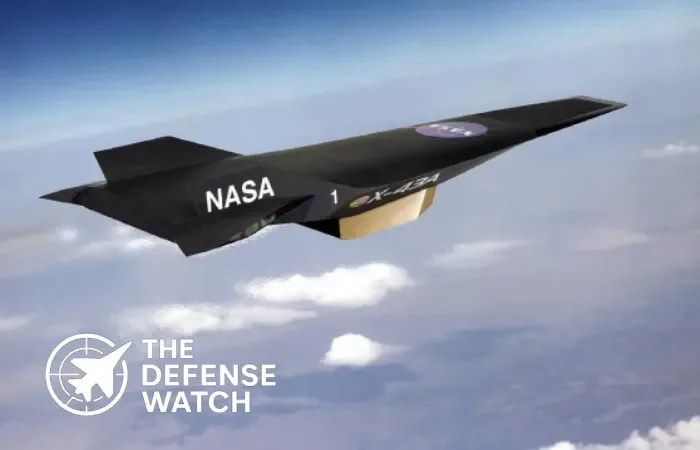
Developed jointly by NASA’s Langley Research Center, Dryden Flight Research Center (now Armstrong Flight Research Center), and aerospace contractors including Boeing, the X-43A is a testament to U.S. innovation in experimental flight research. Its primary goal was to validate scramjet propulsion technology for future military and civilian applications, including ultra-fast aircraft and potential hypersonic missiles.
Capabilities and Technology
The X-43A is an unmanned, winged vehicle measuring 12 feet in length, launched from a Pegasus rocket before igniting its hydrogen-fueled scramjet engine. It holds the world record for the fastest jet-powered aircraft, achieving speeds up to Mach 9.6. Despite its high speed, the X-43A was not armed and had no combat role, serving purely as a testbed for aerodynamic design, high-temperature materials, and engine performance under extreme conditions. Its flight data contributed to the development of next-generation hypersonic vehicles, including the potential for future reconnaissance and strike platforms.
Operational Use
The X-43A flew a series of successful test missions between 2001 and 2004, demonstrating stable hypersonic flight and confirming the viability of scramjet propulsion. While it never entered production, its lessons directly influence modern U.S. hypersonic missile and aircraft research programs.
NASA X-43A Price in US
The NASA X-43A represents a cutting-edge experimental aircraft developed by NASA and the U.S. aerospace industry to explore hypersonic flight at speeds previously unattainable by conventional aircraft. Launched in the early 2000s as part of NASA’s Hyper-X program, the X-43A was engineered to test air-breathing scramjet engines capable of propelling vehicles at speeds exceeding Mach 9, or roughly 7,000 mph.
FAQs – NASA X-43A
Did the X-43A reach Mach 10?
No, the X-43A did not reach Mach 10. Its top speed was approximately Mach 9.6 (about 7,000 mph), setting a record for the fastest jet-powered aircraft in the world.
What happened to the X-43A?
The X-43A was an experimental, unmanned hypersonic aircraft used for research flights between 2001 and 2004. After successfully completing its test missions, the program ended, and the aircraft were retired. Data from the X-43A has been used to inform future hypersonic aircraft and missile programs.
How much does the NASA X-43A cost?
Each X-43A test vehicle had an estimated cost of around $50 million, factoring in development, materials, and flight operations. The program was purely experimental and not a production aircraft.
How long would it take the NASA X-43A to fly around the world?
If it could maintain its top speed of Mach 9.6 continuously, the X-43A could theoretically circumnavigate the Earth in roughly 1.5–2 hours. However, the X-43A was a short-duration test vehicle and not designed for sustained global flight.
NASA X-43 price
The program’s cost per individual X-43A test vehicle was approximately $50 million, though total program costs—including development and multiple launches—were significantly higher.
Is the NASA X-43 real?
Yes, the NASA X-43A was a real unmanned experimental aircraft. It successfully flew hypersonic test missions and demonstrated scramjet propulsion, making it a key milestone in aerospace research.
Disclaimer Note
The information provided on TheDefenseWatch.com is for general informational purposes only. While we strive to ensure the accuracy, completeness, and timeliness of our content regarding defense and aerospace products, technologies, and specifications, we cannot guarantee that all information is 100% accurate or up-to-date due to the evolving nature of military technology and classified data.TheDefenseWatch.com does not warrant the reliability, suitability, or availability of the information for any specific purpose. Users are advised to consult official sources, such as manufacturers, government publications, or defense agencies, for precise and verified data before making decisions based on our content.We are not affiliated with any defense manufacturers, governments, or military organizations mentioned. Opinions, reviews, and ratings reflect expert analysis but are subjective and should not be considered endorsements. TheDefenseWatch.com is not responsible for any errors, omissions, or consequences arising from the use of this website’s content.External links are provided for convenience and do not imply endorsement. TheDefenseWatch.com reserves the right to update or modify content without prior notice. By using this website, you agree to our Privacy & Cookies Policy.





New Arrivals







Popular Comparisons
-
 Tejas vs Gripen: Key Differences and Capabilities
View Comparison →
-
Tejas vs MiG-21 Bison: How India Replaced Its Iconic Supersonic Fighter
View Comparison →
-
F-35 vs F-16: Stealth, Sensors and Combat Roles
View Comparison →
-
Tejas Fighter Jet vs F-16 Fighting Falcon: Capability Compared
View Comparison →
-
Rafale Fighter Jet vs F-16 Fighting Falcon : Which Fighter Has the Edge?
View Comparison →
-
Su-57 Fighter Jet vs J-20 Fighter Jet: Stealth and Air Combat Compared
View Comparison →
-
Mirage 2000 vs Tejas Mk1A: Legacy Combat Power vs Indigenous Modernization
View Comparison →
-
Rafale Fighter Jet vs F-22 Raptor: Which Air Dominance Fighter Has the Edge?
View Comparison →
-
Tejas Fighter Jet vs. Rafale Fighter Jet: India’s Indigenous Fighter Meets France’s Proven Multirole Combat Aircraft
View Comparison →
-
F-22 Raptor vs. F-35 Joint Strike Fighter: Which Fifth Generation Fighter Has the Edge?
View Comparison →


- US Military Weighs MOAB for Potential Future Strikes on Iran, CNN Reports

- Saab Wins $120 Million Order for New Gripen Flight Control Computer
- L3Harris Delivers First VAMPIRE Counter-Drone Systems to U.S. Army
- Lockheed Martin Invests $300 Million in Texas Munitions Expansion, Plans 6,000 U.S. Jobs
- Lockheed Martin Taps Avio for ER GMLRS and PrSM Rocket Motor Production
- Lockheed Martin Wins $16.1 Million Contract Modification for F-35 Processor Support
- Lockheed Martin Wins $74.3 Million Contract Modification for AN/SLQ-32(V)6 Electronic Warfare Systems
- Hegseth Says Autonomous Warfare Has Long Been the Pentagon’s End Goal
- US Rejects Automatic Body Camera Activation for ICE Officers
- Iron Dome Architect Develops New Counter-Swarm Drone Defense System







Fighter Jets
-
 MIG-31 Fighter Jet
-
J-10CE Fighter Jet
-
Chengdu J-10 Fighter Jet
-
Chengdu J-10C Fighter Jet
-
Gripen E Fighter Jet
-
Tejas Mk1A Fighter Jet
-
Tejas Mk‑2 Fighter Jet
-
F-16V Viper Block 70 Fighter Jet
-
F-15EX Eagle II Fighter
-
Boeing F/A-XX Fighter
-
F-15E Strike Eagle Fighter
-
F/A-18E/F Super Hornet Fighter Jet
-
Saab Gripen F Fighter Jet
-
JAS 39E/F Gripen Fighter Jet
-
JAS 39 Gripen Fighter Jet
-
F-35A Lightning II Fighter Jet
-
F/A-18F Super Hornet
-
J-50 Fighter Jet
-
Spanish EF-18 Hornet Fighter
-
F-47 Fighter Jet
-
F-35i Adir Fighter Jet
-
F-16 Fighting Falcon
-
AIDC T-5 Brave Eagle
-
F-CK-1 Ching-Kuo Fighter








Recent Compares
-
Tejas vs Gripen: Key Differences and Capabilities
View Comparison →
-
Tejas vs MiG-21 Bison: How India Replaced Its Iconic Supersonic Fighter
View Comparison →
-
F-35 vs F-16: Stealth, Sensors and Combat Roles
View Comparison →
-
Tejas Fighter Jet vs F-16 Fighting Falcon: Capability Compared
View Comparison →
-
Rafale Fighter Jet vs F-16 Fighting Falcon : Which Fighter Has the Edge?
View Comparison →
Latest Defense Systems
10 Compares Defense Systems
-
Tejas vs Gripen: Key Differences and Capabilities
View Comparison →
-
Tejas vs MiG-21 Bison: How India Replaced Its Iconic Supersonic Fighter
View Comparison →
-
F-35 vs F-16: Stealth, Sensors and Combat Roles
View Comparison →
-
Tejas Fighter Jet vs F-16 Fighting Falcon: Capability Compared
View Comparison →
-
Rafale Fighter Jet vs F-16 Fighting Falcon : Which Fighter Has the Edge?
View Comparison →
-
Su-57 Fighter Jet vs J-20 Fighter Jet: Stealth and Air Combat Compared
View Comparison →
-
Mirage 2000 vs Tejas Mk1A: Legacy Combat Power vs Indigenous Modernization
View Comparison →
-
Rafale Fighter Jet vs F-22 Raptor: Which Air Dominance Fighter Has the Edge?
View Comparison →
-
Tejas Fighter Jet vs. Rafale Fighter Jet: India’s Indigenous Fighter Meets France’s Proven Multirole Combat Aircraft
View Comparison →
-
F-22 Raptor vs. F-35 Joint Strike Fighter: Which Fifth Generation Fighter Has the Edge?
View Comparison →
- US Military Weighs MOAB for Potential Future Strikes on Iran, CNN Reports
- Saab Wins $120 Million Order for New Gripen Flight Control Computer
- L3Harris Delivers First VAMPIRE Counter-Drone Systems to U.S. Army
- Lockheed Martin Invests $300 Million in Texas Munitions Expansion, Plans 6,000 U.S. Jobs
- Lockheed Martin Taps Avio for ER GMLRS and PrSM Rocket Motor Production