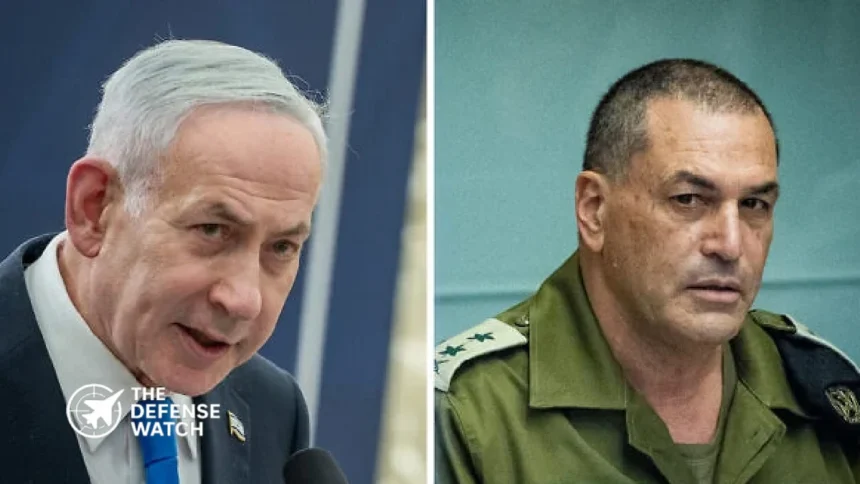
Israel’s military leadership is reportedly seeking further deliberations and formal authorization before carrying out an undisclosed operation linked to Iran, according to Israeli media reports published on October 25. The reported dispute involves Prime Minister Benjamin Netanyahu and Israel Defense Forces Chief of Staff Lt. Gen. Eyal Zamir, with concerns that the proposed action could trigger renewed hostilities with Tehran just before Israel’s October 27 election. Netanyahu has denied that a confrontation occurred.
- What Israeli media reported about the Netanyahu-Zamir dispute
- Netanyahu rejects the report
- Why the timing raises military concerns
- The military command question: operational necessity and authorization
- Iran remains the central strategic consideration
- Opposition leaders question the proposed action
- What remains unknown
- The significance for Israel’s Iran strategy
The dispute, if accurately described, raises questions about how Israel’s political leadership weighs military options against the risks of escalation during a sensitive domestic political period. However, the available reporting does not establish the operation’s intended target, planned method, timing or whether an order was ultimately carried out.
What Israeli media reported about the Netanyahu-Zamir dispute
Israel’s Channel 12 reported that Zamir had resisted an instruction from the political leadership to undertake an unspecified military action related to Iran. According to the broadcaster, the army chief sought additional consultations and signed documentation concerning the operation’s legal authorization.
The report cited unnamed military and political sources who expressed concern that the proposed action could lead to a rapid confrontation with Iran. Some sources reportedly feared that the political leadership might seek to use the Iranian threat for electoral advantage. These allegations have not been independently established.
The Jerusalem Post separately reported the alleged disagreement, drawing on Channel 12’s account. Neither report publicly identified the specific operation or provided enough information to determine whether the instruction concerned a direct strike on Iranian territory, an intelligence operation or another military activity.
That distinction matters. An operation connected to Iran does not necessarily mean a planned airstrike, and the reported request for authorization does not establish that the military refused a lawful order.
Netanyahu rejects the report
Netanyahu rejected the allegations in an interview with Israel’s Channel 14 on October 25, saying there had been no confrontation with Zamir and describing the report as nonsense.
The prime minister argued that the dispute narrative diverted attention from Israeli security officials’ warnings about possible Iranian interference in the election. He also said he had instructed the Israel Defense Forces and Mossad to work toward overthrowing the Iranian regime. His statement established his publicly declared objective, but it did not confirm that the undisclosed operation described by Channel 12 was part of that directive.
The competing accounts leave a central question unresolved: whether the reported disagreement involved a specific operational order, broader strategic discussions about Iran, or a dispute over the timing and authorization of possible military action.
No public operational order or official military statement confirming the reported confrontation was identified in the sources reviewed for this article.
Why the timing raises military concerns
The reported dispute emerged immediately before Israel’s October 27 election, when political rhetoric about Iran had intensified.
Netanyahu has repeatedly warned that Iran and its regional partners could pose a renewed security threat. On October 21, he publicly declared that his directive to Israel’s military and intelligence establishment was to overthrow the Iranian regime. That statement indicates the breadth of his stated strategic objective, although it does not establish which operations were being considered at the end of October.
For military planners, the central issue is the relationship between a proposed operation’s immediate objective and the consequences of Iranian retaliation.
An Israeli attack could prompt Tehran to launch missiles or drones, target Israeli interests through aligned armed groups, or threaten regional shipping. The actual response would depend on the target, the scale of the operation, Iran’s assessment of Israeli intentions and the broader regional military situation. These are potential escalation pathways, not confirmed outcomes of the reported order.
The timing also creates competing demands for Israel’s leadership. A decision to delay military action could be criticized if officials believe an immediate threat exists. Conversely, initiating an operation without a clearly established operational requirement could expose Israel to retaliation without a defined strategic benefit.
The available evidence does not establish that electoral considerations determined either Netanyahu’s alleged instruction or Zamir’s reported response.
The military command question: operational necessity and authorization
The reported request for further deliberations and written authorization is one of the most consequential elements of the story, but it requires careful interpretation.
In Israel’s system of government, the elected political leadership sets national policy and directs the defense establishment, while the IDF’s professional command structure develops and executes military operations. Decisions involving potential conflict with another state can require assessments of military necessity, intelligence reliability, operational feasibility, escalation risks and the legal basis for action.
A senior commander asking for clarification or formal documentation does not, by itself, demonstrate insubordination. Such a request can help establish what has been ordered, the authority under which it is being undertaken and the objectives the operation is expected to achieve.
At the same time, the reporting does not provide enough detail to determine the legal status of the alleged instruction or whether Zamir formally refused it. Without access to the order, relevant legal advice or official statements from the parties involved, stronger conclusions would be premature.
The immediate issue is therefore not simply whether Israel’s military chief opposed the prime minister. It is whether the reported consultations concerned a substantive disagreement about military necessity, the authority for a particular operation, its timing or some combination of those factors.
Iran remains the central strategic consideration
Israel’s security relationship with Iran has been shaped by direct military confrontation, concerns about Tehran’s nuclear program, ballistic missiles and the activities of Iran-aligned armed groups.
Netanyahu’s stated objective of regime change goes beyond a narrowly defined military task such as striking a particular missile facility or disrupting a weapons program. Achieving such a political outcome would involve uncertainties that cannot be resolved through an isolated tactical operation alone.
Military action can damage infrastructure, disrupt command networks or delay specific capabilities. It does not automatically produce a change in government, guarantee the long-term elimination of a weapons program or prevent an adversary from rebuilding its forces.
For Israel, a decision to renew direct attacks would therefore require consideration of both the immediate military objective and the likely conditions after the operation. Relevant factors would include Iran’s capacity to retaliate, the protection of Israeli civilians and military facilities, the availability of defensive interceptors, and the position of the United States.
Washington’s role is particularly important because a renewed confrontation could affect American forces and regional partners, depending on its scale and Iran’s response. However, the available reporting does not establish that the United States approved, rejected or was formally consulted about the specific operation at the center of the alleged Netanyahu-Zamir dispute.
Opposition leaders question the proposed action
The report also became part of Israel’s domestic political debate.
Opposition figures criticized the possibility of military action without what they described as a clear security justification. Gadi Eisenkot expressed support for Zamir and warned against turning the military into an instrument of political interests. Yair Golan similarly argued that any operation should have a clear security requirement, strategic objective and responsible plan. These were political responses to the reported dispute, not independent proof of the alleged motives behind the instruction.
Their statements underscore a broader question facing democratic governments during security crises: how to balance urgent military decisions with public accountability, professional military advice and the legitimacy of electoral processes.
That question is particularly sensitive when the proposed action could initiate a wider conflict. An operation that produces an immediate tactical advantage may still carry substantial strategic costs if its objectives are unclear or its likely consequences have not been adequately assessed.
However, the allegations of electoral motivation remain contested. Netanyahu denied the reported confrontation, and the public information reviewed here does not establish that the proposed action was intended to influence the election or postpone voting.
What remains unknown
Several essential details have not been publicly established.
- The operation: No verified description of the intended target, method or military objective has emerged from the reporting reviewed.
- The authorization: The reports describe a request for signed documentation, but the underlying order and its legal basis have not been made public.
- The military response: It remains unclear whether the reported instruction was changed, delayed, withdrawn or implemented.
- The political motivation: Claims that the proposed action was connected to electoral interests remain allegations rather than established facts.
- The risk of renewed conflict: The reporting describes concerns about escalation, but it does not establish that a new Israeli-Iranian confrontation was imminent.
These gaps prevent a firm assessment of the operation’s military significance. They also make it difficult to distinguish a disagreement over the immediate execution of an order from a deeper strategic dispute over how Israel should approach Iran.
The significance for Israel’s Iran strategy
The reported tension between Netanyahu and Zamir points to a consequential decision-making problem, even as the underlying allegations remain unresolved.
Israel’s leadership must assess whether further military action would address a specific and sufficiently urgent threat, whether the likely results justify the risks, and whether the country is prepared for a possible Iranian response. The military’s role in that process is to provide operational assessments and execute authorized missions within the applicable legal framework.
For now, the public record supports a limited conclusion: Israeli media have reported a dispute over an undisclosed Iran-related operation, while Netanyahu has denied that a confrontation with the IDF chief occurred. The operation’s details, the precise nature of the disagreement and the final decision remain unclear.
Until those questions are answered through official statements or independently verified reporting, claims about an imminent Israeli strike, a refusal to obey orders or a politically motivated decision to restart the conflict should be treated with caution.