
Executive Summary:
The U.S. Air Force is training A-10C Thunderbolt II aircraft to operate in increasingly contested environments where advanced air defenses, drones, and electronic warfare systems pose significant threats. The exercises demonstrate how the service is adapting the iconic close air support platform to remain operationally relevant while continuing to deliver precision strike capabilities.
U.S. Air Force Highlights A-10C Thunderbolt II Training Against Modern Air Defense Threats
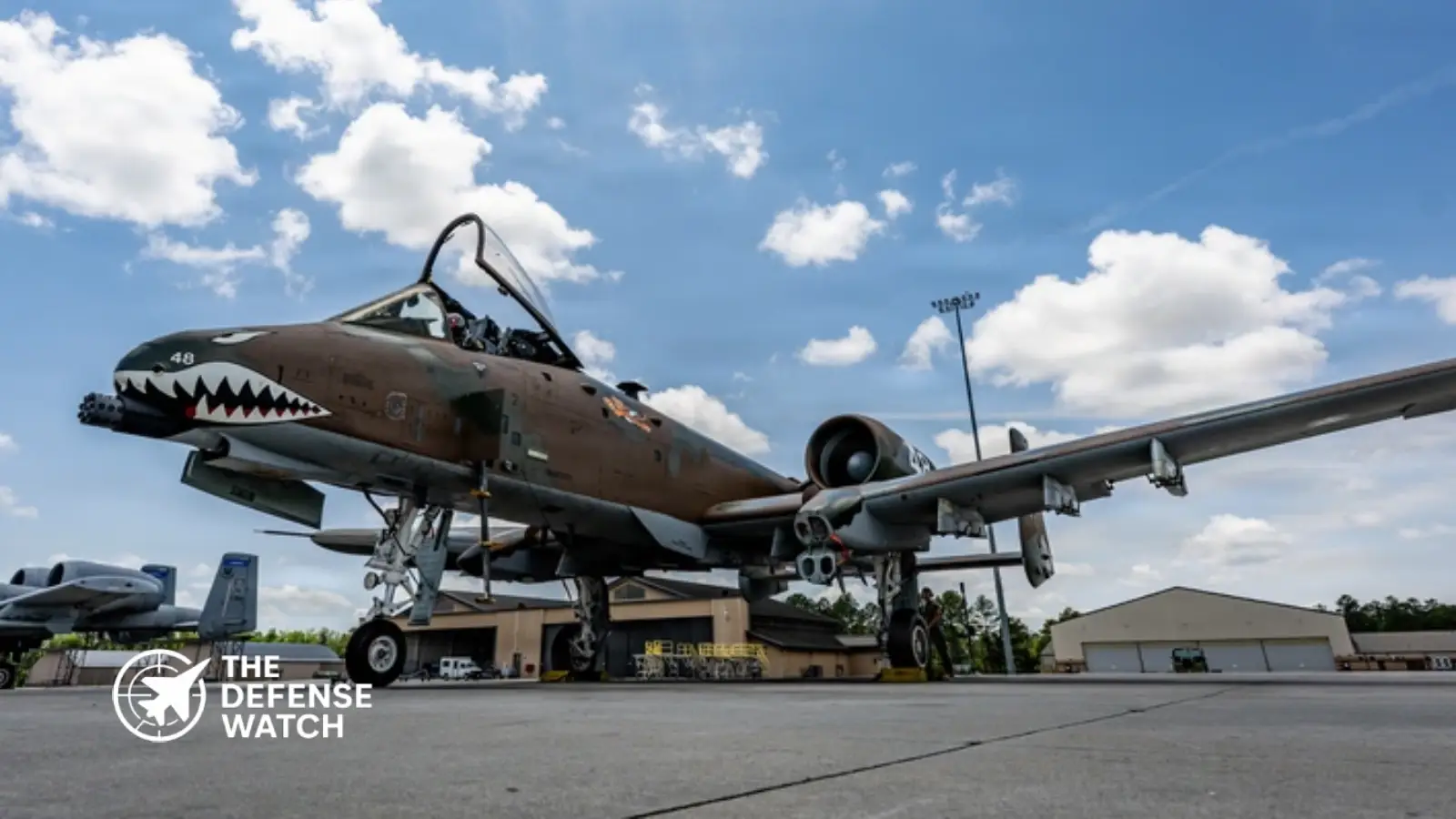
The U.S. Air Force’s A-10C Thunderbolt II is undergoing advanced training designed to improve survivability against modern air defense systems while maintaining its ability to deliver precision strikes in support of ground forces.
Recently released imagery from the U.S. Defense Visual Information Distribution Service (DVIDS) showed an A-10C assigned to the 66th Weapons Squadron deploying defensive flares during operations over the Nevada Test and Training Range. The exercise focused on preparing pilots to operate in environments increasingly populated by infrared-guided missiles, unmanned aerial systems, electronic warfare threats, and mobile surface-to-air defenses.
The training reflects a broader shift across the U.S. Air Force as legacy aircraft are adapted for operations in contested battlespaces rather than permissive environments.
Adapting The Warthog For A Changing Battlefield
For decades, the A-10 Thunderbolt II has been synonymous with close air support missions. Designed during the Cold War to destroy armored formations and support ground troops, the aircraft remains one of the most recognizable platforms in the U.S. inventory.
According to official U.S. Air Force fact sheets, the A-10C combines long loiter time, low-speed maneuverability, survivability features, and the ability to employ both guided and unguided munitions. Its avionics suite includes electronic countermeasures and systems designed to help crews operate in the presence of surface-to-air threats.
However, modern warfare has evolved significantly. Adversaries increasingly field layered integrated air defense networks capable of detecting and engaging aircraft at greater distances than in previous conflicts. The widespread use of drones, mobile missile systems, and electronic attack capabilities has further complicated the operating environment for low-altitude attack aircraft.
As a result, Air Force training now emphasizes threat avoidance, defensive maneuvering, electronic warfare awareness, and precision weapons employment while minimizing exposure to enemy air defenses.
Why The Training Matters
The latest A-10C Thunderbolt II training demonstrates that the Air Force continues to extract operational value from the platform despite long-standing retirement discussions.
The service has increasingly explored ways to employ the aircraft beyond traditional close air support. Recent exercises have included operations from austere airfields under the Agile Combat Employment concept, enabling aircraft to disperse across multiple locations rather than relying on large, vulnerable bases. Such concepts are intended to complicate enemy targeting and improve force survivability during high-intensity conflict.
The emphasis on contested-environment training suggests the Air Force recognizes that future operations may require legacy aircraft to operate under greater threat conditions than those encountered during counterinsurgency campaigns in Iraq and Afghanistan.
While the A-10 is not designed to penetrate advanced integrated air defense systems in the same manner as stealth aircraft, improving pilot tactics and defensive procedures can expand the aircraft’s usefulness in lower-tier contested environments and during support missions conducted after enemy air defenses have been degraded.
A-10 Remains Relevant As Retirement Debate Continues
The A-10’s future has been the subject of debate for more than a decade. Air Force leadership has repeatedly sought to retire the fleet to free resources for newer aircraft such as the F-35 and F-15EX. However, lawmakers have often intervened to preserve portions of the fleet due to its unique close air support capabilities.
In April 2026, the Air Force confirmed that selected A-10 squadrons would remain in service through 2030 following operational reviews and congressional restrictions on fleet reductions.
The aircraft’s continued participation in operational deployments, maritime security missions, and close air support exercises demonstrates that it still fills mission sets valued by combatant commanders.
From a strategic perspective, the latest training underscores a broader reality facing modern air forces. Even as stealth fighters and next-generation systems receive increasing attention, military planners continue to invest in enhancing the effectiveness and survivability of existing platforms.
For the A-10C Thunderbolt II, adapting to modern air defense threats may prove essential to maintaining relevance during the final years of its operational service.