Executive Summary:
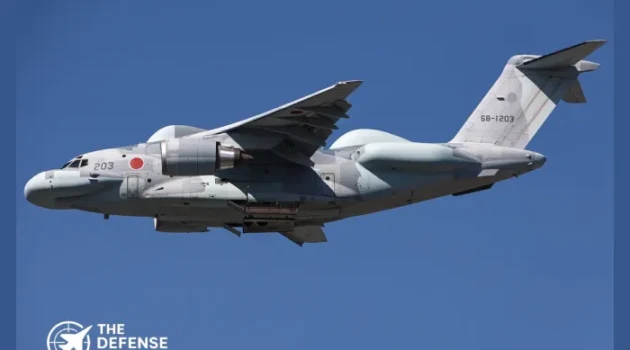
Japan has moved its EC-2 Stand Off Jammer electronic warfare aircraft into flight testing, marking a significant milestone in the country’s effort to modernize airborne electromagnetic warfare capabilities. Based on the Kawasaki C-2 transport aircraft, the EC-2 is designed to disrupt hostile radar and communications networks while supporting future air operations across the Indo Pacific.
Japan Advances EC-2 Electronic Warfare Aircraft Toward Operational Service
Japan’s EC-2 electronic warfare aircraft has entered flight testing, representing an important step in the Japan Air Self Defense Force’s effort to expand its ability to conduct stand off electronic attack missions. Recent imagery released by the Air Development and Test Command confirms the aircraft is progressing through its development program after extensive structural modifications to the Kawasaki C-2 transport platform.
The EC-2 is intended to replace Japan’s lone EC-1 electronic warfare aircraft, which has served since 1986. Rather than maintaining a single specialized platform, Tokyo plans to field four EC-2 aircraft, providing a significantly larger operational electronic warfare fleet capable of supporting multiple missions simultaneously.
A Purpose Built Stand Off Jammer
Unlike conventional intelligence aircraft, the EC-2 is designed to remain outside the engagement range of hostile air defense systems while disrupting enemy radar, communications, and command networks.
Major mission areas include:
- Long range radar jamming
- Communications disruption
- Electronic intelligence collection
- Electromagnetic spectrum support for fighter operations
- Suppression of integrated air defense systems (IADS)
Large mission radomes mounted on the aircraft’s nose, upper fuselage, and rear fuselage house antennas and electronic warfare equipment required for detecting, analyzing, and transmitting high power electronic attack signals.
Development Timeline
Japan’s Ministry of Defense structured the EC-2 program into two major phases.
Program Phase Timeline Primary Objective Phase One FY2020 to FY2026 Develop stand off jamming capability and integrate electronic warfare systems Phase Two FY2023 to FY2032 Improve system maturity, reliability, and prepare for operational deployment The aircraft incorporates domestically developed electronic warfare technologies derived from previous Japanese programs, including upgraded electronic countermeasure systems and advanced radio frequency measurement equipment. This approach reduces dependence on foreign suppliers while protecting sensitive mission technologies.
Built Upon The Kawasaki C-2 Airlifter
The EC-2 uses the Kawasaki C-2 military transport aircraft as its baseline platform.
Key characteristics include:
Specification Details Platform Kawasaki C-2 Engines Two GE CF6-80C2 turbofan engines Maximum Payload Approximately 36 tons Typical Cargo Range About 7,600 km Maximum Speed Mach 0.82 Primary Mission Stand off electronic warfare The C-2’s large internal volume, electrical generation capacity, and long endurance make it well suited for carrying sophisticated electronic warfare equipment while maintaining extended mission durations.
Why The EC-2 Matters
The EC-2 represents more than a replacement aircraft. It reflects Japan’s broader shift toward operating within contested electromagnetic environments, where controlling the spectrum has become as important as traditional air superiority.
Modern military operations increasingly rely on interconnected sensors, secure communications, and networked command systems. Electronic warfare aircraft such as the EC-2 can degrade or deny these systems without launching kinetic weapons, allowing friendly aircraft to operate with reduced exposure to advanced air defense networks.
For Japan, this capability is particularly relevant given the growing density of long range surveillance radars, integrated air defense systems, and anti access capabilities throughout the Indo Pacific. A stand off jammer can help open corridors for fighter aircraft, support maritime operations, and complicate an adversary’s ability to detect or coordinate against Japanese and allied forces.
The expansion from one EC-1 aircraft to a planned fleet of four EC-2s also improves operational resilience. Multiple aircraft can sustain longer deployments, support simultaneous regional operations, and provide redundancy during maintenance or upgrades.
Part Of Japan’s Broader C-2 Mission Expansion
The EC-2 is one of several specialized variants built on the Kawasaki C-2 platform.
Japan has already introduced the RC-2 electronic intelligence aircraft for signals collection, while defense planners have also examined adapting the C-2 for long range strike support and other specialized missions. Together, these variants transform the aircraft from a strategic transport into a flexible multi mission platform supporting intelligence, electronic warfare, logistics, and future long range operations.
Strategic Outlook
The EC-2’s flight testing marks a significant milestone in Japan’s defense modernization strategy. Although the aircraft has not yet entered operational service, successful testing demonstrates continued progress toward fielding an indigenous airborne electronic attack capability.
As militaries place increasing emphasis on electromagnetic spectrum operations, stand off jamming platforms such as the EC-2 are becoming essential force multipliers alongside fighters, airborne early warning aircraft, and intelligence assets. For Japan and its regional partners, expanding electronic warfare capacity strengthens the ability to operate effectively in increasingly contested environments while enhancing deterrence across the Indo Pacific.