Executive Summary:
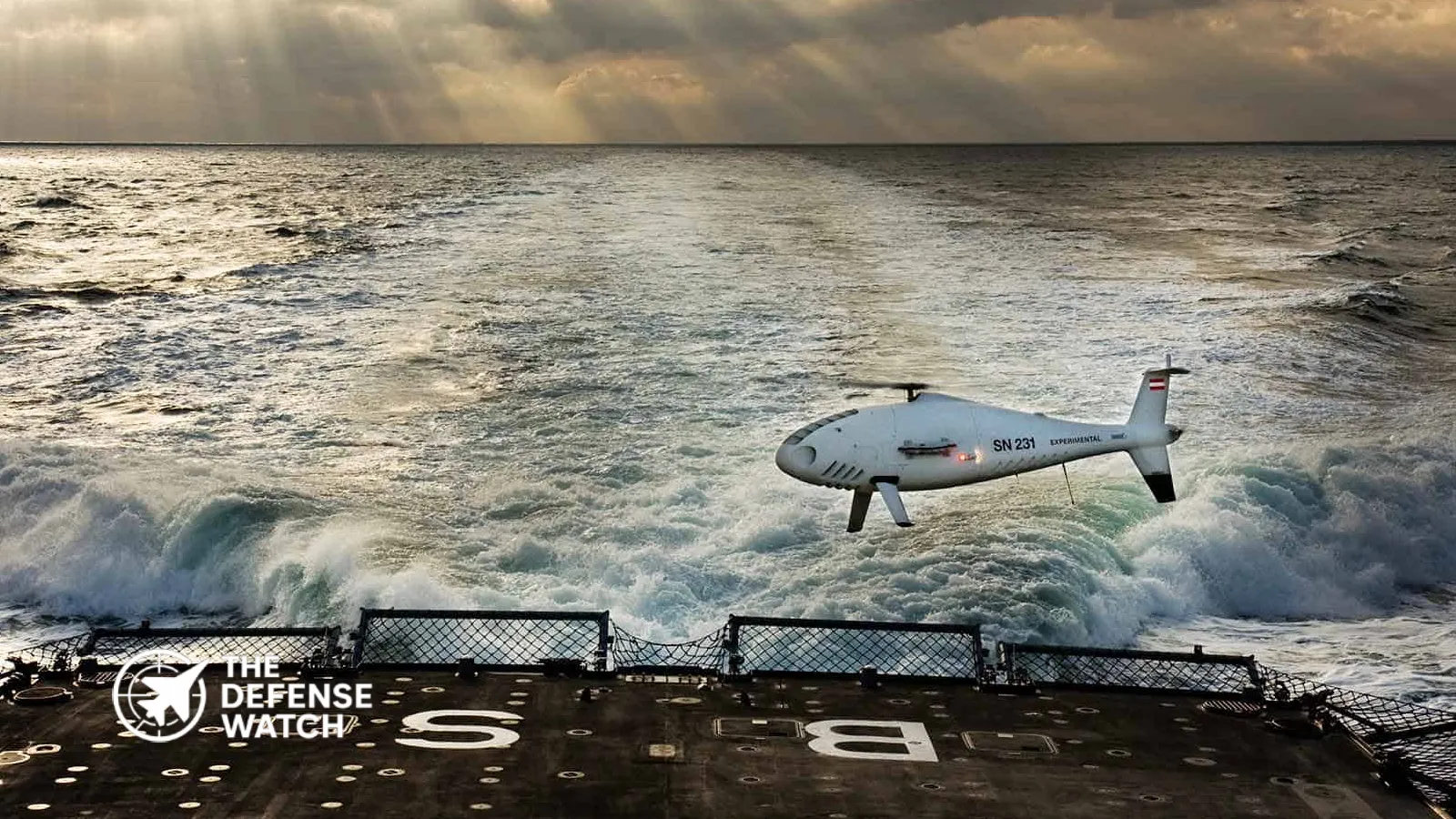
The Royal Canadian Navy has accepted its first Schiebel S-100 uncrewed maritime rotorcraft following factory acceptance testing, with the system locally designated the CU179 Peregrine. Intended for operation from Halifax-class frigates, the VTOL UAS will provide enhanced intelligence, surveillance, target acquisition, and reconnaissance (ISTAR) support alongside the CH-148 Cyclone helicopter. The initial order for two aircraft, valued at approximately C$39 million, includes options for up to six total and is delivered through prime contractor MDA Space in partnership with Austria’s Schiebel.
The Royal Canadian Navy (RCN) has taken delivery of its first S-100 uncrewed maritime rotorcraft, marking a significant step in the integration of uncrewed systems into its surface fleet. According to reporting by FlightGlobal on July 17, 2026, the aircraft—designated CU179 Peregrine in Canadian service—successfully completed factory acceptance testing and is slated for operations from the RCN’s Halifax-class frigates.
This development stems from contracts awarded in 2025 to MDA Space as prime contractor, partnering with Schiebel, to fulfill the RCN’s ISTAR Uncrewed Aircraft Systems (UAS) requirements.
Program Background and Contract Details
The RCN ISTAR UAS project addresses the need for an organic, shipborne VTOL platform to extend situational awareness beyond the horizon from the Halifax-class frigates, which form the backbone of Canada’s surface fleet. The initial acquisition covers two systems at roughly C$39 million (including taxes), with options for four additional aircraft. A separate five-year in-service support contract is valued at approximately C$27 million, with potential extensions up to 20 years.
MDA Space leads the Canadian effort, leveraging Schiebel’s mature S-100 platform, which has accumulated extensive maritime operational experience with navies including the UK (as Peregrine), France, and Greece. Initial operational capability is targeted for 2028, with full operational capability expected by 2032.
Technical Capabilities of the S-100 / CU179 Peregrine
The S-100 is a rotary-wing VTOL UAS designed for demanding maritime environments. Key specifications include:
- Endurance: Up to 6-10 hours depending on payload configuration.
- Range: Real-time ISTAR out to 100 nautical miles from the ship; beyond line-of-sight data link up to 200 km.
- Payload Capacity: Up to 50 kg, supporting modular suites including EO/IR sensors (e.g., WESCAM), maritime radar, SAR (such as IMSAR NSP), AIS, and IFF.
- Operations: Day/night, all-weather capability with autonomous launch and recovery from small ship decks without specialized equipment.
| Specification | Details |
|---|---|
| MTOW | ~200 kg |
| Length / Rotor Diameter | 3.11 m / 3.4 m |
| Service Ceiling | 5,500 m (18,000 ft) |
| Cruise / Dash Speed | ~55 kts / 120 kts |
| Primary Role | Maritime ISTAR |
The system will complement the CH-148 Cyclone helicopters, enabling persistent surveillance and targeting while reducing risk to manned assets.
Strategic and Operational Implications
For the RCN, the S-100 introduces Class 2 UAS operations for the first time, enhancing the Halifax-class frigates’ ability to conduct long-range surveillance in complex maritime domains, including the North Atlantic, Arctic approaches, and expeditionary operations. This capability is particularly relevant given increasing great-power competition and hybrid threats in maritime environments.
Analysis: The integration of the S-100 addresses a longstanding gap in organic ship-based ISR for medium-sized frigates. Unlike larger fixed-wing UAVs requiring catapults or dedicated carriers, the VTOL S-100 offers flexible deployment from existing flight decks already shared with helicopters. This multiplies sensor coverage without proportionally increasing crew workload or platform vulnerability. For U.S. allies and partners, Canada’s adoption reinforces NATO interoperability standards in uncrewed maritime systems, potentially influencing future joint operations and standardization efforts. Technical hurdles remain, including safe integration with ship combat management systems (e.g., CMS 330), data fusion, and operations in high sea states or contested electromagnetic environments—challenges that will be validated during shipboard trials leading to IOC in 2028.
Economically, the program supports Canadian industry through MDA’s prime role and potential long-term sustainment, contributing to GDP and skilled jobs as noted in government statements.
Broader Context in Allied Navies
The S-100 has proven its value in allied fleets. The UK Royal Navy operates it as Peregrine from Type 23 frigates, while the French Navy employs variants from Mistral-class ships. Canada’s selection aligns with a growing trend toward mature, off-the-shelf VTOL UAS for frigate enhancement rather than bespoke development, accelerating capability delivery.