

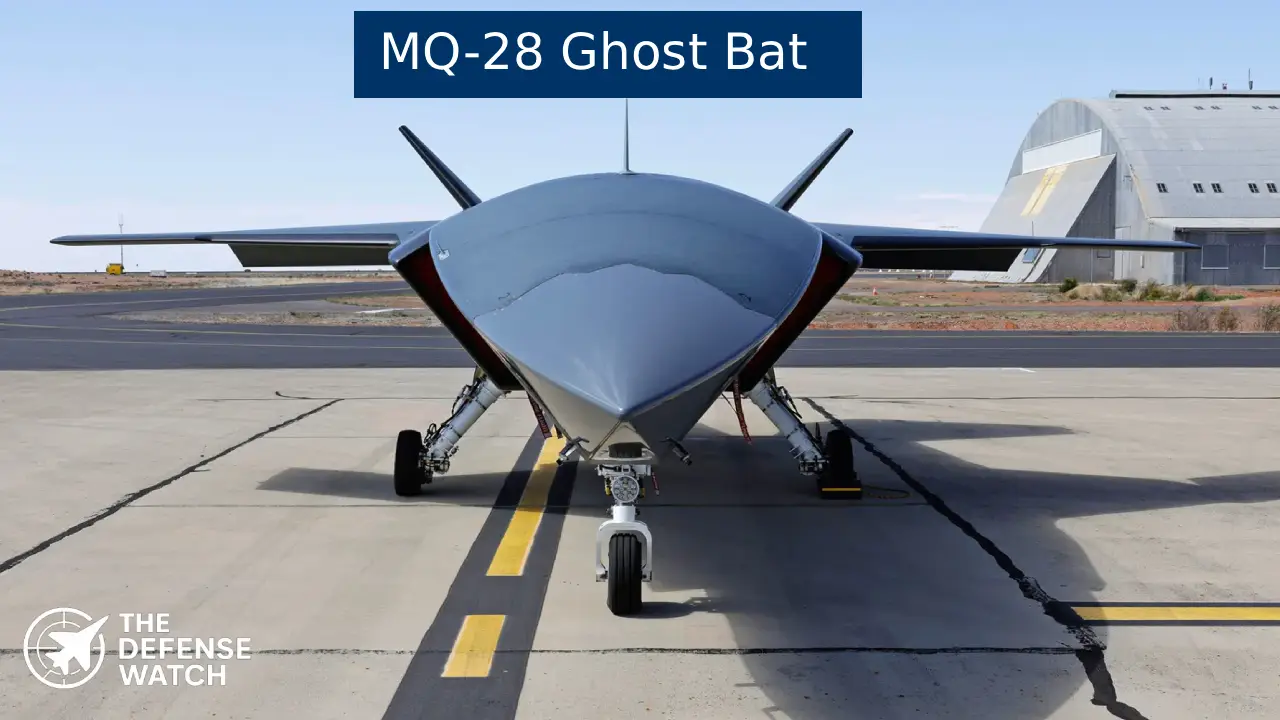
MQ-28 Ghost Bat: Current Status and Operational Progress
The MQ-28 Ghost Bat, Boeing Australia’s collaborative combat aircraft (CCA), has made significant strides in 2025, with the Royal Australian Air Force (RAAF) now validating its operational viability and planning its first live-fire weapons test.
Operational Demonstrations Complete
- In Capability Demonstration 2025, Boeing and the RAAF validated the Ghost Bat’s autonomous behaviors, multi-aircraft operations, deployment flexibility, and data-sharing capabilities.
- The platform has now logged more than 150 flight hours and over 20,000 hours of virtual testing.
- In a first-of-its-kind mission, two MQ-28s were controlled in flight by a single operator aboard an E-7A Wedgetail AEW&C aircraft, validating collaborative control from a crewed command platform.
- The aircraft’s deployment capability was tested during Exercise Carlsbad at RAAF Base Tindal, demonstrating rapid redeployment, base operations, and integration with local RAAF units.
- For the first time, the MQ-28 operated from an operational air base, showing the aircraft can be transported (via C-17), set up, launched, and redeployed within a short timeframe.
Live-Fire Test Planned: AIM-120 AMRAAM
- Boeing has announced plans for the first live-fire test of the MQ-28, expected in late 2025 or early 2026, using an AIM-120 Advanced Medium-Range Air-to-Air Missile (AMRAAM).
- According to Boeing, the test will take place over the Woomera Range Complex and simulate a “tactically relevant scenario” against a real airborne target.
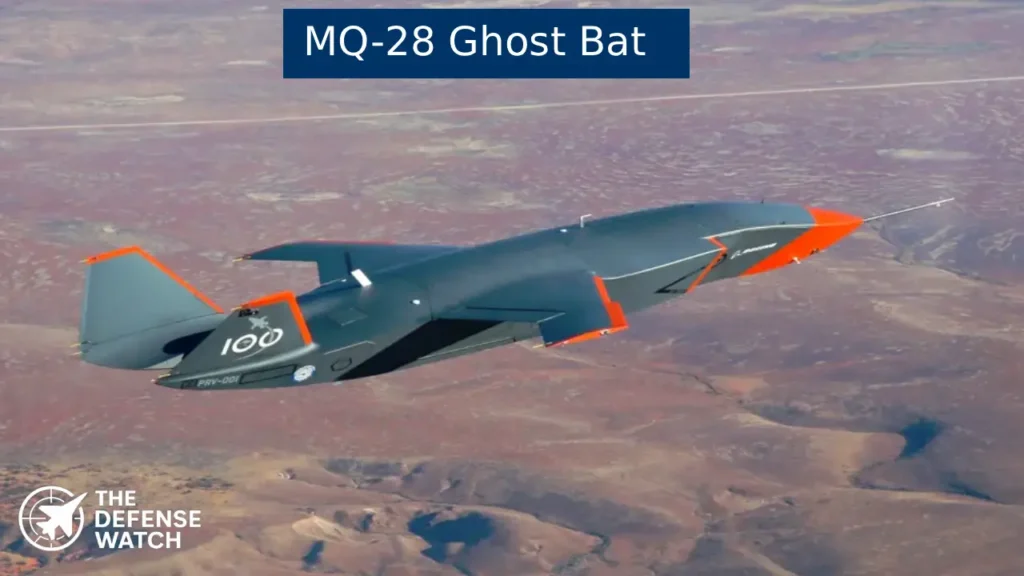
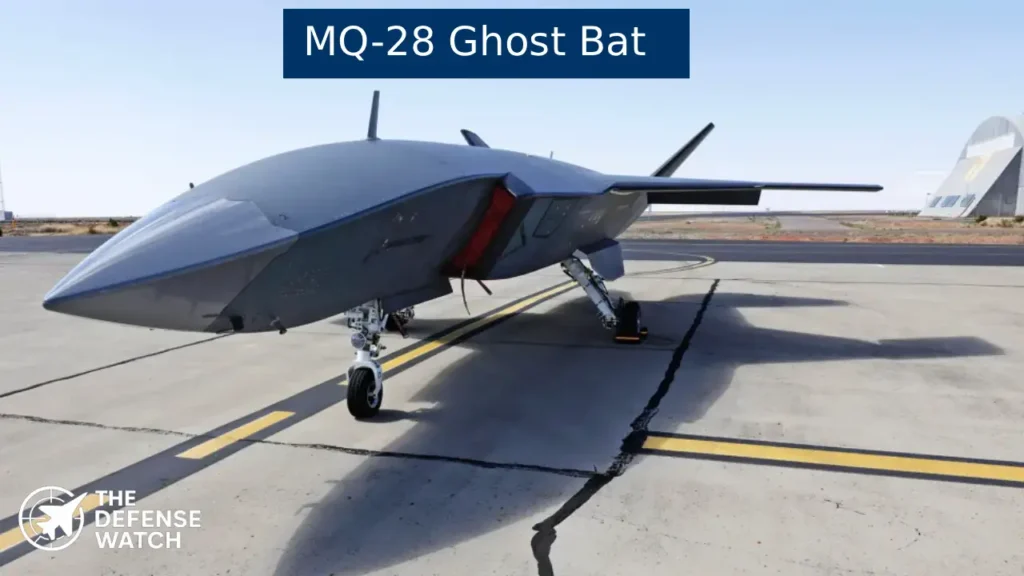
- The Ghost Bat is configurable: its nose section is modular and swappable, enabling payload flexibility. Some early test aircraft have been spotted carrying an infrared search and track (IRST) sensor, which could be used to detect and target threats.
Program Maturity and Next Phases
- Boeing is now building Block 2 MQ-28s, which incorporate improvements such as a refined wing design and upgraded GPS/INS.
- The operational lessons from 2025 will feed directly into the Block 2 production aircraft, forming the basis of an initial operational capability (IOC) for the RAAF.
- Boeing has also invested in a production facility in Queensland (Wellcamp, Toowoomba), which will support local assembly and future export potential.

Analysis: Strategic Implications and Challenges
The progress of the MQ-28 Ghost Bat reflects the growing seriousness of “loyal wingman” concepts in modern air warfare. By demonstrating multi-ship autonomy, base deployability, and the capacity to carry air-to-air weapons, the MQ-28 offers the RAAF a scalable way to add combat mass without relying solely on traditional manned platforms.
If the live-fire test succeeds, it could mark a first among CCAs: an uncrewed aircraft firing an air-to-air missile in a combat-like scenario. That would significantly shift the narrative on unmanned combat aircraft, not merely as surveillance or decoy drones, but as active combat participants.
However, there are challenges:
- The AIM-120 test is still pending, and success is not guaranteed — integrating a missile onto a CCA is non-trivial, especially in terms of guidance, targeting, and launch dynamics.
- While Block 2 production is underway, the path to full operational deployment and export remains uncertain; further funding and partner adoption will be critical.
- Rules of engagement, command & control, and doctrine for fully autonomous or semi-autonomous combat operations are still developing, especially for weapons employment.
Key Facts at a Glance
Item Status Developer Boeing Defence Australia User Royal Australian Air Force (RAAF) Demonstration Program Capacity Demonstration 2025 (CD-25) Flight Hours ~150 real + 20,000+ virtual First Live-Fire Weapon Planned AIM-120 AMRAAM Deployment Proven from RAAF Base Tindal (Exercise Carlsbad) Team Control Demonstrated control from E-7A Wedgetail Production Standard Block 2 in production FAQs
Is the MQ-28 Ghost Bat already in active service?No, as of now it is in a demonstrator/testing phase. While its deployment and operational capabilities are being validated, it has not yet been declared as fully operational service by the RAAF.
Has the MQ-28 fired its missile yet?Not yet. The AIM-120 live-fire test is planned but has not yet been publicly confirmed as completed.
What makes the MQ-28 different from other drones?It’s designed as a Collaborative Combat Aircraft (CCA) — not just a drone for ISR, but to actively team with crewed aircraft, share data, perform combat missions, and potentially fire weapons.
Which aircraft has it teamed with?It has teamed in trials with a Boeing E-7A Wedgetail AEW&C, where one operator onboard controlled two MQ-28s simultaneously.
Is this just for Australia, or could it be exported?While the primary user is the RAAF, Boeing aims for export potential. The production facility in Toowoomba underlines that ambition. However, export will depend on customer interest, funding, and strategic alignment.


15 comments
[…] upgrades, integrating advanced data links for collaborative tactics with unmanned systems under the Collaborative Combat Aircraft (CCA) initiative. In Pacific theater simulations, F-22s have quarterbacked drone swarms to […]
[…] tempo substantially The War Zone. The smaller, relocated island creates additional space for aircraft operations and simplifies flight deck traffic […]
[…] The Future Combat Air System, commonly referred to as FCAS, is a joint defense initiative launched by France and Germany and later joined by Spain. The program is designed to produce a next-generation fighter jet to replace current platforms such as the French Rafale and the Eurofighter Typhoon starting in the 2040s. The FCAS effort also includes advanced unmanned aircraft, networked sensor systems, and combat cloud technologies intended to provide multi-domain operational capability. […]
[…] that the vehicles not only replace Soviet‑era systems, but also significantly enhance the operational capability of the 15th Mechanized […]
[…] as a “loyal wingman,” the Ghost Bat can operate alongside crewed aircraft. Its modular nose allows for rapid reconfiguration for different missions such as surveillance, […]
[…] Lightning II aircraft. Deliveries of the jets are scheduled to begin later this decade, with full operational capability expected in the early […]
[…] the agreement, engineering work will be led from the United Kingdom. Both companies say the collaboration could help establish a sovereign capability in this domain, support skilled employment in the UK, and create potential export […]
[…] firing was described as a technical milestone rather than final operational acceptance. It confirmed that the missile, weapon station, and vehicle platform can operate […]
[…] to enter production at those points. A further information notice is expected as the concept phase progresses toward formal industry […]
[…] aging CVR(T) fleet, providing advanced sensors, digital networking, and improved protection. Full operational capability has already slipped several years behind the original […]
[…] 3 standard as part of a long term effort to sustain a credible heavy armor capability. Initial operating capability is expected later this decade. Further trials are planned to expand testing across mobility, […]
[…] including Navy-led assessments at sea. Following successful completion, the carrier will move toward commissioning and full operational capability. These steps typically involve integrated system tests, weapons checks, and flight operations with […]
[…] commentary notes the government has committed to a minimum viable product for 2026 and full operational capability by 2027, though milestones could adjust with evolving […]
[…] the Royal Navy and its international partners. The deployment saw HMS Prince of Wales achieve Full Operational Capability, qualifying the carrier for NATO frontline […]
[…] planned orbits. The offshore launch from waters off Yangjiang, Guangdong Province, demonstrates advancements in sea-based operations, offering advantages in payload capacity, orbital insertion flexibility, and reduced impact on […]