
- Home
- Defense Systems
- Military Satellites & Space Systems
- GPS IIIF Navigation Satellite
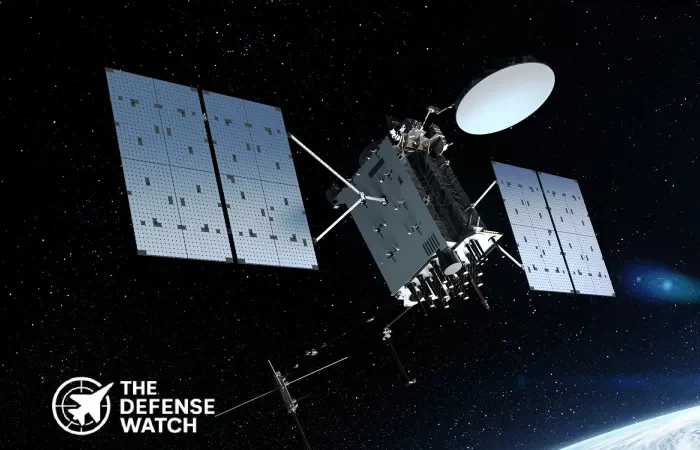
GPS IIIF Navigation Satellite


Defense Systems Full Specifications
1. General Information
| System Name | GPS IIIF Navigation Satellite |
| Manufacturer | Lockheed Martin |
| Country of Origin | United States |
| Type / Role | Military & Civilian Navigation |
| In Service | Yes |
| Year Introduced | 2025 |
| Unit Cost | USD 600–700 Million (Estimated) |
2. Performance & Capabilities
| Orbit Type | Medium Earth Orbit (MEO |
| Operational Altitude | ~20,200 km |
| Operational Inclination | 55° |
| Imaging / Sensor Type | L1C, L2C, L5, Encrypted SATCOM |
| Resolution / Accuracy | Few nanoseconds |
| Revisit Time / Coverage | Global, continuous coverage |
| Mission Duration | ~15 years |
3. Payload & Sensor Specifications
| Primary Sensor | Atomic Clocks (Rubidium & Cesium) |
| Secondary Sensor | N/A (Navigation only) |
| Data Transmission | Encrypted SATCOM |
| Imaging Capability | N/A |
| Payload Weight | ~4,000 kg |
| Onboard Power | Solar Arrays, 2–3 kW |
4. Guidance, Control & Communication
| Attitude Control System | Reaction Wheels + Thrusters |
| Orbit Control | Chemical / Electric Propulsion |
| Communication Link | L-Band / Encrypted SATCOM |
| Data Encryption | AES-256 / Military-Grade |
| Telemetry & Command System | Secure Ground Network |
5. Launch & Deployment
| Launch Vehicle | Atlas V / Falcon 9 |
| Launch Site | Cape Canaveral / Vandenberg |
| Deployment Orbit | MEO ~20,200 km |
| Launch Mass | 4,000–4,500 kg |
| Deployment Method | Rocket-launched, direct orbit injection |
6. Operational & Command Use
| Primary Operators | USAF / NRO / NGA |
| Global Coverage | Yes |
| Combat Proven | Yes |
| Typical Missions | Navigation, Timing, Secure Comms |
| Notable Feature | Anti-Jamming, High-Precision Signals |
7. Future & Experimental Use
| Planned Upgrades | Improved signals, longer lifespan |
| Replacement / Next Gen | GPS III Follow-ons |
| Experimental Variants | Enhanced anti-jamming, autonomous navigation |
| International Collaboration | Minimal / Classified |
PROS
- High-precision global navigation
- Long operational lifespan (15 years)
- Advanced anti-jamming technology
- Supports both military and civilian use
- Autonomous navigation capability
CONS
- High unit cost
- Launch dependent on large rockets
- Sensitive to space debris impacts
- Ground infrastructure needed for full capability
- Classified tech limits international use
The GPS IIIF navigation satellite represents the latest generation of the United States’ global positioning technology. Designed to provide precise, reliable navigation and timing signals, GPS IIIF enhances both military and civilian capabilities worldwide. Its advanced features ensure secure, uninterrupted positioning data even in contested or jammed environments.
Manufacturer and Origin
Produced by Lockheed Martin in the United States, GPS IIIF is part of the U.S. Air Force’s ongoing effort to maintain global positioning superiority. It builds on previous GPS III satellites, offering improved signal accuracy, increased resistance to interference, and longer operational life.
Capabilities and Technology
GPS IIIF features high-powered atomic clocks and enhanced L1C, L2C, and L5 signals for both military and civilian users. Its anti-jamming and anti-spoofing systems protect U.S. forces in critical missions. With a lifespan of approximately 15 years, the satellite supports worldwide coverage and delivers timing precision within a few nanoseconds. Its autonomous navigation capability ensures redundancy in case of ground control interruptions.
Operational Use
Primarily operated by the U.S. Air Force, GPS IIIF satellites provide navigation and timing support for military operations, aviation, maritime, and emergency services. They also facilitate secure communication synchronization and precision-guided munitions targeting.
GPS IIIF satellite Price
While exact pricing is classified, estimates place the unit cost at roughly USD 600–700 million per satellite, factoring in launch, deployment, and operational systems. These investments secure the backbone of U.S. strategic and tactical navigation capabilities.
FAQs
What is the lifespan of a GPS IIIF satellite?
Approximately 15 years.
How accurate is GPS IIIF?
Timing precision within a few nanoseconds.
Can GPS IIIF resist jamming?
Yes, it has advanced anti-jamming and anti-spoofing capabilities.
Who operates GPS IIIF satellites?
Primarily the U.S. Air Force.
What improvements does IIIF have over GPS III?
Enhanced signals, longer lifespan, and stronger anti-jamming features.
Disclaimer Note
The information provided on TheDefenseWatch.com is for general informational purposes only. While we strive to ensure the accuracy, completeness, and timeliness of our content regarding defense and aerospace products, technologies, and specifications, we cannot guarantee that all information is 100% accurate or up-to-date due to the evolving nature of military technology and classified data.TheDefenseWatch.com does not warrant the reliability, suitability, or availability of the information for any specific purpose. Users are advised to consult official sources, such as manufacturers, government publications, or defense agencies, for precise and verified data before making decisions based on our content.We are not affiliated with any defense manufacturers, governments, or military organizations mentioned. Opinions, reviews, and ratings reflect expert analysis but are subjective and should not be considered endorsements. TheDefenseWatch.com is not responsible for any errors, omissions, or consequences arising from the use of this website’s content.External links are provided for convenience and do not imply endorsement. TheDefenseWatch.com reserves the right to update or modify content without prior notice. By using this website, you agree to our Privacy & Cookies Policy.


New Arrivals



Popular Comparisons
-
 Tejas vs Gripen: Key Differences and Capabilities
View Comparison →
-
Tejas vs MiG-21 Bison: How India Replaced Its Iconic Supersonic Fighter
View Comparison →
-
F-35 vs F-16: Stealth, Sensors and Combat Roles
View Comparison →
-
Tejas Fighter Jet vs F-16 Fighting Falcon: Capability Compared
View Comparison →
-
Rafale Fighter Jet vs F-16 Fighting Falcon : Which Fighter Has the Edge?
View Comparison →
-
Su-57 Fighter Jet vs J-20 Fighter Jet: Stealth and Air Combat Compared
View Comparison →
-
Mirage 2000 vs Tejas Mk1A: Legacy Combat Power vs Indigenous Modernization
View Comparison →
-
Rafale Fighter Jet vs F-22 Raptor: Which Air Dominance Fighter Has the Edge?
View Comparison →
-
Tejas Fighter Jet vs. Rafale Fighter Jet: India’s Indigenous Fighter Meets France’s Proven Multirole Combat Aircraft
View Comparison →
-
F-22 Raptor vs. F-35 Joint Strike Fighter: Which Fifth Generation Fighter Has the Edge?
View Comparison →


- US Rejects Automatic Body Camera Activation for ICE Officers

- Iron Dome Architect Develops New Counter-Swarm Drone Defense System
- U.S. Navy Conducts First F-35C Landing on USS John F. Kennedy
- Huntington Ingalls Wins $56.2 Million Contract for Foreign Nuclear Submarine Support
- US Forces Disable Cargo Ship Attempting to Evade Iran Blockade
- Netherlands Deploys Nuclear-Capable F-35s for NATO Steadfast Noon
- Pakistan Tests Extended-Range Fatah-2 Hypersonic Ballistic Missile
- CSG Acquires 9.5% Stake in MDA Space, Expanding Into Space Technology
- RAF Voyager Completes 14 Missions During Saudi Arabia Deployment
- L3Harris Wins $250 Million GMLRS Rocket Motor Contract



Fighter Jets
-
 MIG-31 Fighter Jet
-
J-10CE Fighter Jet
-
Chengdu J-10 Fighter Jet
-
Chengdu J-10C Fighter Jet
-
Gripen E Fighter Jet
-
Tejas Mk1A Fighter Jet
-
Tejas Mk‑2 Fighter Jet
-
F-16V Viper Block 70 Fighter Jet
-
F-15EX Eagle II Fighter
-
Boeing F/A-XX Fighter
-
F-15E Strike Eagle Fighter
-
F/A-18E/F Super Hornet Fighter Jet
-
Saab Gripen F Fighter Jet
-
JAS 39E/F Gripen Fighter Jet
-
JAS 39 Gripen Fighter Jet
-
F-35A Lightning II Fighter Jet
-
F/A-18F Super Hornet
-
J-50 Fighter Jet
-
Spanish EF-18 Hornet Fighter
-
F-47 Fighter Jet
-
F-35i Adir Fighter Jet
-
F-16 Fighting Falcon
-
AIDC T-5 Brave Eagle
-
F-CK-1 Ching-Kuo Fighter








Recent Compares
-
Tejas vs Gripen: Key Differences and Capabilities
View Comparison →
-
Tejas vs MiG-21 Bison: How India Replaced Its Iconic Supersonic Fighter
View Comparison →
-
F-35 vs F-16: Stealth, Sensors and Combat Roles
View Comparison →
-
Tejas Fighter Jet vs F-16 Fighting Falcon: Capability Compared
View Comparison →
-
Rafale Fighter Jet vs F-16 Fighting Falcon : Which Fighter Has the Edge?
View Comparison →
Latest Defense Systems
10 Compares Defense Systems
-
Tejas vs Gripen: Key Differences and Capabilities
View Comparison →
-
Tejas vs MiG-21 Bison: How India Replaced Its Iconic Supersonic Fighter
View Comparison →
-
F-35 vs F-16: Stealth, Sensors and Combat Roles
View Comparison →
-
Tejas Fighter Jet vs F-16 Fighting Falcon: Capability Compared
View Comparison →
-
Rafale Fighter Jet vs F-16 Fighting Falcon : Which Fighter Has the Edge?
View Comparison →
-
Su-57 Fighter Jet vs J-20 Fighter Jet: Stealth and Air Combat Compared
View Comparison →
-
Mirage 2000 vs Tejas Mk1A: Legacy Combat Power vs Indigenous Modernization
View Comparison →
-
Rafale Fighter Jet vs F-22 Raptor: Which Air Dominance Fighter Has the Edge?
View Comparison →
-
Tejas Fighter Jet vs. Rafale Fighter Jet: India’s Indigenous Fighter Meets France’s Proven Multirole Combat Aircraft
View Comparison →
-
F-22 Raptor vs. F-35 Joint Strike Fighter: Which Fifth Generation Fighter Has the Edge?
View Comparison →
- US Rejects Automatic Body Camera Activation for ICE Officers
- Iron Dome Architect Develops New Counter-Swarm Drone Defense System
- U.S. Navy Conducts First F-35C Landing on USS John F. Kennedy
- Huntington Ingalls Wins $56.2 Million Contract for Foreign Nuclear Submarine Support
- US Forces Disable Cargo Ship Attempting to Evade Iran Blockade