
- Home
- Defense Systems
- Attack & Multirole Drones (UAVs)
- Anka-3 Stealth Drone
Anka-3 Stealth Drone

Defense Systems Full Specifications
1. General Information
| Name | Anka-3 (ANKA III) |
| Manufacturer | Turkish Aerospace Industries (TUSAŞ) |
| Country of Origin | Turkey |
| Type / Role | Stealth Unmanned Combat Aerial Vehicle (UCAV) |
| First Flight / Introduced | December 2023 |
| Status | Prototype / Advanced Flight Testing |
| Unit Cost | Estimated $25–30 million (projected) |
2. Performance
| Maximum Speed | Mach 0.7 (787 km/h) |
| Cruise Speed | 250 knots (460 km/h) |
| Operational Range | >1,000 km (combat) |
| Endurance | 10 hours |
| Service Ceiling | 40,000 ft (12,000 m) |
3. Dimensions
| Length | 7.9–8.9 m |
| Wingspan | 12.5–13.1 m |
| Height | 2.5–2.6 m |
| Maximum Takeoff Weight (MTOW) | 6,500–7,250 kg |
4. Payload & Armament
| Payload Capacity | 1,200–1,600 kg |
| Hardpoints | 2 internal bays + external stations |
| Weapons | Precision munitions, SOM-J, glide bombs, EW pods |
| Sensors | EO/IR, SAR, electronic warfare suite |
5. Propulsion
| Engine Type | Turbofan (AI-322) |
| Engine Power | Approximately 5,000+ lb thrust (est.) |
6. Communication & Control
| Control Type | Remote / Autonomous |
| Data Link Range | LOS / BLOS Satellite |
| Navigation | GPS/INS with anti-jam capabilities |
7. Operational Use
| Primary Users | Turkish Air Force (projected) |
| Combat Proven | No (in development) |
| Notable Operations | Loyal wingman testing with Süper Şimşek |
PROS
- Reduced radar signature via flying-wing configuration improves survivability in IADS environments.
- High subsonic speed provides better responsiveness than propeller-driven MALE UAVs.
- Substantial payload capacity for internal stealthy weapons carriage.
- Indigenous development supports rapid upgrades and supply chain independence.
- Common avionics/GCS with Anka family eases operator transition and logistics.
CONS
- Still in prototype/testing phase with full operational capability pending.
- Single-engine design may limit redundancy compared to twin-engine peers.
- Limited public data on exact RCS performance and full sensor suite.
- Shorter endurance than large U.S. MALE platforms like the MQ-9.
- Export restrictions and integration challenges with Western munitions possible.
Anka-3 Stealth UCAV: Turkey’s Flying-Wing Combat Drone
The Anka-3 represents a significant advancement in Türkiye’s indigenous unmanned combat aerial vehicle (UCAV) program. Designed as a stealthy, high-subsonic platform, it enables operations in contested airspace where traditional MALE UAVs face higher risks.
Turkish Aerospace Industries (TUSAŞ) developed the Anka-3 as part of Türkiye’s push for self-reliant defense technologies. The program builds on the successful Anka family while introducing a tailless flying-wing configuration optimized for reduced radar cross-section. First flight occurred in December 2023, with advanced testing ongoing and entry into service targeted for 2026.
The Anka-3 features a single turbofan engine (Ivchenko-Progress AI-322, with future indigenous options) that propels it to a maximum speed of Mach 0.7 (approximately 425 knots / 787 km/h) at altitude. It offers a service ceiling of 40,000 ft and endurance of around 10 hours at 30,000 ft, supporting deep-strike missions with an operational radius exceeding 1,000 km in certain configurations.
Payload capacity reaches 1,200–1,600 kg, distributed across two internal weapon bays and external hardpoints. This allows carriage of precision-guided munitions, SOM-J cruise missiles, glide bombs, and electronic warfare pods while maintaining stealth. The platform supports ISR with EO/IR and SAR sensors, electronic attack, satellite communications, and loyal wingman operations, including deployment of smaller UAVs like the Süper Şimşek.
For U.S. defense analysts and allied procurement teams, the Anka-3 highlights emerging capabilities from NATO partner nations. Its design emphasizes cost-effective survivability through low observability and distributed effects rather than pure kinetic performance.
Key Capabilities
- Low-observable flying-wing design
- Autonomous and MUM-T (manned-unmanned teaming) potential with platforms like TF Kaan
- Multi-role flexibility: strike, SEAD/DEAD, ISR, and EW
Disclaimer Note
The information provided on TheDefenseWatch.com is for general informational purposes only. While we strive to ensure the accuracy, completeness, and timeliness of our content regarding defense and aerospace products, technologies, and specifications, we cannot guarantee that all information is 100% accurate or up-to-date due to the evolving nature of military technology and classified data.TheDefenseWatch.com does not warrant the reliability, suitability, or availability of the information for any specific purpose. Users are advised to consult official sources, such as manufacturers, government publications, or defense agencies, for precise and verified data before making decisions based on our content.We are not affiliated with any defense manufacturers, governments, or military organizations mentioned. Opinions, reviews, and ratings reflect expert analysis but are subjective and should not be considered endorsements. TheDefenseWatch.com is not responsible for any errors, omissions, or consequences arising from the use of this website’s content.External links are provided for convenience and do not imply endorsement. TheDefenseWatch.com reserves the right to update or modify content without prior notice. By using this website, you agree to our Privacy & Cookies Policy.


New Arrivals











Popular Comparisons
-
 J-10C vs JF-17 Thunder: Which Fighter Is More Capable?
View Comparison →
-
Tejas vs Gripen: Key Differences and Capabilities
View Comparison →
-
Tejas vs MiG-21 Bison: How India Replaced Its Iconic Supersonic Fighter
View Comparison →
-
F-35 vs F-16: Stealth, Sensors and Combat Roles
View Comparison →
-
Tejas Fighter Jet vs F-16 Fighting Falcon: Capability Compared
View Comparison →
-
Rafale Fighter Jet vs F-16 Fighting Falcon : Which Fighter Has the Edge?
View Comparison →
-
Su-57 Fighter Jet vs J-20 Fighter Jet: Stealth and Air Combat Compared
View Comparison →
-
Mirage 2000 vs Tejas Mk1A: Legacy Combat Power vs Indigenous Modernization
View Comparison →
-
Rafale Fighter Jet vs F-22 Raptor: Which Air Dominance Fighter Has the Edge?
View Comparison →
-
Tejas Fighter Jet vs. Rafale Fighter Jet: India’s Indigenous Fighter Meets France’s Proven Multirole Combat Aircraft
View Comparison →


- How Much Does a Tomahawk Missile Cost? Price, Range and Blocks

- Faster Than Sound, Unstoppable at Sea: Inside China’s YJ-20 and YJ-17 Hypersonic Missiles
- U.S., Australia and UK Test Maritime Autonomy Under AUKUS
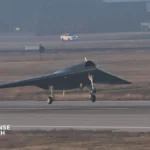
- TAI Anka-3: Turkey’s Stealth Flying-Wing Drone and Specifications
- Lockheed Martin’s Third-Quarter Innovations Span Missile Defense, Aviation and Space
- RTX Plans to Increase Missile Production Up to Fourfold Under Pentagon Contracts
- UK Restarts Large-Caliber Gun Manufacturing After 20-Year Gap
- Britain to Deploy RAF Chinooks and A400M Aircraft Against Wildfires
- China-Pakistan Military Drills Feature Drone-Resistant Type 08 Infantry Fighting Vehicle
- Department of War and Lockheed Martin Sign 10-Year F-35 Agreement With $7 Billion Investment Commitment



Fighter Jets
-
 SU-57 Felon Stealth Fighter
-
Boeing F/A-XX Fighter
-
JF-17 Thunder Fighter Jet
-
F-47 Fighter Jet
-
MIG-31 Fighter Jet
-
J-10CE Fighter Jet
-
Chengdu J-10 Fighter Jet
-
Chengdu J-10C Fighter Jet
-
Gripen E Fighter Jet
-
Tejas Mk1A Fighter Jet
-
Tejas Mk‑2 Fighter Jet
-
F-16V Viper Block 70 Fighter Jet
-
F-15EX Eagle II Fighter
-
F-15E Strike Eagle Fighter
-
F/A-18E/F Super Hornet Fighter Jet
-
Saab Gripen F Fighter Jet
-
JAS 39E/F Gripen Fighter Jet
-
JAS 39 Gripen Fighter Jet
-
F-35A Lightning II Fighter Jet
-
F/A-18F Super Hornet
-
J-50 Fighter Jet
-
Spanish EF-18 Hornet Fighter
-
F-35i Adir Fighter Jet
-
F-16 Fighting Falcon






Recent Compares
-
J-10C vs JF-17 Thunder: Which Fighter Is More Capable?
View Comparison →
-
Tejas vs Gripen: Key Differences and Capabilities
View Comparison →
-
Tejas vs MiG-21 Bison: How India Replaced Its Iconic Supersonic Fighter
View Comparison →
-
F-35 vs F-16: Stealth, Sensors and Combat Roles
View Comparison →
-
Tejas Fighter Jet vs F-16 Fighting Falcon: Capability Compared
View Comparison →
Latest Defense Systems
10 Compares Defense Systems
-
J-10C vs JF-17 Thunder: Which Fighter Is More Capable?
View Comparison →
-
Tejas vs Gripen: Key Differences and Capabilities
View Comparison →
-
Tejas vs MiG-21 Bison: How India Replaced Its Iconic Supersonic Fighter
View Comparison →
-
F-35 vs F-16: Stealth, Sensors and Combat Roles
View Comparison →
-
Tejas Fighter Jet vs F-16 Fighting Falcon: Capability Compared
View Comparison →
-
Rafale Fighter Jet vs F-16 Fighting Falcon : Which Fighter Has the Edge?
View Comparison →
-
Su-57 Fighter Jet vs J-20 Fighter Jet: Stealth and Air Combat Compared
View Comparison →
-
Mirage 2000 vs Tejas Mk1A: Legacy Combat Power vs Indigenous Modernization
View Comparison →
-
Rafale Fighter Jet vs F-22 Raptor: Which Air Dominance Fighter Has the Edge?
View Comparison →
-
Tejas Fighter Jet vs. Rafale Fighter Jet: India’s Indigenous Fighter Meets France’s Proven Multirole Combat Aircraft
View Comparison →
- How Much Does a Tomahawk Missile Cost? Price, Range and Blocks
- Faster Than Sound, Unstoppable at Sea: Inside China’s YJ-20 and YJ-17 Hypersonic Missiles
- U.S., Australia and UK Test Maritime Autonomy Under AUKUS
- TAI Anka-3: Turkey’s Stealth Flying-Wing Drone and Specifications
- Lockheed Martin’s Third-Quarter Innovations Span Missile Defense, Aviation and Space