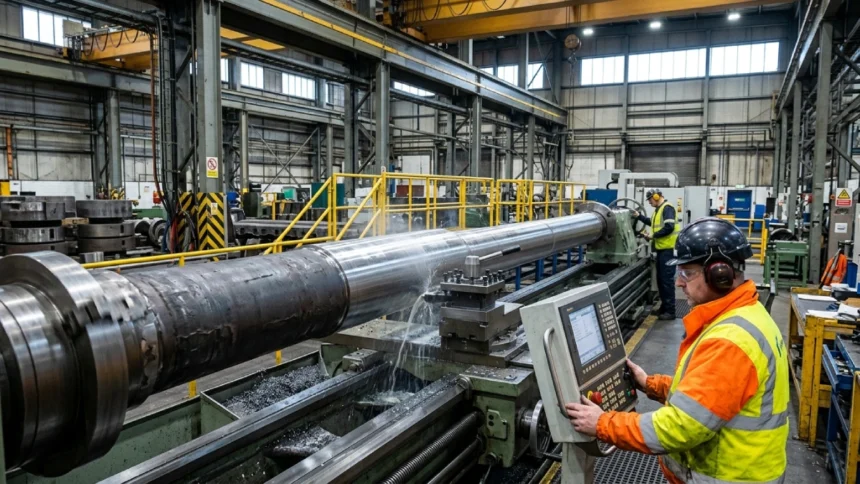
The United Kingdom has resumed domestic production of large-caliber gun components after a two-decade gap, with Rheinmetall UK’s new manufacturing facility in Telford beginning production of barrels and breeches for 120mm and 155mm weapon systems.
Announced by the Ministry of Defence on October 22, 2026, the facility restores a specialized industrial capability that Britain has lacked for approximately 20 years. The site is intended to support British Army equipment programs while strengthening the country’s ability to manufacture critical weapon components at home.
The immediate significance is industrial rather than operational. Domestic manufacturing gives the UK a new source for components used in tank and artillery systems, although the facility’s opening does not, by itself, establish how quickly the armed forces will receive additional equipment or whether the factory can meet demand during a prolonged conflict.
What the Telford facility will produce
Rheinmetall UK’s Telford Gun Hall manufactures barrels and breeches for 120mm and 155mm weapon systems. These components serve different purposes within a gun assembly.
Gun barrels guide and contain the projectile during firing, while the breech assembly closes the rear of the gun and helps contain the pressure generated by the propellant. Both require specialized engineering, precision machining and rigorous quality controls.
The British Ministry of Defence identifies the German defense company’s UK operation as the manufacturer and says the facility will support the RCH 155 mobile artillery system and future artillery platforms. The 120mm production capability is also relevant to Britain’s wider tank and armored-vehicle requirements.
The government says the facility will support approximately 100 skilled jobs, with the workforce expected to expand as production increases. British employees received specialist training at Rheinmetall’s manufacturing facility in Unterlüß, Germany, before bringing that expertise back to Telford.
According to the Ministry of Defence, the company moved the site from an empty facility to full production in eight months after taking it over in autumn 2025. That timeline demonstrates how an established international manufacturer can transfer industrial processes and technical knowledge into a UK-based operation.
Why Britain needs domestic gun production
Modern military readiness depends on more than the number of tanks, howitzers and ammunition rounds listed in an inventory. Armed forces also need dependable access to replacement components, maintenance capacity and manufacturers able to sustain equipment over years of service.
Large-caliber gun components are specialized products. Re-establishing domestic manufacturing can reduce reliance on overseas production for at least part of the supply chain, while giving the Ministry of Defence and equipment manufacturers a production base closer to British maintenance and procurement activities.
That matters most during a sustained period of high demand. If a conflict increases equipment losses, accelerates barrel wear or creates a need for more artillery systems, manufacturers may face competing demands from several customers. Domestic production can provide another source of supply, but its contribution depends on actual output, workforce capacity, available raw materials and the availability of other components.
The Telford facility therefore addresses a specific part of Britain’s industrial requirements. It does not establish that the country can independently manufacture every component needed for its armored vehicles and artillery systems.
Nor does the return of gun-component production automatically solve the separate challenge of producing enough ammunition. Gun barrels and breeches are hardware; shells, propellants and explosives depend on different manufacturing processes and supply chains.
A wider effort to rebuild Britain’s ammunition supply chain
The Telford Gun Hall is one part of a wider British effort to rebuild domestic defense manufacturing. In July 2026, the Ministry of Defence announced feasibility-study contracts for 22 companies to assess potential sites for new factories producing energetic materials, including explosives, propellants and pyrotechnics.
The government said the studies would help advance plans for at least six new munitions and energetic-materials factories. It also cited £11.1 billion allocated through the Defence Investment Plan for munitions and weapons. These are separate initiatives from the Telford facility, but together they address different links in the supply chain.
The distinction matters because a gun-component factory cannot compensate for shortages of artillery shells or propellant. Sustained military output requires several industrial processes to work together, from steel processing and precision machining to explosive production, assembly, testing and transportation.
Britain’s broader Defence Investment Plan, published on June 30, 2026, sets out £298 billion in investment over four years. That figure covers the wider defense plan, not the cost of the Telford factory. The Ministry of Defence’s announcement did not disclose a separate construction or equipment cost for the gun hall.
Rheinmetall’s role in British land-force modernization
The project also illustrates how the UK is using an international defense company to rebuild domestic industrial capacity.
Rheinmetall is headquartered in Germany, but its British operation is involved in major UK land-force programs, including the Boxer mechanized infantry vehicle and Challenger 3 main battle tank. Its Telford facility adds gun-component manufacturing to that industrial presence.
The UK government links the project to the Trinity House Agreement, signed by Britain and Germany in October 2024 to strengthen bilateral defense cooperation. The partnership provides a framework for industrial collaboration, while the Telford site gives the UK a manufacturing capability located on its own territory.
That arrangement brings potential advantages, including access to established manufacturing expertise and a trained workforce. It also means the UK remains reliant on a company whose wider operations, technical knowledge and supply relationships extend beyond Britain.
The strategic value of the facility will therefore depend on more than its location. Its contribution will be determined by production volumes, the reliability of its supply chain, the availability of skilled workers and the extent to which output meets the requirements of British equipment programs.
Production capacity will be the key test
The Ministry of Defence has confirmed that production has begun, but its public announcement does not provide a detailed annual output schedule, delivery commitments or a breakdown of production allocated to individual weapon programs.
Those figures will be important in assessing how much the facility improves Britain’s ability to sustain its land forces. A factory can restore a missing industrial skill without necessarily producing enough components to meet every operational requirement.
The opening is therefore best understood as an initial step in rebuilding domestic manufacturing rather than proof that Britain has achieved self-sufficiency in artillery and tank production.
For the British Army, the immediate benefit is a new source of specialized gun components. For the wider defense industry, the challenge is to connect that capability with sufficient ammunition production, dependable suppliers and long-term procurement commitments.
Whether the Telford Gun Hall produces a lasting improvement in military readiness will depend on how consistently the facility can manufacture components at the scale required by the UK’s future force structure.